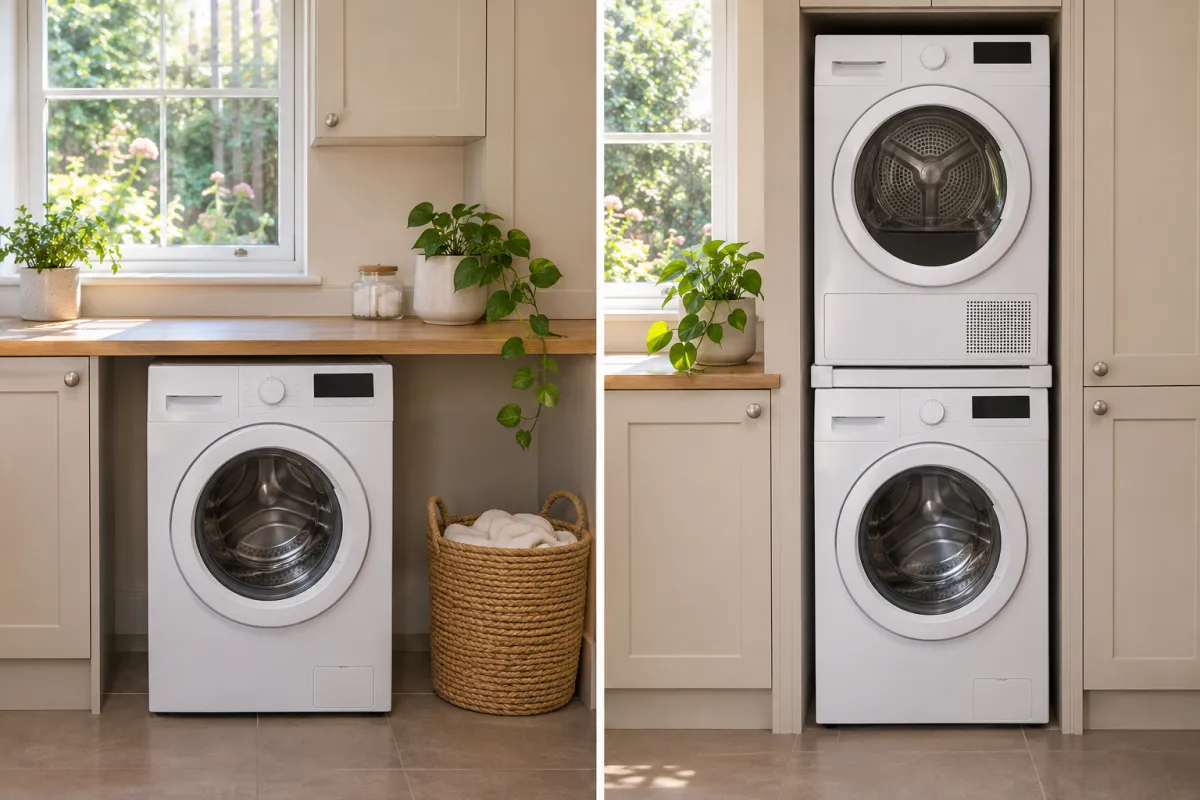
Choose a washer-dryer if you have one appliance space and usually air-dry some of your washing. If you tumble-dry several loads most weeks, a separate washer and dryer let you wash one load while the previous one dries. A compatible stack gives you that flexibility in a single floor space if you have the height.
Three ways to fit washing and drying into your home
How the three laundry layouts compare| Layout | Suits you if | What to check first |
|---|---|---|
| One washer-dryer | You have one gap under a worktop, or you want a small load to go from dirty to dry without moving it. | Check the combined load limit and cycle time. The drum stays occupied until drying finishes. |
| Stacked washer and dryer | You dry frequently and have a tall space. You can start the next wash while the first load dries. | Check that the exact models can be stacked and that you can reach the upper drum, controls and filters. |
| Side-by-side washer and dryer | You have two spaces and prefer to load both drums at floor level, or you want to keep a working washer and add a dryer. | Check both door swings, access to the connections and room to set down a basket. |
If a single machine suits your space, the washer-dryer buying guide compares full wash-and-dry times, drying capacities and labelled electricity use across six models.
How much of a full wash can you dry?
Check the drying limit for the programme you’ll actually use, as well as the big wash-capacity number on the listing. The Hisense 3S WD3S9043BW3, for example, is rated for 9 kg of washing and 6 kg on its full wash-and-dry cycle. Those figures refer to the weight of the laundry before washing. Individual programmes can take less.
If you wash the full 9 kg, roughly a third of the original load has to come out before the rated 6 kg dry cycle. Air-dry that portion or run a second drying cycle if the fabrics allow. It’s easier to sort the laundry before it gets wet. Start with up to 6 kg of suitable fabrics when you want the machine to wash and dry the whole load in one go. Follow the garment care labels and the programme limits, especially for bedding or mixed fabrics.
Two appliances can close that capacity gap if your usual wash fits both drums on the programmes you use. Check the stand-alone dryer’s programme limits too. Our guide to washing-machine sizes can help you judge your normal loads before you choose either appliance.
What happens when you have two loads?
- One drum. Wash and dry the first load. The second load waits until the drum is free. For a mix of tumble-dried and air-dried items, you can take the air-dry items out after washing and run a separate dry cycle for the rest.
- Two drums. Once the first wash finishes, transfer it to the dryer and put the second load in the washing machine. The second wash can finish while the first load dries. It may still have to wait for the dryer, especially with a long drying programme.
Think about a day when you do towels and bedding back to back. If you need both loads dry that evening, the ability to overlap jobs can matter more than a quick programme timed with a small load. If your usual morning wash is a small load you want to tumble-dry in full, a single drum can take it straight through without a transfer.
Will a stack fit and be easy to use?
A two-drum laundry tower packages the washer and dryer together in one tall unit. Some pair the controls or programme settings. You still move the clothes between drums. Check the exact model’s limits, including whether both drums can run together and what happens if one unit needs servicing.
- Measure the space as installed. Allow for the plugs, pipes and required gaps, then check you can fully open the doors and still stand in front with a basket. Check whether nearby cupboard doors or handles get in the way.
- Check approved stacking combinations. Where the manufacturer permits stacking, use the compatible kit and follow its instructions, with the dryer above the washer. For a tall installation, check whether you can see the controls, lift wet bedding into the upper drum and reach any water tank or filters.
- Check air and connections. Follow the exact models’ ventilation and clearance requirements, especially in a cupboard. Confirm power and drainage before delivery. A vented dryer also needs a route for its exhaust. Our comparison of dryer types explains which setups need a vent and what to do with the collected water.
If your existing washer works and you have a suitable spot for a dryer, adding one lets you keep a machine you already know. If floor-level reach matters or you cannot find a compatible stack for that washer, check a side-by-side setup before replacing it.
Compare electricity for the laundry you actually do
A washer-dryer label gives separate figures for washing only and for the full wash-and-dry cycle. If you frequently air-dry, the wash-only figure applies to more of your loads. If you usually run clothes straight through, check the combined figure alongside its rated load and time. If you wash everything and then run a dry-only programme for some items, neither figure tells you how much electricity that dry-only programme adds. Check the model’s programme data if the maker provides it.
For a pair, use the washing machine’s wash figure and the dryer’s drying figure. Match the units before adding them. Divide a figure quoted per 100 cycles by 100 to get a per-cycle estimate. If the dryer quotes annual use, the product sheet can tell you the standard cycle count used. Compare the same amount of washing and tumble-drying in a typical week. If you split a wash across two dryer loads, count both drying cycles.
Multiply the estimated electricity use in kWh by the unit rate on your bill for a rough cost. Real use varies with the programmes, load sizes and how wet the clothes are after spinning. Also compare purchase and installation costs, and look at water figures if you’re choosing between washer-dryers that differ on the combined cycle.
Which setup is right for you?
Choose one washer-dryer if space is tight and your normal tumble-dry load fits its combined programme. Stack a compatible pair if you regularly have another wash waiting and can comfortably reach the upper machine. Choose side-by-side if you have the width and want both drums easy to load, or if you can keep your washer where it is and add a dryer beside it.
Sources and checks
- Hisense UK model specifications and manual for the 9 kg wash and 6 kg drying example.
- Bosch UK’s stacking kit guide shows why you need to check the exact appliance and kit combination.
- Energy Saving Trust’s appliance label guide explains the two washer-dryer ratings. GOV.UK’s energy labelling guidance explains why standalone dryers can appear with different labels.