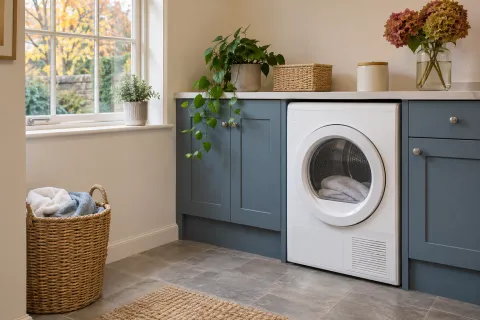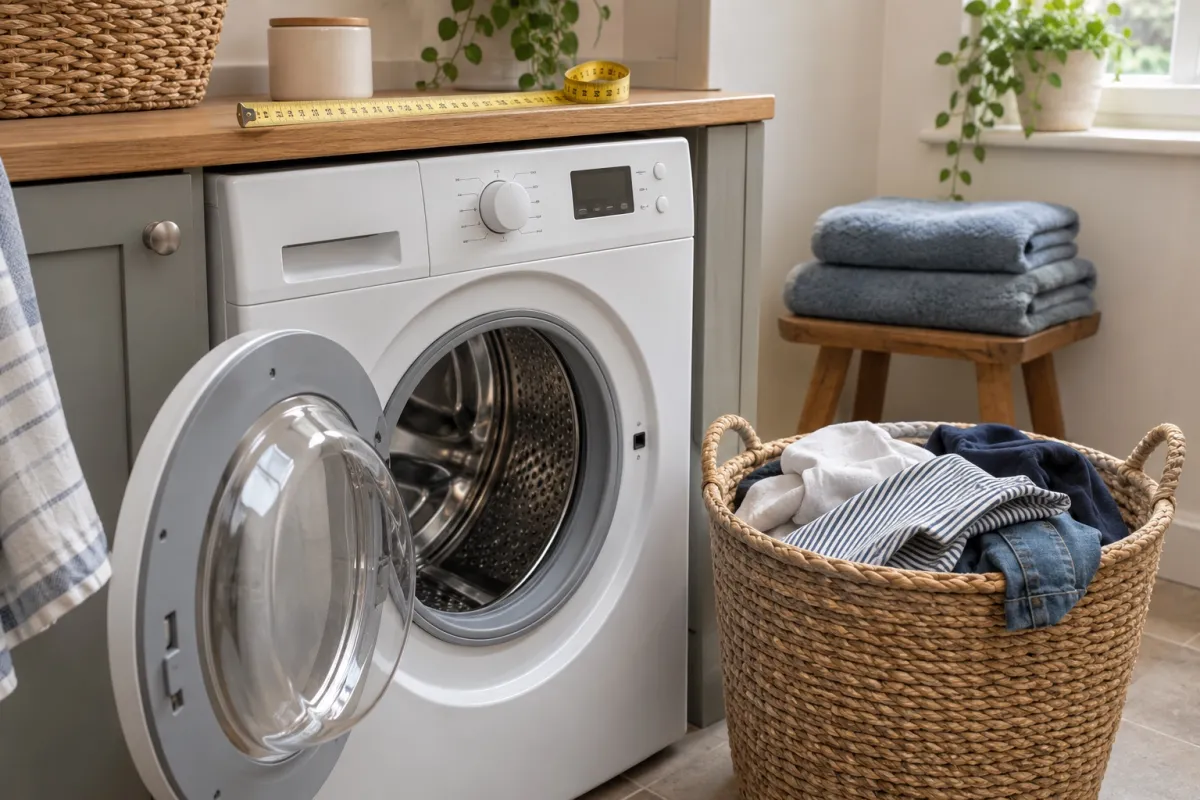
A washing machine needs to be big enough for the laundry you actually wash, on the programmes you actually use. It also has to fit through the door and work comfortably in its final space. The largest kilogram number within your budget is only part of that decision.
Start with your usual dry load, check the programme’s own limit, then measure the complete installation. That is more useful than choosing a capacity from the number of people in your home alone.
Find out how much you wash at once
Look at a normal week before browsing machines. Separate everyday clothes from towels, bedding, sportswear and anything that needs a gentler wash. These often go into different cycles, so a large total laundry pile does not necessarily mean you need one enormous drum.
- Make up a typical load while it is dry. Include the clothes you would genuinely wash together, following their care labels.
- Weigh it if you are unsure. If your scales can safely hold a basket, weigh the empty basket and subtract that weight from the full one. Do not use wet washing as your comparison.
- Check your busiest regular load too. Towels or bedding may be the reason your current machine feels small, even when everyday washes fit easily.
- Decide how often you want to wash. Someone doing small washes frequently may need less space than someone saving compatible laundry for a few larger loads.
Use your present machine as a practical starting point. If it handles your normal wash without packing clothes tightly, a similar capacity may be enough. If you repeatedly split suitable loads because they will not fit, more usable drum space could help. If you split them because the fabrics need different treatment, a bigger machine will not remove that need.
What does an 8kg, 9kg or 12kg label mean?
The kilogram figure describes a maximum weight of dry laundry, not the weight after it absorbs water. It does not mean every programme accepts that amount, or that every mixture of fabrics will fit equally well.
Weight and bulk are different. A light duvet can occupy more drum space than a heavier pile of shirts. A tightly packed drum is not a useful full load: the laundry still needs room to move, and the correct loading advice depends on the programme.
There is no dependable “one kilogram per person” rule. A smaller household washing workwear and bulky towels can have different needs from a larger household spreading washes through the week. Choose the capacity that handles your regular compatible loads, rather than buying extra kilograms for an occasional job the machine may still be unsuitable for.
Once you know what you need to fit, our washing-machine buying guide compares models across different capacities and includes an integrated option.
Check the programme before trusting the capacity
Quick washes are an easy place to get caught out. A large machine may offer a very short cycle for only a small, lightly soiled load. Both machines below are rated at 9kg, but the amount you can wash depends on the programme.
Beko BM3WT3941W
- Quick: up to 9kg, advertised at 28 minutes.
- Super Quick: up to 2kg on the 14-minute option.
AEG 9000 AbsoluteCare LFR94946WS
- Cottons: up to 9kg.
- AbsoluteWash 49min: up to 5kg.
- 20min 3kg: up to 3kg.
These are programme limits, not a promise that any bundle weighing that much is suitable. Beko’s manual restricts the short Quick/Super Quick wash to lightly soiled cotton clothes and excludes towels and heavy cottons. AEG’s 20-minute cycle is for lightly soiled cottons and synthetics, or items worn once.
Compare the cycle you plan to use most. If your usual mixed load weighs 5kg and you want a short wash, a 9kg badge alone does not answer whether the machine suits you. Check the programme table, fabric restrictions and any load reduction when selecting a faster option. Also allow for drying: a quicker wash is less useful if the laundry comes out too wet for your normal routine.
Will a duvet or blanket fit?
Do not buy on a blanket claim that a particular drum capacity takes every double or king-size duvet. Filling, thickness and the item’s care instructions matter as well as its size. Check that the item is machine washable and that the washer’s manual allows it on a suitable programme.
Being able to push an item through the door is not enough. It needs room for the prescribed washing action. If the item has to be forced in, or the manual does not support washing it, use a suitable larger machine or a professional service that accepts it. Do not treat the dry weight alone as permission.
For regular sheets and towels, decide whether you want to wash them together where their care instructions permit, or in separate loads. That choice may matter more than moving up one kilogram on the specification sheet.
Measure the whole space, not just the gap
Start at the entrance and follow the route to the installation point. Check narrow doorways, corners, stairs and any turn where the appliance has to change direction. Give the retailer the awkward measurements and access details before booking delivery; packaging can make the delivered appliance larger than its listed dimensions.
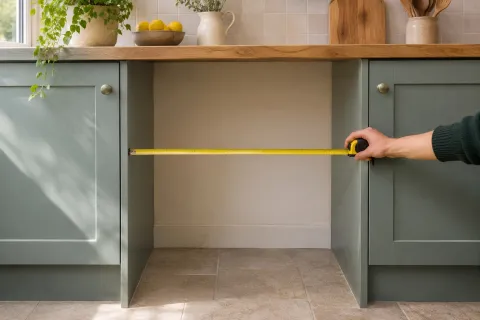
At the installation point, record the opening’s width, height and depth at its tightest places. Look for skirting boards, pipes, sockets and uneven flooring. Then compare those measurements with the exact model’s installation drawing and required clearances, rather than assuming all nominally 60cm machines fit the same opening.
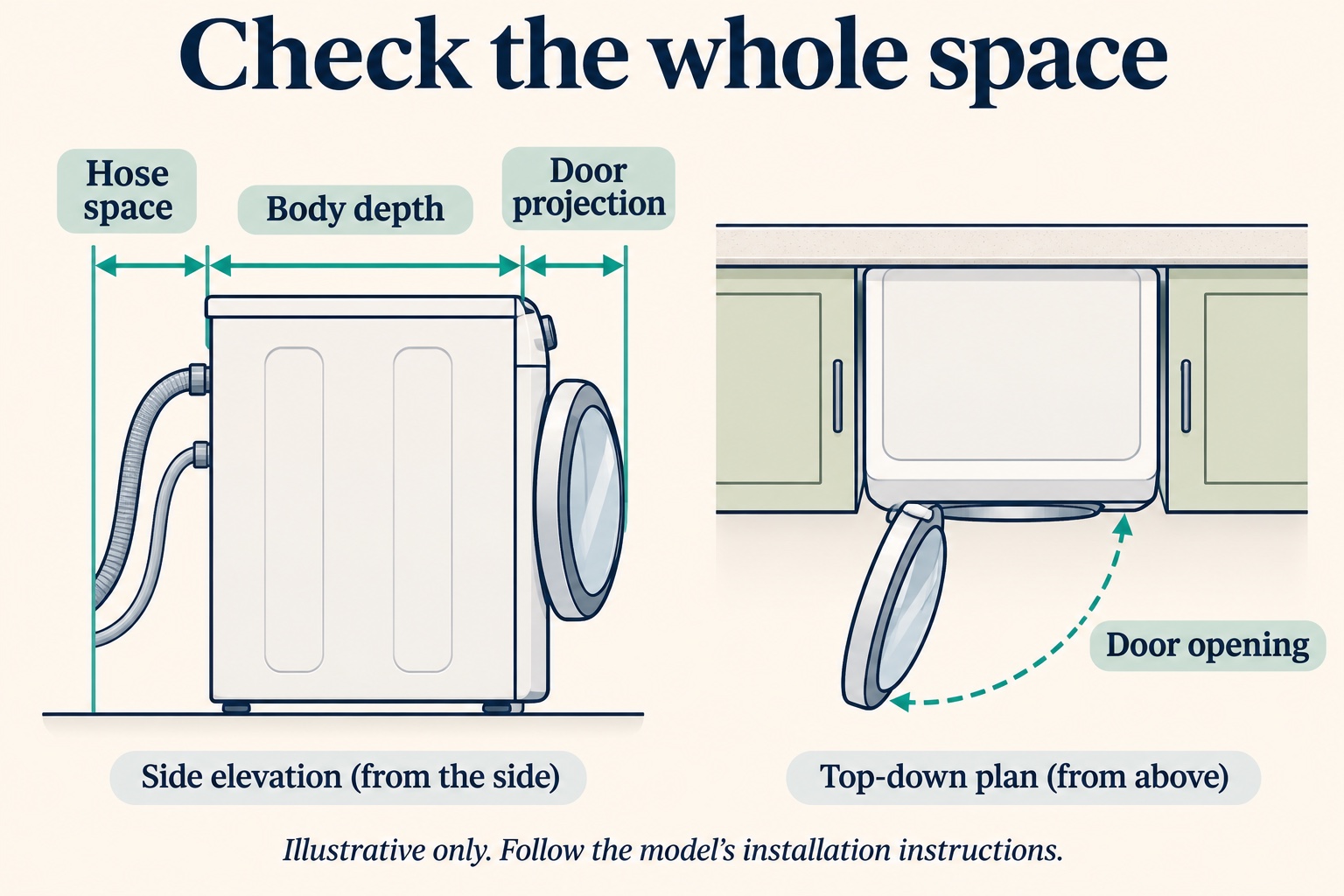
Check the body, protruding door, hose space and room to open the door. Follow the exact model’s installation instructions; the illustration is not to scale. Credit: Product Inspector
- Body and overall depth: establish whether the listed depth includes the door, controls and other protrusions. Leave the space the manual requires for hoses and connections; do not crush them to make the machine sit farther back.
- Door and drawer access: allow the door to open far enough for loading, and check the detergent drawer clears the worktop or nearby obstruction.
- Height and levelling: check the allowed adjustment range and floor condition. Do not assume removing the top is permitted.
- Later access: the filter, connections and appliance need to remain accessible for the maintenance and servicing described in the manual.
Two 9kg machines can take very different amounts of space. Beko lists the BM3WT3941W at 845 × 600 × 546mm, while AEG lists the LFR94946WS at 847 × 597 × 660mm maximum, both in height × width × depth order. Those figures help shortlist; they do not replace the installation instructions or establish that either machine will fit your kitchen.
Replacing an integrated washing machine needs extra checks
An integrated machine is designed to carry a furniture door and sit within the kitchen layout. A freestanding machine does not become integrated because it fits under a worktop or looks flush with neighbouring cupboards.
Before replacing one, check the opening, furniture-door dimensions, hinge positions, door-opening direction and plinth — the strip along the bottom of the kitchen units. The old furniture door is not guaranteed to attach unchanged. Compare the new model’s template and fittings, and ask the installer about any cabinet work before ordering.
The Hoover H-WASH 300 Pro HBW 49TAMEJ-80, for example, has its own furniture-door mounting instructions and installation dimensions. Its 9kg capacity does not tell you whether its hinges and door clearances match the appliance it replaces.
Agree delivery and installation before ordering
Check what the retailer will actually do at your address. Room-of-choice delivery, disconnection, connection, fitting an integrated door and removing the old machine can be separate services. Availability may depend on your postcode and access.
Retailer requirements are not universal. Currys’ laundry-installation checklist, for instance, requires suitable water and electricity connections within 1.5m and clear access, including room to manoeuvre on stairs. Confirm the service you are booking, tell the team about restrictions, and ask what happens if plumbing or cupboards need alteration.
Keep the model number, installation drawing and your measurements together. Before paying, check current prices, the applicable warranty and any registration deadline, as well as installation and recycling charges. A long parts guarantee should not be assumed to include every labour or call-out cost.
Choose capacity and fit together
The right size is the machine that handles your regular laundry on a suitable programme and fits with all the access its instructions require. Weigh a representative dry load, check your bulky items separately and compare the programme limits before paying for extra capacity.
If either the laundry or the installation is a tight squeeze, resolve that before ordering. A bigger kilogram label cannot make an unsuitable cycle, awkward doorway or incompatible kitchen door work.
Sources and checks
- Beko BM3WT3941 specifications: compare the 9kg and 2kg quick-wash options, dimensions and guarantee registration details.
- AEG LFR94946WS manuals and dimensions: open the user manual for the programme-load table and installation instructions.
- Hoover HBW 49TAMEJ-80 installation documents: check the furniture-door mounting and installation requirements.
- Currys laundry-installation checklist: check connections, access and the service you need before booking.