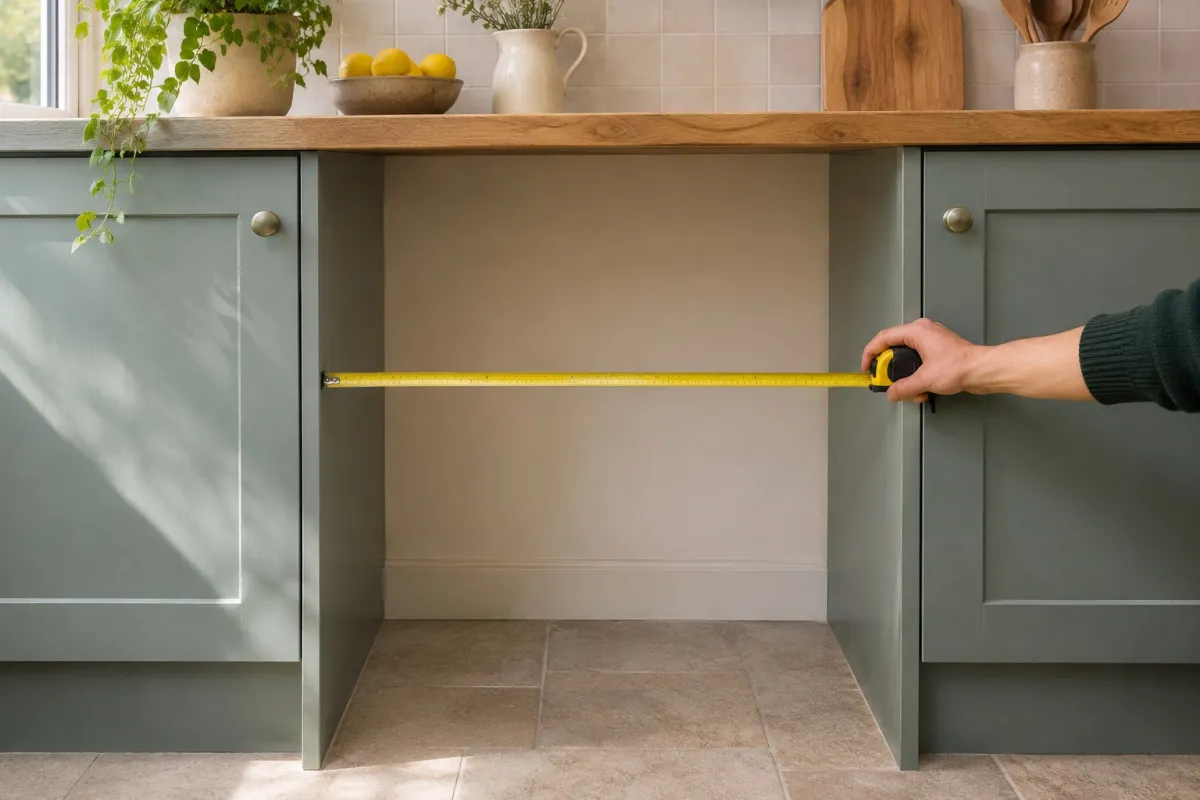
Start with the space you have and the dishes you wash most often. A full-size dishwasher gives trays and pans more room, a slimline model fits a narrower floor-level gap, and a compact model can sit on a worktop. In a tight kitchen, the deciding measurement may be how far the door opens or whether there’s room to fill a tank under a wall cupboard.
Which dishwasher format fits your kitchen?
| Format | Fit and first check |
|---|---|
| Full-size | About 60 cm wide at floor level. Check the opening and room to stand beyond the open door. |
| Slimline | About 45 cm wide at floor level. Check the depth and whether a pan fits alongside your usual dishes. |
| Compact worktop | Examples are 42–55 cm wide. Check overhead space, door reach and where the drain hose will go. |
| Drawer | Built into cabinetry. A double drawer can be about 60 cm wide. Check how far it pulls out and what fits in each drawer. |
Once you know which formats fit, you can compare our dishwasher picks by format.
Measure the gap and the space in front
Write down the smallest clear width, the height from the finished floor to the underside of the worktop and the usable depth. Measure in more than one place. Pipes, skirting and an uneven floor can take up space you thought you had. If you’re replacing a machine, measure the opening itself as well as checking the old model’s dimensions.
Compare your opening with the installation drawing for the exact model. A fully integrated machine takes a matching cupboard door. The Hisense HV693A60UVADUK is 598 mm wide and 816 mm high, while its stated minimum opening is 600 mm wide and 820 mm high. Both depths are listed as 555 mm. Check where the hoses and plug need to sit before counting all of that depth as usable.
A freestanding dishwasher has its own finished front. The integrated Bosch Series 4 SPV4EMX17G and freestanding Hisense HS523E15WUK are both 448 mm wide. The Bosch body is 815 mm high and 550 mm deep, while the freestanding Hisense is 845 mm high and 600 mm deep. If you plan to put a freestanding model under a worktop, check the manufacturer’s instructions for that setup.
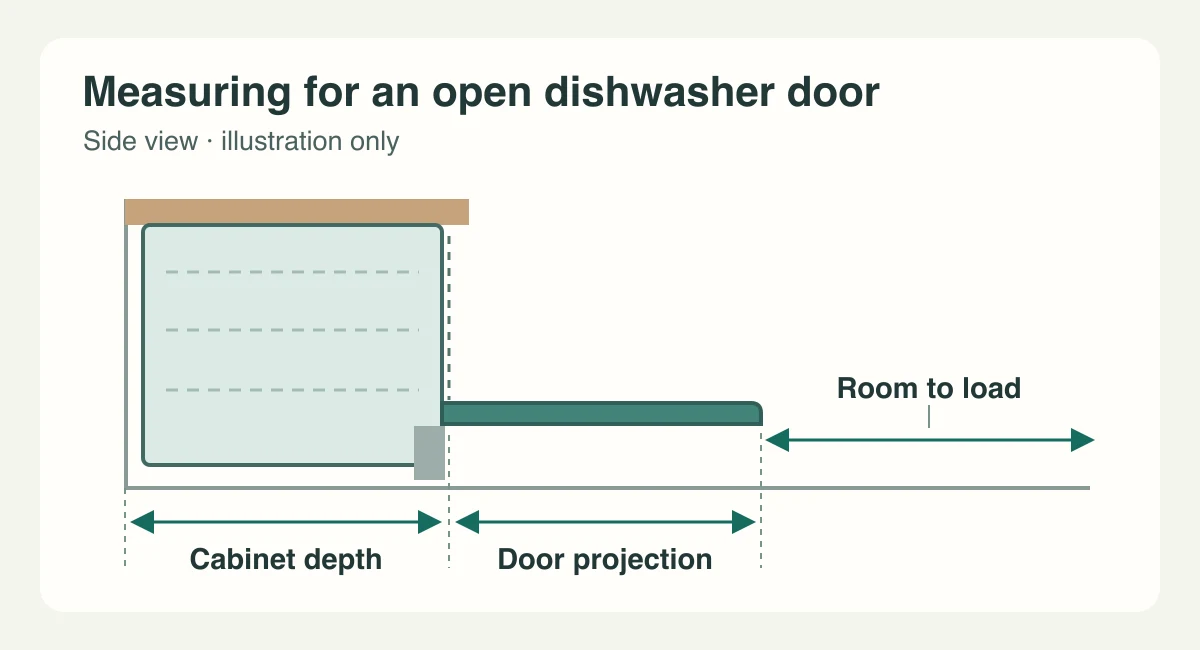
Measure the opening, then check how much room is left to stand and load with the door fully open. Credit: Product Inspector
Mark the front of the machine and the edge of the open door or drawer on the floor with masking tape. Check whether you can stand and load comfortably and whether a nearby cupboard, handle or island will get in the way. With the door open at 90°, the Bosch measures 1,150 mm from the back of the machine to the tip of the door. The Fisher & Paykel Series 9 DD60DDFHB9 drawing gives a maximum drawer extension of 547 mm from the front. Use the matching starting point when you mark out either measurement.
For an integrated dishwasher, check the size and weight of the matching cabinet door, how the hinges move and whether the door clears the plinth, the strip below the cupboards. Check the route to the socket, water inlet and drain while the appliance is in place. Use the model’s fitting instructions for hose reach and drain height, and allow room for the hoses without trapping or kinking them.
Check the worktop, cupboard and sink together
A worktop dishwasher can be wider than a slimline floor model. The six-place Candy Rapidò CP 6E51LW-80 is 550 mm wide, 443 mm high and 501 mm deep. It needs a water supply and a drain. Its door projects 338 mm when open, measured from the front of the strip at the bottom of the machine.
The three-place COMFEE Mini Plus CDWMT305W-UK is 420 mm wide, 465 mm high and 435 mm deep with the door shut. It takes up 780 mm from back to front with the door open at 90°. You can fill it through the top or use its inlet hose. If you plan to fill it by hand, leave room to lift the cap and tip a jug under the cupboard. You’ll still need a socket and a place to secure the drain hose as shown in the manual.
Check that the worktop can support the machine and a full load, and that the feet sit securely on it. Try the door position and the route to the sink on your actual worktop before giving up the space you use to prep food.
Check your largest dishes against the rack
A place setting represents a standard set of crockery and cutlery. The number on the energy label tells you the rated capacity on Eco. Two machines with the same number can still suit very different loads, depending on where the racks, plate supports and spray arms sit.
- Pick a normal load. Measure your widest dinner plate, tallest glass and the tray or pan you wash most. Consider whether you usually need to wash them all together.
- Check the loading diagram. Look for folding supports, a rack that moves up or down and room around the spray arms. Raising an upper rack can make space for dinner plates below while reducing headroom for glasses. A cutlery tray can free space below while using some height at the top.
- Picture the wash you’ll actually run. A worktop machine might take your daily crockery, with the roasting tin still needing a separate wash. The Fisher & Paykel takes six settings per drawer and lists round plates up to 280 mm. A wide pan still has to fit inside one drawer.
If you compare running costs, look at electricity per 100 Eco cycles and water per Eco cycle, then consider how often you’d run each machine for your own load. A drawer model may quote figures per drawer.
What to check before ordering
- The smallest opening dimensions, or the usable worktop space and overhead clearance.
- Enough room for the door or drawer to open fully, and for you to load it.
- A matching cabinet door and clearance at the plinth for an integrated model.
- A suitable socket, water source and waste connection within reach.
- Space for your everyday plates, glasses and cookware together in the rack layout you’ll use.
Keep those measurements handy when you shortlist models. A narrow kitchen gap can settle the format quickly. The load check tells you whether that format will work after dinner.