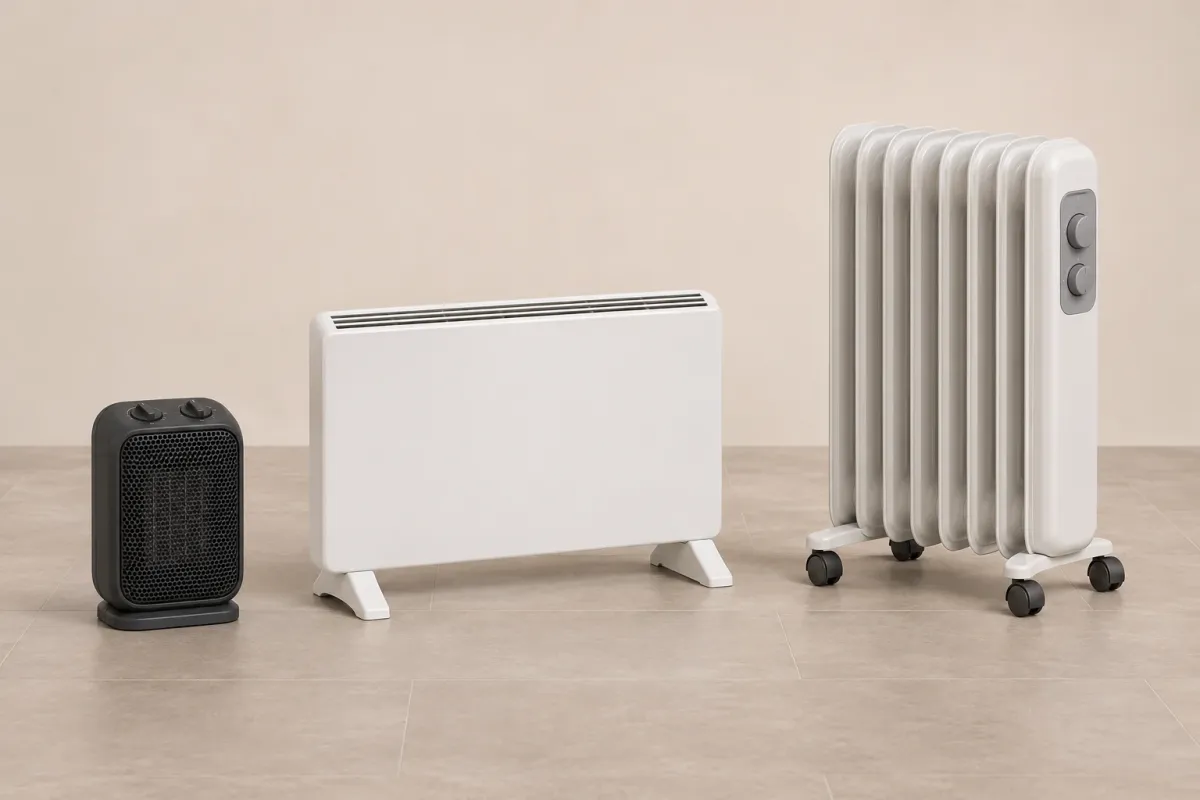
A cold chair and a cold room call for different kinds of warmth. A fan heater can make the chair comfortable before the rest of the room warms up. For a longer spell of work or reading, how the heater spreads warmth and sounds while it runs may matter more than the first few minutes.
Compare the three heater types
| Heater | Choose it for | What you’ll notice |
|---|---|---|
| Fan heater | A short boost where you’re sitting or working. | Warm air reaches you quickly. You’ll hear the fan while it runs. |
| Fan-free convector | Quiet warmth that has time to spread through the room. | It starts warming the air straight away. The air rises and circulates gradually. |
| Oil-filled radiator | A longer stay in one room, when gentle heat between bursts of power is useful. | The fins take time to warm and keep giving out heat as they cool. They can stay hot after switch-off. |
If you know which type suits you, compare our portable electric heater picks for size, controls and price.
Picture how you’ll use the room
A quick boost at your desk
A fan heater is the best fit when you want to feel warm before the whole room comes up to temperature. One that blows in a fixed direction works for one seat. A swivelling model makes sense when two people sit apart and you can place it so the warm air sweeps past both. Check the heater has a clear spot near a wall socket. A small unit can still be a poor fit if a desk panel blocks the airflow or the only free space is beside papers and cables.
Think about when the fan will be running. Its sound may be fine while you get settled and distracting once a call starts. If you expect to keep the heater on through successive calls, a fan-free convector is usually the better choice when you can give it time to warm the room.
A quiet room you’ll use for several hours
A fan-free convector heats the air passing through it, so it starts putting heat into the room as soon as it’s on. Give the warmer air space to rise and circulate. If you want quiet heat for a short evening in a room that’s already close to comfortable, a simple convector is often enough.
An oil-filled radiator first warms the oil and metal fins. Once it is warm, you’ll still feel heat nearby while the thermostat pauses the power. That suits a long stretch of reading or working. The trade-off is the wait when you first switch it on and the time it takes to cool before you can move it. If you often carry a heater upstairs, check the weight. Wheels help on the same floor. They still leave you carrying the full weight on stairs.
One cold seat in a large or draughty room
If a room opens into the rest of your home, it can lose heat faster than a portable heater builds it. For one person, a directed fan heater may make the seat comfortable with a short boost. If everyone in the room stays cold even with the heater running continuously, check where the heat is escaping and how the main heating is set. Fixing an unwanted draught can help, while purpose-made vents need to stay clear.
A floor-area claim is a rough guide. Ceiling height, draughts and how cold the room is to start with affect what you’ll feel. If several rooms need heat for hours each day, compare your main heating before buying more portable units.
Choose controls for the way you heat
Power and temperature do different jobs. A power setting changes how quickly the heater adds heat while it’s running. A thermostat controls when to stop heating and when to start again. A lower power setting may be enough once the room is comfortable. Turning the thermostat higher on a basic heater usually leaves it heating for longer at the selected power.
If you mainly want an occasional boost, two switches and a dial may be plenty. The Daewoo HEA1146 convector gives you three power levels without a timer. Compare that with the Dimplex ECR20TiE oil-free radiator, whose timer can store four daily heating periods. The extra controls are worth paying for if they suit a routine you’ll actually follow. Use timed heating only during sessions you’ll supervise and switch the heater off before you leave.
Compare the cost of the session
Use the price per kilowatt-hour (kWh) on your bill. Divide the heater’s watts by 1,000 to get kilowatts, multiply by the hours it actually draws that power, then multiply by your unit rate. These examples use 26p per kWh and leave out the daily standing charge.
| Time actually heating | Electricity used | Example cost |
|---|---|---|
| 2 kW for 30 minutes | 1 kWh | 26p |
| 2 kW for one hour | 2 kWh | 52p |
| 1 kW for two hours | 2 kWh | 52p |
Time at power matters more than the label on the heater. A 2 kW fan heater and a 2 kW oil-filled radiator cost the same for an hour at full power. A fan heater can cost less for the job if you only need it for a short burst. A radiator that spends part of a longer session with its heating element off uses less than the full-power estimate for that session. Heat from the fins after switch-off was stored while it drew electricity.
For example, a two-hour session where a 2 kW heater draws full power for a total of one hour would use about 2 kWh for heating, or 52p at the example rate. If it draws full power for both hours because the room keeps losing heat, that rises to 4 kWh, or £1.04. How often it cycles depends on the room and the setting.
Measure the spot before you order
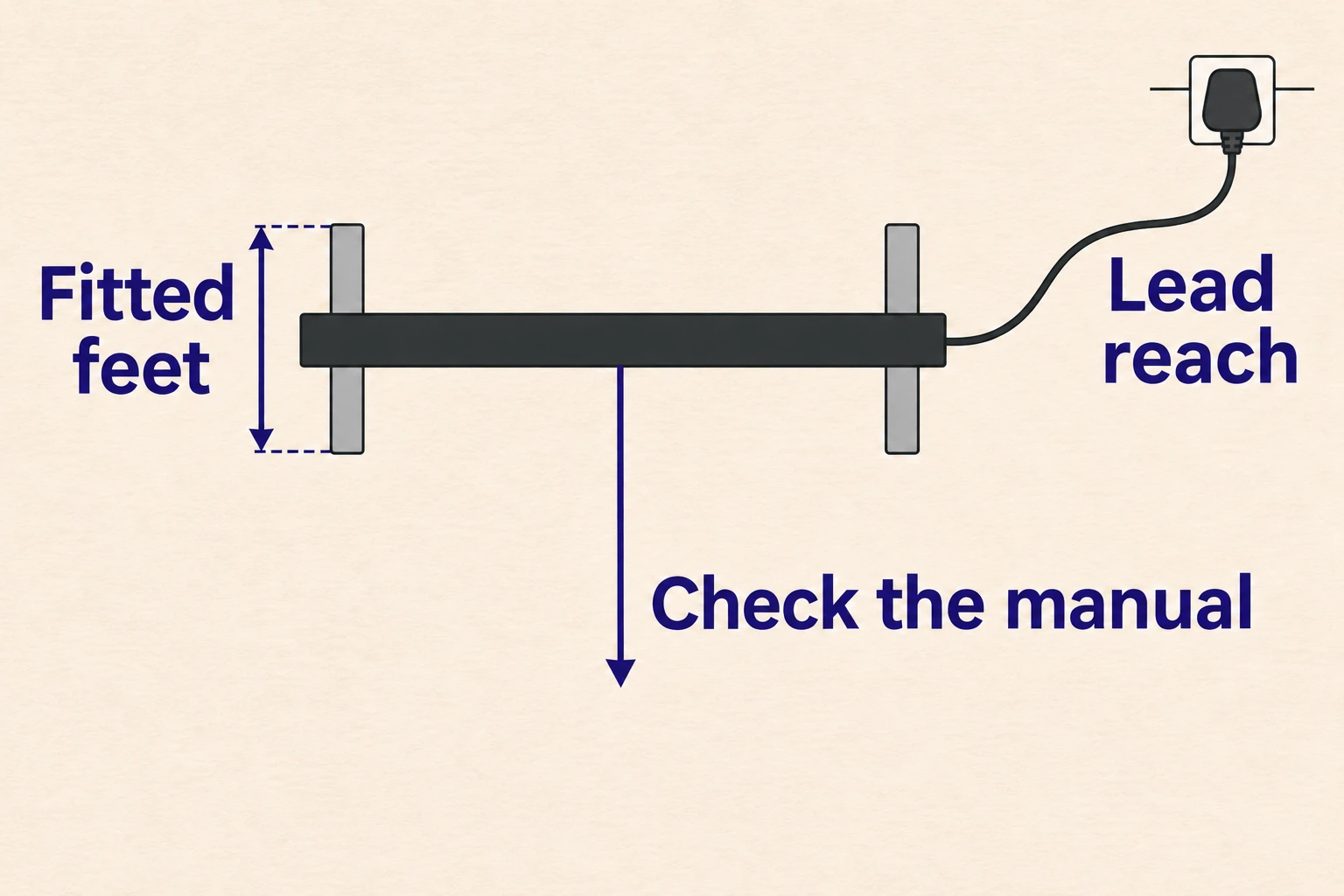
Measure the feet, follow the lead’s route to the wall socket and check the manual for clearances on every side. Diagram not to scale.
- Start at the socket. Choose a spot in a dry room. Measure the lead’s route from a suitable wall socket to the heater, including enough slack for the plug and cable to sit comfortably. Plug it directly into the wall. Choose another position if the lead would cross a walkway or you would need an extension lead.
- Measure the assembled footprint. Check the feet or castors as well as the body. The Princess 2000G glass panel heater, for example, has a slim body but is 92 cm wide and stands on feet that project beyond the glass. A wide, shallow heater and a short, deeper radiator use the floor in different ways.
- Leave the heater clear. Use a stable, level surface where it won’t get knocked. Keep it at least a metre from curtains, paper, upholstery and anything else that can catch fire. Follow the manual if it requires more space or specifies how much room the vents need.
- Plan to switch it off and let it cool. Turn it off before leaving the room or going to sleep. Never cover it or use it to dry clothes. Keep people and pets away from hot surfaces, particularly the fins on an oil-filled radiator. Stay in the room while the heater is on, including when a timer is set.
Which should you buy?
Give a fan heater first consideration if the job is a short, directed boost. For quiet background warmth, a fan-free convector is the simpler choice if you want the air to start warming straight away. Choose an oil-filled radiator when you’ll stay long enough for it to come up to temperature and value heat that tapers off after switch-off. If your chosen spot fails the lead or clearance check, find a safer position or choose a heater that fits it.
Sources and checks
- Electrical Safety First’s portable heater guidance explains how the heater types work and how to position and use them safely.
- Energy Saving Trust’s electric heating guide explains where portable heaters fit alongside main heating. Its draught-proofing advice covers tackling unwanted gaps while keeping ventilation clear.
- Ofgem’s guide to your electricity bill explains the unit rate and standing charge.