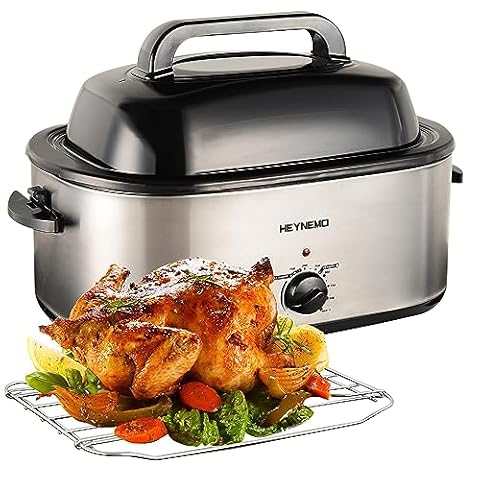
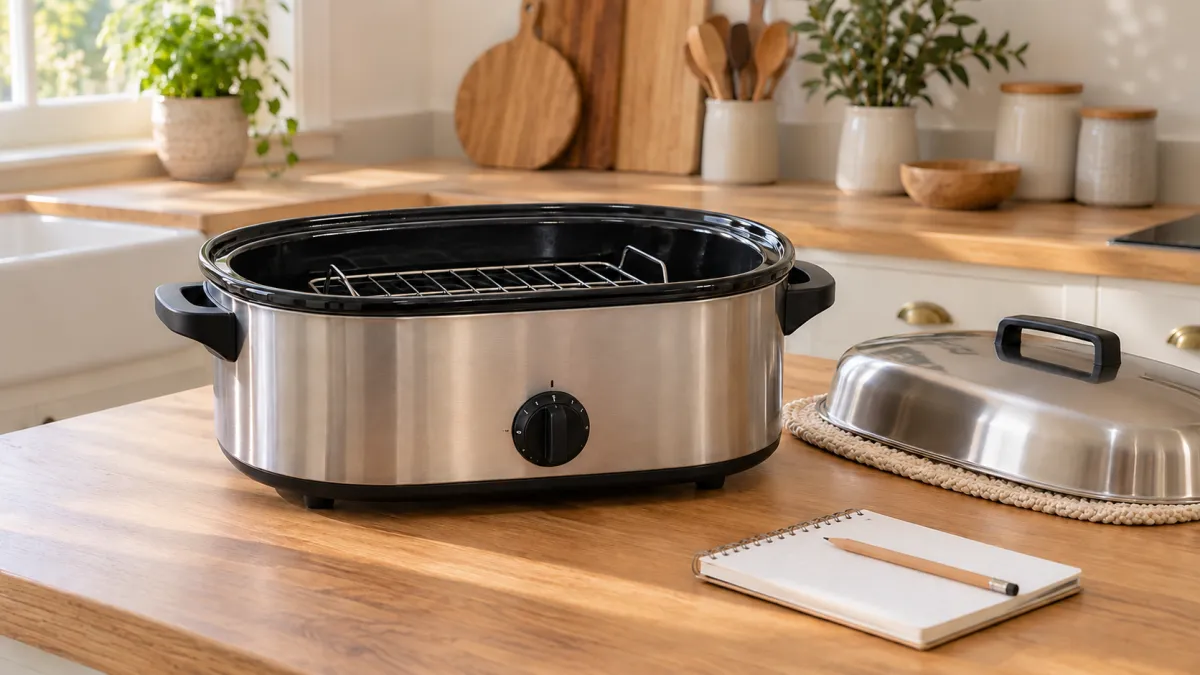
An American electric roaster can free up your main oven for the rest of a roast dinner. Using one in the UK takes more planning than ordering from a UK shopping site: the appliance, power supply and cooking space all need to suit the job.
Never connect a 120 V roaster directly to a UK 230 V socket. A plug adaptor changes the connection, not the voltage. A correctly specified step-down transformer can solve the voltage difference, but an ordinary transformer leaves the frequency at 50 Hz. Check that the exact roaster can use that supply before buying either appliance.
Start with the appliance rating
Ask the seller for a clear photograph of the rating label on the exact model being supplied. Check its voltage, frequency and input power, together with the plug and the instructions. A product listed on Amazon UK may be an imported American version; the website address and a price in pounds do not establish electrical suitability.
- Voltage, in V: an appliance marked 120 V needs the appropriate lower-voltage supply. Do not assume that a nominal 110 V or 115 V transformer output is suitable for every 120 V appliance.
- Frequency, in Hz: UK mains is 50 Hz. A label marked 50/60 Hz allows both frequencies within the manufacturer's other requirements. If it says 60 Hz only, obtain the roaster manufacturer's confirmation for 50 Hz use or use equipment that genuinely provides the required frequency.
- Power, in W or VA: use the appliance's maximum input requirement when choosing the supply, rather than its average electricity use while the thermostat cycles.
A simple heating element may be relatively insensitive to frequency, but that does not prove that the complete appliance, including its controls, is suitable. A mechanical temperature dial is not confirmation of 50 Hz compatibility.
What a converter needs to do
For a roaster confirmed to accept 50 Hz, look for a transformer designed for UK mains input and the exact output voltage the appliance requires. It must support the load continuously for the full cooking session, with the manufacturer's required spare capacity and ventilation.
A large number on the front of a converter can describe a peak or maximum load. Read the separate continuous rating and any lower limit for heating appliances. For example, a converter advertised as 2,000 VA but restricted to appliances below 1,400 W is unsuitable for a 1,450 W roaster. A thermostat switching off occasionally is not a reason to ignore that restriction.
Watts and volt-amperes are different ratings. Ask the transformer supplier to match the exact appliance and its cooking duration rather than assuming that equal numbers make a suitable pair. Give them the rating-label photograph and the manufacturer's frequency requirements.
A voltage transformer does not turn 50 Hz into 60 Hz. Equipment that also converts frequency is a different purchase, often much more expensive. If the roaster needs 120 V at 60 Hz, a voltage-only step-down unit does not provide the specified supply.
| Equipment | What it changes | What still needs checking |
|---|---|---|
| Plug adaptor | The physical plug connection | Voltage and frequency stay the same; any required earth must be preserved |
| Step-down transformer | Voltage, such as 230 V to 120 V | Output remains 50 Hz; confirm continuous load, plugs and earthing |
| Voltage and frequency converter | Both, when explicitly specified for the required output | Exact voltage, frequency, waveform, continuous load and appliance suitability |
Check plugs, earthing and where the equipment will sit
The complete setup needs a suitable fused UK input plug and an output socket that properly accepts the roaster's plug. Preserve any required earth connection throughout; a three-pin socket shape alone is not proof that it is wired correctly. Do not remove an earth pin, improvise wiring or use an adaptor that defeats the appliance's protection.
Follow both manufacturers' instructions on ventilation, cable use, clearances and placement. Keep the transformer dry and away from the roaster's heat and steam. Allow space for the lid to lift safely, the loaded pan to come out and the extra power equipment to stand securely. Some suitable transformers are substantial boxes, rather than compact travel accessories.
Work out the whole cost before ordering
Add the roaster, suitable power equipment, delivery, any import charges and the practical cost of returning a heavy appliance. Check who supplies it, where a return must go and whether the manufacturer's warranty covers use in the UK with the proposed setup. An attractive appliance price can become poor value once those costs are included.
Our best electric roaster ovens compares traditional options by size and purpose. Treat an imported model as a purchase conditional on a suitable power supply; a converter's advertised wattage alone does not settle that decision.
Would a UK countertop oven do the job more easily?
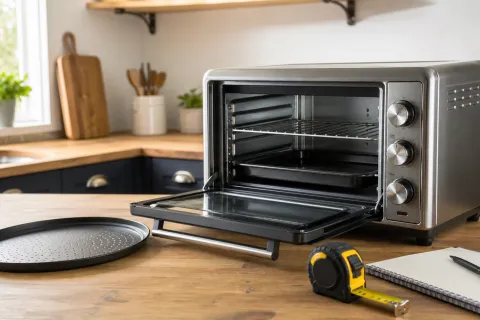
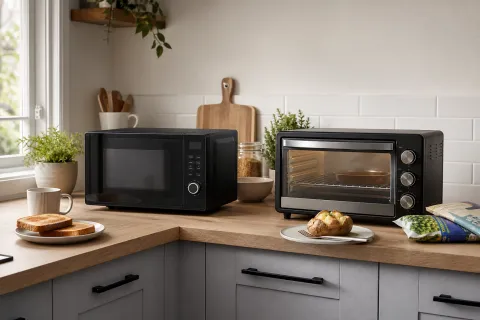
If you mainly want to roast a chicken, bake or cook everyday meals, a UK appliance can be a simpler choice. The Ninja Combi SFP700UK combines steam and hot-air cooking in a model intended for UK mains. It needs space for steam and its door, and it is a different shape from a deep oval roaster.
Do not treat its quoted cooking capacity as a promise that it will hold the same turkey as a large traditional roaster. Compare the usable tray and food dimensions. For more oven-style alternatives, see our mini oven guide, or compare the formats in mini oven, pizza oven or roaster oven.
Choose the size around the food
American roaster capacities usually use US quarts. Six US quarts is about 5.7 litres, 18 is about 17 litres and 28 is about 26.5 litres. Those are nominal volumes, not measurements of the space available above a rack.
Check the bird or joint against the pan's internal dimensions, rack position and lid clearance. A small six-quart roaster suits much smaller meals than an 18- or 28-quart model. A claimed maximum turkey weight is a starting point: the bird's shape still needs to fit, and the lid must close as instructed.
Plan for browning and check the food temperature
A covered roaster keeps moisture around the food, so do not expect the same dry, crisp skin as an uncovered roast in a fan oven. If a browned finish matters, plan a suitable finishing step in your main oven in line with the cooking instructions, and make sure the food can be transferred safely.
Use the appliance's cooking instructions and a clean food thermometer. For poultry, check the thickest parts without touching bone. For thorough cooking, the centre should reach 70°C for two minutes, or an equivalent combination such as 75°C for 30 seconds. The oven dial setting is not the temperature at the centre of the meat.
Before you buy
- Get the exact model's rating label and instructions.
- Confirm the required voltage, frequency and maximum input power.
- Have the complete power setup matched to the appliance and the full cooking duration.
- Check usable food space, worktop clearances, delivery, returns and warranty terms.
- Compare the total cost with a suitable UK countertop oven.
This is general buying guidance. Confirm electrical suitability with the appliance manufacturer and power-equipment supplier before purchase; if the required supply or earthing is unclear, ask a qualified electrician before use.
Sources and checks
Electrical Safety First: plug adaptors, voltage and frequency; Airlink Transformers: matching transformer capacity and frequency; Food Standards Agency: cooking temperatures and food thermometers.