In this article
A mini oven can look generous on a product page and still feel cramped once you try to use your own trays, plates and food. The headline litre capacity is useful for broad comparison, but it does not tell you whether a pizza pan slides in cleanly, whether toast sits close enough to the grill, or whether a small roasting tin can fit without touching the sides.
Before you compare prices, check the space your food actually uses. The best mini oven for a small kitchen is usually the one with a sensible rack footprint, enough height above the food, clear shelf positions and parts you can clean without turning every meal into a project.
Start with the fit checks that change daily use
Mini oven listings often lead with litres, cooking functions and wattage. Those numbers matter, but they are not the first thing I would use to judge capacity. A compact oven is only useful if the rack and tray shape suit the food you repeat most.
| Check | Why it matters | What to look for |
|---|---|---|
| Rack width and depth | This decides whether your tray, pizza pan or plate fits, not the litre number alone. | Published pan sizes, rack dimensions, or a manual diagram. Check the usable internal space, not just the outside width. |
| Shelf positions | Toast, grilling, baking and reheating need different distances from the heating elements. | At least two useful rack heights, ideally with clear guidance in the manual. |
| Internal height | Food can burn on top if it sits too close to the element, especially small pies, part-baked rolls and topped toasties. | Enough headroom above your usual food, plus a lower rack position for taller items. |
| Clearance around the oven | Mini ovens get hot and need space around them. A model that technically fits a shelf may still be awkward or unsafe there. | Manufacturer clearance guidance, side vents that are not blocked, and a worktop position away from clutter. |
| Cleaning access | A cramped oven with fiddly trays is less likely to be used for messy food. | Removable crumb tray, smooth interior access, washable racks and pans that are easy to replace. |
Once those checks make sense, use our mini oven guide to compare models that are already worth shortlisting. If the checks point towards faster tossed food rather than tray cooking, an air fryer may suit you better. If reheating and drinks are still the main jobs, a microwave is usually the more direct route.
Measure tray size before trusting litre capacity
Litres describe the oven cavity, but trays, racks and curved interiors decide what you can cook. A tall narrow oven can quote an impressive capacity and still struggle with a standard frozen pizza. A shorter, wider oven may feel more useful for toast, flatbreads, fish fillets and tray bakes even if the litre figure is lower.
Start with the foods that would make you buy a mini oven in the first place. For many households that means one or two portions of chips, open sandwiches, part-baked bread, small pizzas, chicken pieces, pastries, reheated leftovers with crisp edges, or a compact tray of vegetables. Measure the tray or pan those foods need, then check whether the oven includes something close to that size.
Do not assume a bundled tray is generous. Some trays fit the rack rails neatly but have shallow corners, rounded edges or a smaller flat cooking area than expected. If you plan to buy spare trays, check that common mini oven baking trays* are close to the size your oven can take, rather than relying on one awkward proprietary pan.
Shelf positions matter more than extra modes
Two mini ovens can both offer bake, grill and toast settings, but feel very different if one gives you useful rack positions and the other effectively has one comfortable height. Shelf positions control how close food sits to the top and bottom heating elements. That changes browning, burning risk and whether a taller item can cook without scraping the roof of the oven.
For toast and quick grilling, an upper position helps the top brown quickly. For pizza, pastry and small tray bakes, a middle position is usually easier to control. For taller foods, a lower position gives more headroom. If the manual names different rack positions for different cooking functions, that is a good sign that the oven has been designed around real use rather than just a list of modes.
Think of shelf positions as usable capacity. A mini oven with a smaller cavity but better rack placement can be more useful than a larger box that leaves food too close to the elements.
Check pizza and toast fit separately
Pizza fit is a simple but revealing test. If a product page says it fits a certain pizza size, check whether that means a round pan is included, a pizza can sit directly on the rack, or only a smaller supermarket pizza fits after removing packaging. A 12-inch style claim is useful only if the shape of the cavity and rack lets you turn or remove the pizza safely.
Toast is a different test. Four slices may fit on paper, but the result depends on rack width, spacing and how evenly the top element browns. If your main reason for buying is toast, bagels or cheese on toast, look for clear toast settings, a rack height near the top element and a crumb tray that slides out without dismantling the oven.
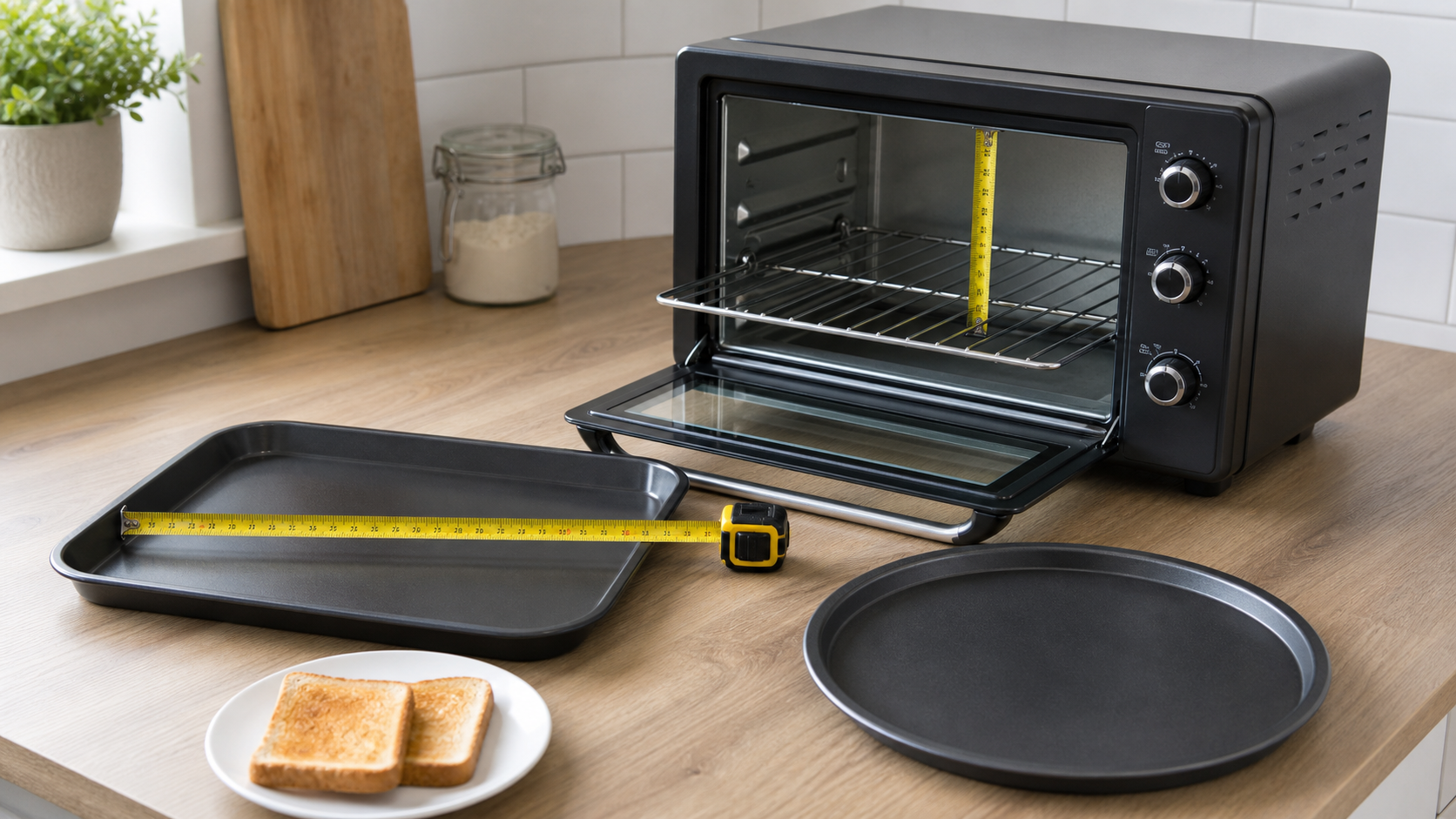
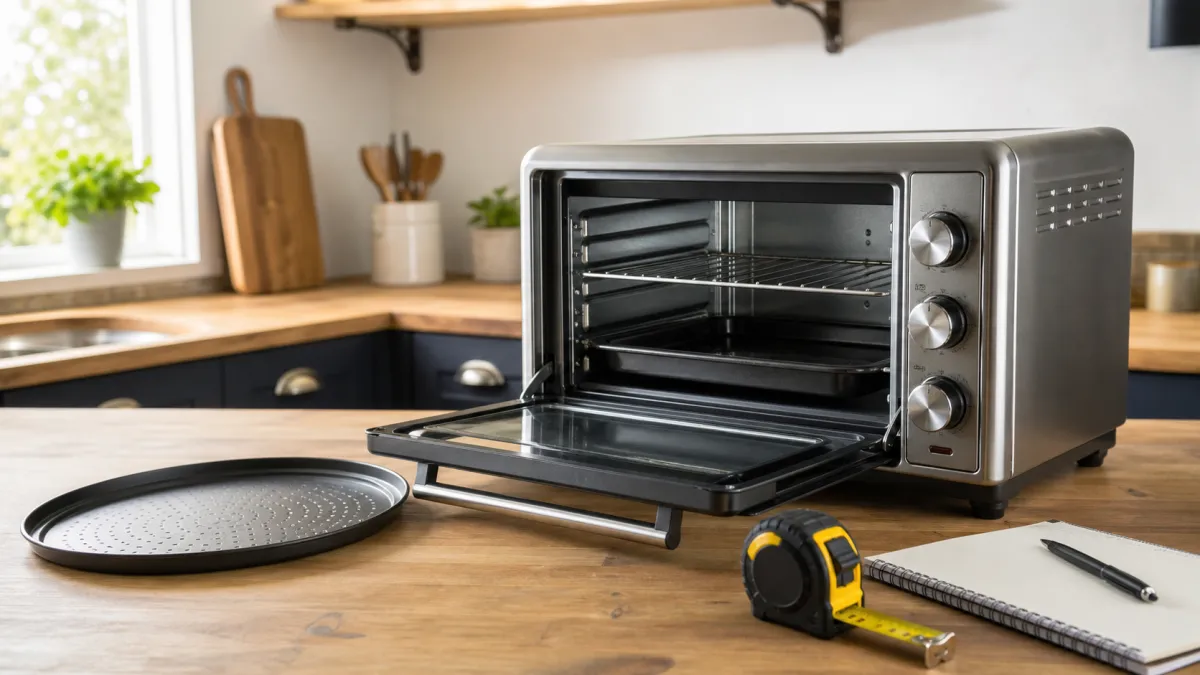
Use the tray, rack and pizza-pan dimensions as a practical fit check before trusting the headline capacity.
Leave enough heat clearance around the appliance
A mini oven should not be treated like a microwave that can be tucked into any tight corner. It is a small oven with heating elements, hot surfaces and side or rear vents. The space around it can matter as much as the food space inside it.
Check the manual before you plan where it will live. Some models need clear space at the sides and above the oven, and that can rule out low shelves, tight appliance garages or crowded worktop corners. Be careful with overhead cupboards, plug sockets, trailing leads and anything stored on top of the appliance. If the oven cannot sit somewhere with proper clearance, it is not a good fit for that kitchen even if the footprint looks compact.
Grease is part of this too. Mini ovens used for bacon, sausages, cheese toasties or roasted vegetables need more cleaning than one used mainly for toast. If vents, door seals or crumb trays are hard to reach, the oven can become unpleasant quickly.
Controls should match the way you cook
Mini ovens can look simple, but their controls vary a lot. Some use three dials for temperature, time and function. Others add presets, fan modes, digital displays or dedicated toast settings. More controls are not automatically better. What matters is whether you can set the oven accurately enough for the jobs you repeat.
- For toast and snacks: a clear timer, visible toast setting and easy rack position matter more than a long preset list.
- For baking and reheating: check the temperature range, fan setting and whether the timer is long enough for the food you cook.
- For grilling: look for a rack height that gets food close enough to brown without forcing it against the element.
- For shared households: simple dials can be easier than menus if several people will use the oven.
Also check whether the oven keeps running when the timer finishes, whether it has an audible end alert, and how easy the markings are to read. These sound like small details, but they decide whether a compact oven feels like a daily tool or a fussy backup appliance.
Cleaning can make the capacity feel smaller
The foods that benefit most from a mini oven are often the foods that create crumbs, melted cheese, oil or sugar. That makes cleaning part of the buying decision, not an afterthought.
A removable crumb tray is especially useful for toast, pastries and bread. Removable racks and a tray that can be washed easily matter for roasted vegetables, meat and saucy leftovers. Look at the door opening too: if the oven is narrow and the tray has to be angled sharply to come out, you are more likely to spill hot oil or crumbs.
Cleaning also affects what you can cook comfortably. A mini oven may technically fit a small roasting dish, but if there is barely any space to lift it out level, you will avoid using it for wet or greasy food. Capacity is not just what fits cold on the worktop. It is what you can load, remove and clean safely after cooking.
When an air fryer or microwave still makes more sense
A mini oven is strongest when you want a compact version of ordinary oven cooking: trays, toast, pizza, pastries, open sandwiches and food that benefits from dry heat. It is less compelling if your main jobs are reheating drinks, warming leftovers quickly, or cooking foods that need shaking and fast airflow.
Choose an air fryer instead if you mostly cook chips, frozen snacks, chicken pieces or small portions that benefit from a basket you can shake. Choose a microwave if speed, reheating and softening are the real jobs. A mini oven can overlap with both, but it should earn its place by doing the tray and browning tasks you would otherwise miss.
The mini oven checks I would not skip
Before buying, I would make these checks in this order:
- Measure the largest tray, pizza or plate you expect to use.
- Check the included pan, rack and pizza-pan dimensions, not just litres.
- Confirm there are useful rack positions for toast, baking and taller food.
- Read the manual's clearance guidance before choosing a worktop spot.
- Check whether the crumb tray, racks and pans are easy to remove and clean.
- Make sure the controls are simple enough for the person who will use it most.
The best mini oven is not always the biggest one. It is the one that fits your real trays, gives food enough height, sits safely where you need it, and is easy enough to clean that you keep using it.
Sources and checks
These references are useful when checking a mini oven's physical fit, rack positions and safe placement before buying.
- Sage Smart Oven Pro product information: compare how one current UK countertop oven publishes its appliance dimensions, included pan sizes and cooking functions.
- Sage Smart Oven Pro instruction manual: check an example of model-specific rack positions, clearance guidance and crumb-tray cleaning instructions.
- Electrical Safety First kitchen safety guidance: review UK advice on appliance condition, grease build-up, overloaded sockets and safe use of hot kitchen appliances.