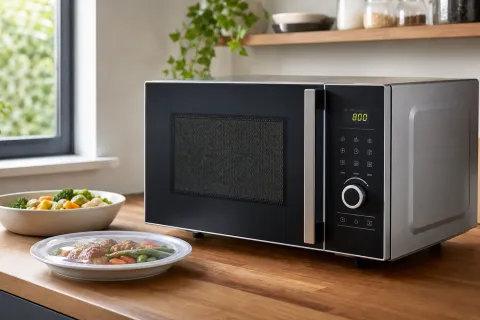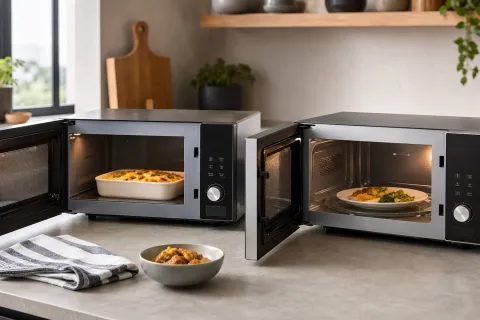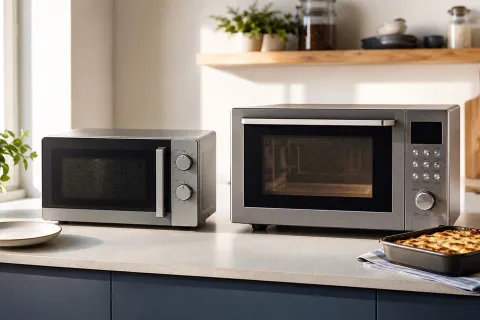
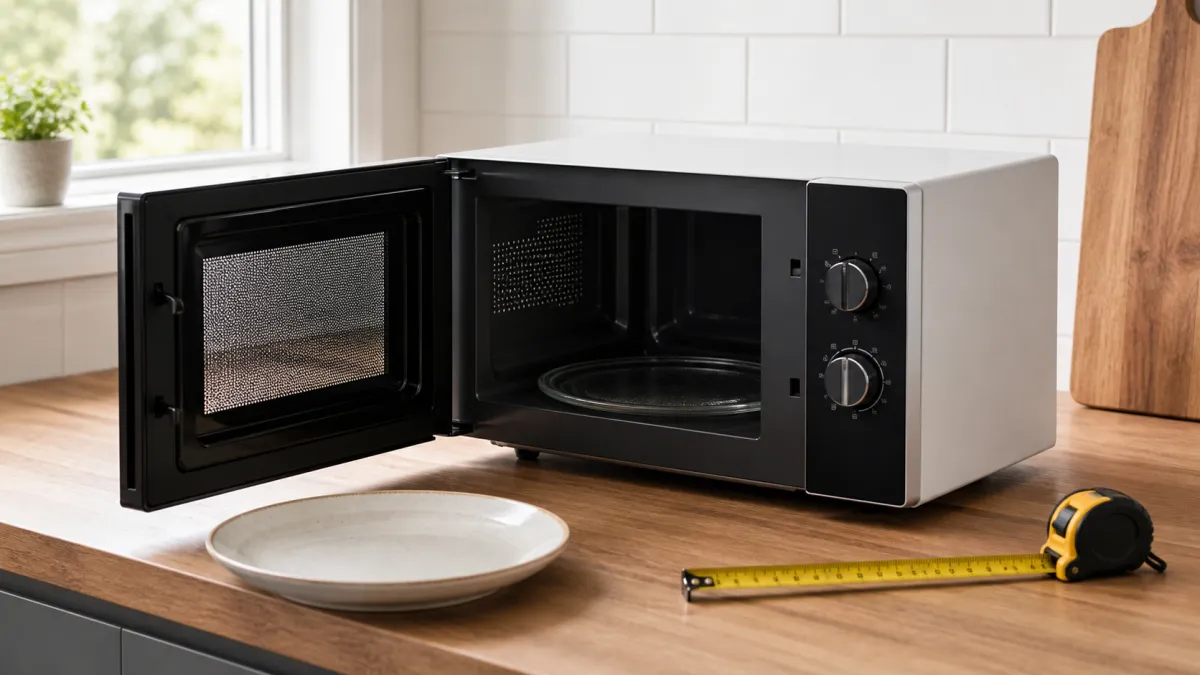
A microwave's litre capacity is useful, but it is not the whole answer. The right size is the one that fits the plates and dishes you actually use, sits safely on your worktop, and has enough room for the way you reheat, defrost or cook.
Start with the plate, not the litre number
For most UK kitchens, a 20-23 litre solo microwave is the sensible everyday size. It is usually big enough for reheating plates, bowls, mugs and ready meals without taking over the counter. Go smaller only when space matters more than flexibility, and go larger when you regularly use wide dinner plates, batch-cook portions, rectangular dishes or combi-oven functions.
| Microwave size | Best for | Watch out for |
|---|---|---|
| Under 20 litres | Small kitchens, student rooms, occasional reheating, mugs and compact bowls. | Dinner plates and taller containers may be awkward, especially on a small turntable. |
| 20-23 litres | Most solo-microwave buyers: leftovers, ready meals, defrosting, porridge, soup and everyday reheating. | Check your largest plate before buying; two models with the same capacity can feel different inside. |
| 25-28 litres | Larger plates, wider bowls, small families, batch reheating and some grill or flatbed models. | The outside footprint can jump more than the litre number suggests. |
| 30 litres and above | Combi microwaves, large dishes, oven-style use and households that want one appliance to do more. | Only worth the space if you will use the extra functions or regularly cook larger portions. |
If that table already points you towards a size, compare current recommendations in our best microwaves guide before narrowing by brand, budget and features.
The fit checks that matter most
Capacity is measured in litres, but shoppers live with dimensions. Before choosing, measure three things:
- Your largest everyday plate. If it catches the sides or cannot rotate, the microwave will be annoying even if the capacity sounds adequate.
- Your tallest regular container. Soup mugs, microwave rice steamers and covered bowls need height as well as width.
- Your available worktop depth. Leave room behind and around the appliance as the manual requires, and make sure the door can open comfortably.
A microwave that looks compact online can still be deep once you include the door, handle and rear clearance. This matters most in galley kitchens, rentals and corners where the door swing competes with kettles, coffee machines or wall cupboards.
Decision rule: buy the smallest microwave that comfortably fits your normal plate and container habits. Extra litres are useful only when they solve a real fit problem.
Which size suits your household?
One person or a compact kitchen
A compact model under 20 litres can work if you mostly heat mugs, small bowls, soup, porridge and single portions. It is the space-saving choice, not the most flexible one. If you use standard dinner plates or tall containers often, stepping up to around 20 litres usually makes daily use less fiddly.
Couples and everyday family reheating
Most households should start around 20-23 litres. This is the range where many solo microwaves sit, and it gives a good balance of capacity, price and counter space for reheating, defrosting and quick cooking.
Families, batch cooking and larger plates
If you reheat several portions, use large dinner plates, cook microwave rice or vegetables in bigger bowls, or rely on the microwave alongside an air fryer or oven, look at 25 litres and above. The extra room is less about bragging rights and more about reducing the number of times you have to decant food into a smaller dish.
Combi-microwave buyers
Combination microwaves often need more internal space because they are expected to grill, bake or roast as well as reheat. A 25-30 litre combi can make sense if you want a second oven or a compact all-in-one cooking appliance. If you only want fast reheating and defrosting, a large combi can be expensive, heavy and space-hungry for very little benefit.
Use our best combination microwaves guide if you want those oven-style functions; stay with a solo model if simplicity and counter space matter more.
Turntable or flatbed changes the usable space
A turntable microwave uses a rotating glass plate, so your usable area is limited by the plate diameter and the need for dishes to rotate. That is fine for most round plates and bowls, but it can be restrictive with square trays, wide casserole dishes or containers with handles.
A flatbed microwave removes the turntable and can make the interior feel more flexible, especially for rectangular dishes. It does not automatically mean every flatbed model is better: check the internal width, depth and height, and remember that heating performance and controls still matter.
Common sizing mistakes
- Buying by litres alone. Internal shape, turntable diameter and door opening can matter as much as capacity.
- Forgetting the outside dimensions. A larger cavity often means a deeper, wider and heavier appliance.
- Assuming family use always needs 30 litres. Many families mostly reheat plates and bowls, where a good 23-25 litre model may be enough.
- Choosing a combi for occasional reheating. Extra cooking modes are useful only if you will use them regularly.
- Ignoring ventilation clearance. A microwave squeezed into a tight corner can be unsafe, inconvenient and harder to clean around.
So, what size should you buy?
Choose under 20 litres only when space is the overriding concern. Choose 20-23 litres for the most balanced everyday solo microwave. Move to 25-28 litres when you need room for wider plates, larger bowls or family portions. Choose 30 litres and above only when you genuinely want a large combi or oven-style appliance.
The best test is simple: measure your largest plate, your normal containers and the counter space where the microwave will live. If the model passes those checks, the litre number is doing its job.
Ready to compare models? Start with our best microwaves guide, or go straight to solo microwaves and combination microwaves if you already know which type fits your kitchen.
Sources and checks
These links are useful when checking real-world footprint and function claims before buying.
- Sage Combi Wave 3 in 1 product specifications show how a multi-function combi microwave can grow into a deep worktop appliance once convection and air-fryer functions are included.