In this article
A knife block is better value only when you will use most of the knives in it. If the block gives you three or four genuinely useful blades, safe storage and a sensible upgrade path, it can be a tidy first buy. If half the slots are filler, buying individual knives is usually the better long-term decision.
The simplest way to judge the deal is to ignore the piece count and ask a harder question: would you choose these knives one by one if the block did not exist? If the answer is mostly no, the block is not a bargain.
| Choice | Best for | Where value is won | Where value is lost |
|---|---|---|---|
| Knife block | First kitchens, neat worktops and cooks who want one straightforward purchase. | Useful core knives, included storage and a matched set that is easy to keep together. | Duplicate utility knives, poor sharpening, bulky blocks and pieces you rarely use. |
| Individual knives | Careful upgraders, small kitchens and anyone who already owns one good knife. | Better fit, fewer compromises and money spent only on knives that suit your cooking. | Storage costs, slower buying decisions and the temptation to under-buy a safe setup. |
If you already know you want a set rather than a slow upgrade, start with our Best Knife Sets guide and judge each option by the knives you will actually use, not by the biggest number on the box.
Start with the three knives that earn their place
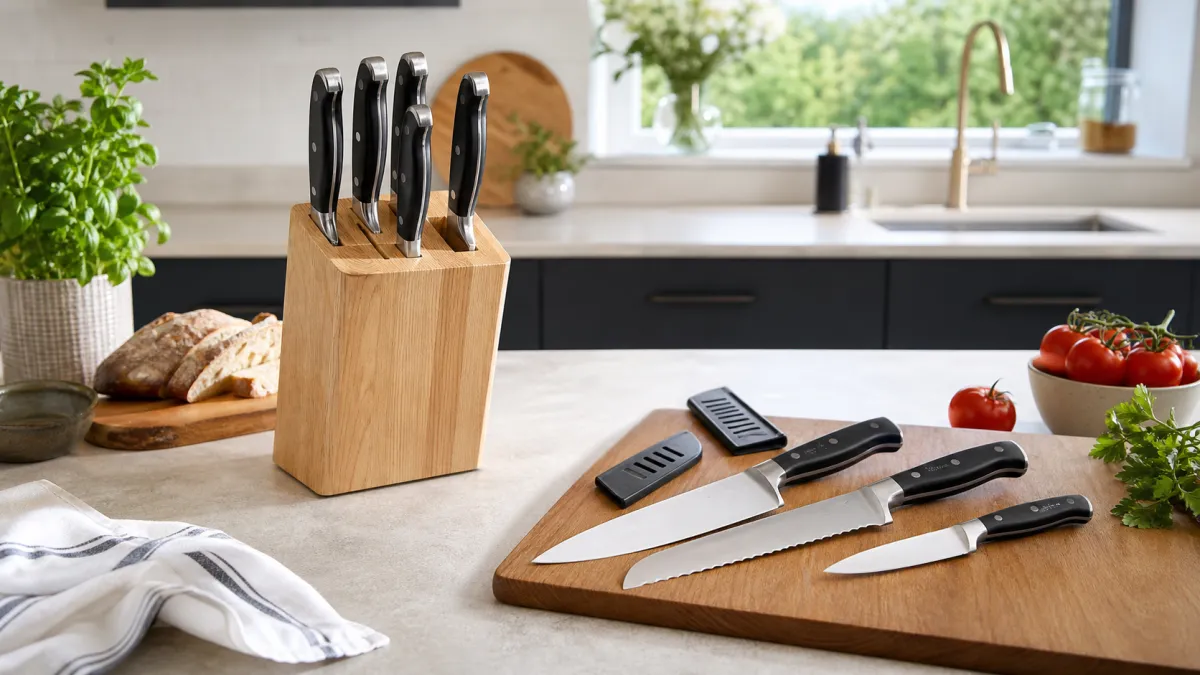
Most home kitchens can do a lot with three knives: a chef's knife or santoku for chopping, a small paring or utility knife for trimming and close work, and a serrated bread knife for crusty loaves, tomatoes and soft foods with tough skins. That is the practical baseline.
A carving knife, boning knife, cleaver, steak knives and kitchen scissors may be useful, but they are not automatically useful to every household. They should count as value only if they match how you cook. Sunday roasts, whole fish, large joints and frequent entertaining change the calculation; weekday pasta, salads, toast and stir-fries usually do not.
Value rule: a smaller set of knives you reach for every week is better value than a full block that mostly decorates the worktop.
The block itself can be part of the value
A good block gives every blade a protected home, keeps sharp edges away from loose drawers and makes it harder to misplace the knife you use most. For a first kitchen, that convenience has real value. It also means you are not immediately shopping for blade guards, an in-drawer organiser or a magnetic rack.
But the block is also a commitment. It takes worktop space, may be awkward under wall cupboards and can keep you tied to knives you would not choose again. Some blocks have empty slots for future upgrades, which is helpful; others are shaped tightly around the supplied set, so replacing one weak knife later can be irritating.
Watch for filler pieces
Piece count is where many knife blocks look stronger than they are. A ten-piece set may include six steak knives, scissors, a sharpening steel and only three preparation knives. That can still suit the right household, but it is not the same as ten serious cooking knives.
Before buying, make a quick useful-piece count:
- Core prep knives: chef's knife or santoku, paring or utility knife, bread knife.
- Useful extras: carving knife, kitchen scissors, honing steel or sharpener, only if you will use them.
- Possible filler: duplicated utility knives, specialist blades with no clear job in your kitchen, or steak knives included mainly to inflate the set.
If two-thirds of the set passes that test, a block deserves serious consideration. If half the box feels like padding, buy fewer knives individually and choose storage separately.
Storage and safety change the calculation
Individual knives are often better value on blade quality, but only if you also store them properly. Loose knives in a drawer are bad for fingers and blade edges. If you go individual, budget for knife blade guards*, an in-drawer organiser, a wall-mounted magnetic rack or another safe storage method that suits your kitchen.
A block keeps the decision simple, especially in a family kitchen where different people put things away. Individual storage is more flexible: blade guards work in small drawers, in-drawer trays keep worktops clear, and magnetic strips can make sense if they are mounted securely and away from children.
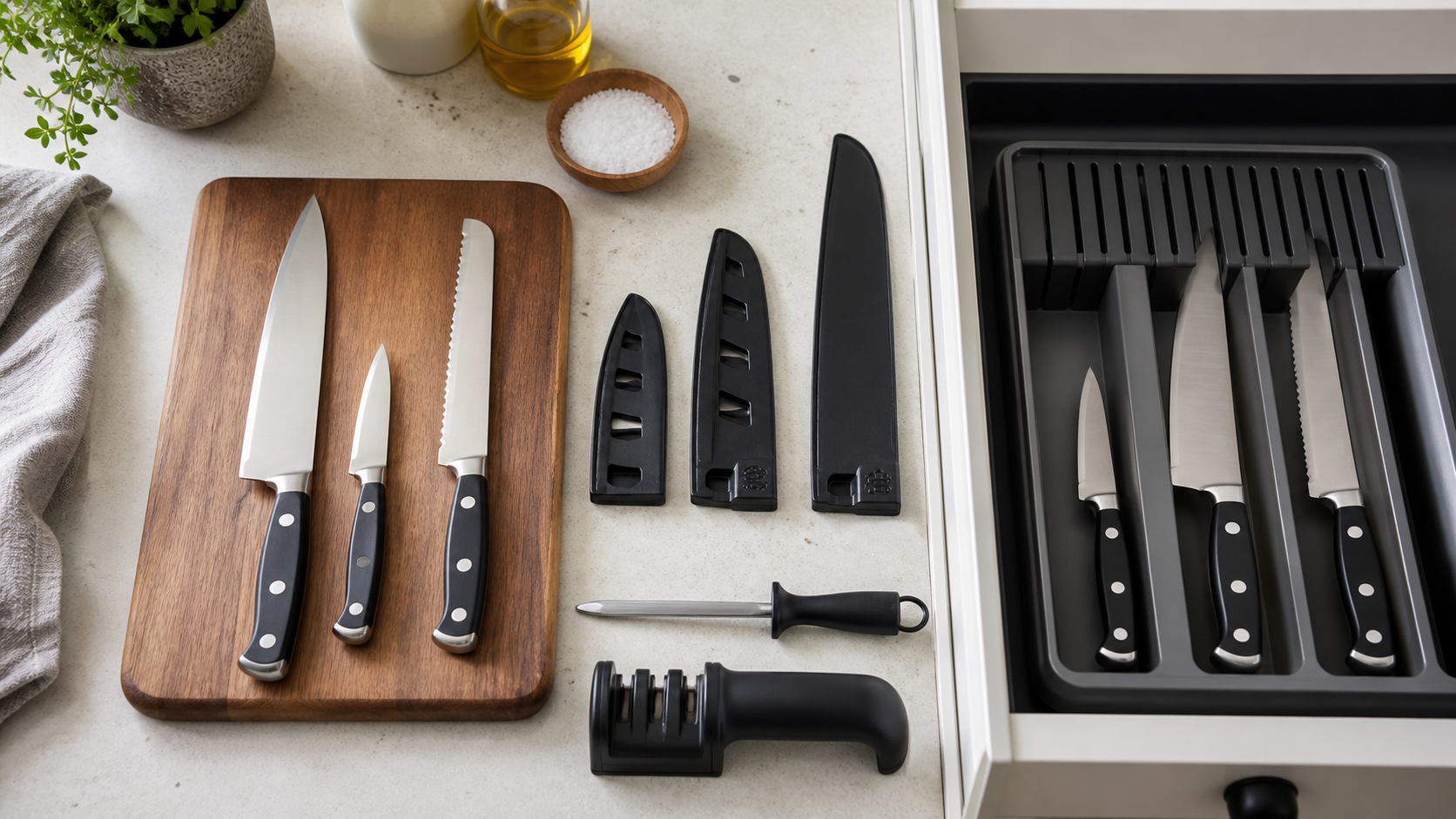 If you buy individual knives, choose the storage method at the same time so sharp blades are protected from day one.
Also think about cleaning. Knives should be easy to wash and dry soon after use, and handles should feel secure when wet. If the set includes wooden handles, check the care guidance before assuming they can go in the dishwasher. A knife that needs more care is not a problem, but it should match your habits.
Sharpening matters more than matching handles
Long-term value depends on whether the knives stay useful. A cheap block that becomes frustrating after a few months is not better value than two better knives and a simple sharpening routine. Look for comfortable balance, a handle you can grip safely and steel that can be sharpened without specialist fuss.
A honing steel helps maintain an edge between proper sharpening sessions, but it does not replace sharpening forever. Pull-through sharpeners are convenient; whetstones give more control but take practice. The right choice is the one you will actually use correctly.
Buy a block if you want a finished setup
A knife block is the better-value route when you are starting from scratch, want a neat worktop and can see a job for most of the knives. It is especially sensible when the included storage is part of the appeal and the set does not force you to pay for lots of specialist blades you will ignore.
Choose a block with a strong core rather than the largest count: one reliable main knife, a small knife, a bread knife and genuinely useful extras. Empty or flexible slots are a bonus because they let you replace or add knives later without replacing the whole block.
Buy individually if you already know your habits
Individual knives usually make better value when you cook enough to know what annoys you. Maybe you want a lighter chef's knife, a better bread knife, a left-hand-friendly handle or a compact setup that fits a drawer. Buying separately lets you put more of the budget into the knives that matter most.
The trade-off is discipline. It is easy to buy one good chef's knife and then keep using a blunt old bread knife because the rest of the setup was never finished. If you choose the individual route, decide the first three knives and the storage method together.
The verdict
For most first kitchens, a well-chosen knife block is the easiest good-value buy. It solves knives and storage in one go, and it reduces the risk of leaving sharp blades loose in a drawer. The catch is that the set must be judged by useful knives, not by how full the block looks.
For cooks who already have preferences, individual knives are usually the sharper value play. Buy fewer, buy better, and spend a small amount on safe storage. The best answer is not block versus individual in the abstract; it is whether your money is going into knives you will actually use, keep sharp and store safely.
Sources and checks
These references are useful when checking knife-buying rules, kitchen hygiene and common knife/storage terms before buying.
- GOV.UK knife rules explains age-restricted knife sales, public carrying rules and banned knife types.
- Food Standards Agency cleaning guidance covers cleaning utensils, chopping boards and surfaces to reduce cross-contamination.
- John Lewis kitchen knife guide is a useful retailer reference for common knife types, blade terms, storage choices and disposal guidance.