In this article
Centrifugal and slow juicers can both turn fruit and vegetables into juice, but they feel very different to live with. The short version is simple: a centrifugal juicer is usually faster and more forgiving with hard fruit and veg, while a slow juicer is calmer, quieter and often better suited to leafy greens.
That does not mean one type is automatically healthier or better. The right choice depends on how much chopping you will tolerate, what you want to juice, how quickly you want a drink, and whether you will clean the machine as soon as you finish.
The practical difference at a glance
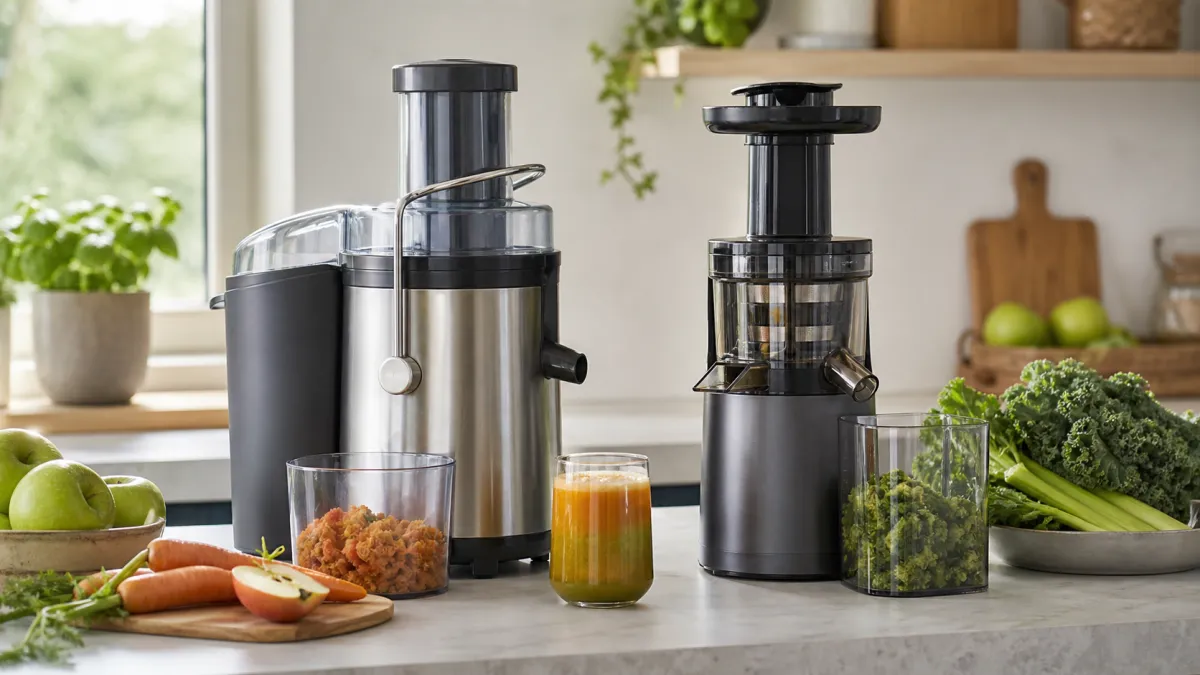
A centrifugal juicer uses a fast-spinning cutting disc and mesh basket to shred ingredients and fling juice out through the filter. A slow juicer, often called a cold-press or masticating juicer, crushes ingredients more gradually with an auger. In plain English, an auger is the turning screw-shaped part that presses food through the machine.
| What changes | Centrifugal juicer | Slow juicer |
|---|---|---|
| Speed | Usually the faster choice, especially for apples, carrots and other firm ingredients. | Slower feed and extraction, but less frantic in use. |
| Prep | Often has a wider feed chute, so some ingredients need less chopping. | Usually needs smaller pieces and a steadier feeding pace. |
| Juice texture | Can produce more foam and a lighter, sometimes pulpier juice depending on the filter. | Often produces a denser-looking juice with less foam, though results vary by model and ingredient. |
| Leafy greens | Can struggle with spinach, kale and herbs unless they are packed with firmer produce. | Often the better fit for leaves and softer ingredients because it presses rather than flings them. |
| Noise | More likely to sound like a loud blender or food processor. | Usually quieter and lower-pitched. |
| Cleaning | The fine mesh basket can be quick to rinse if cleaned immediately, but annoying once pulp dries. | More parts can mean more assembly, although some strainers are easier to brush clean than a fine basket. |
| Storage | Can be broad and bulky, with a pulp bin beside the main body. | Can be tall and awkward under wall cupboards, especially vertical slow juicers. |
If this table already points you towards a juicing machine, start with our juicer guide. If the whole-fruit texture of smoothies sounds more useful than clear juice, compare jug blenders or smoothie makers before buying a dedicated juicer.
Choose by routine, not by the word cold-press
Slow juicers are often sold with cold-press language, but shoppers should be careful with nutrition claims. A slow juicer may suit leafy greens, softer fruit and a calmer morning routine, but that does not prove it will make a meaningfully healthier drink for every household.
Fruit juice and smoothies still concentrate sugars from fruit and remove some of the eating effort that comes with whole fruit. UK NHS guidance treats fruit juice, vegetable juice and smoothies cautiously: together, they count as no more than one of your 5 A Day, with a combined daily portion of 150ml.
Buy a slow juicer for the ingredients and routine it handles better, not because the label promises a shortcut to better nutrition.
For most buyers, the stronger question is practical: which machine will you actually use twice a week, clean promptly and keep within easy reach?
Centrifugal juicers suit speed and hard ingredients
A centrifugal juicer is the better fit if your normal drink is based on apples, carrots, cucumber, celery or beetroot and you want it quickly. The wider chute on many models can reduce chopping, and the fast motor makes the process feel more like using a blender or food processor than feeding ingredients slowly one by one.
The trade-off is noise and pace. Centrifugal models can be loud, and the juice may look frothier. Very soft fruit, herbs and loose leaves can be less efficient because the spinning basket has less to grip. You can often improve results by feeding leaves alongside firmer ingredients, but if green juice is the main reason you are buying, do not assume every fast juicer will suit it.
- Best for: quick morning juice, hard fruit and veg, wider feed chutes, and households that value speed over quiet operation.
- Watch for: mesh basket cleaning, foam, noise, counter width and how easily the pulp container clips in and out.
Slow juicers suit leaves, softer produce and quieter use
A slow juicer feeds ingredients through a pressing mechanism rather than a high-speed cutting basket. That slower action can be useful for spinach, kale, wheatgrass-style leaves, herbs, berries and softer ingredients that might be thrown around inside a centrifugal basket.
It is not automatically easier. Smaller pieces often feed better, and you may need to alternate soft and firm ingredients so the machine keeps moving smoothly. Some slow juicers also have narrower chutes, so the prep time you save in cleaning or quieter running can come back as chopping time.
- Best for: leafy green juices, quieter kitchens, softer fruit, and buyers who do not mind a slower feed.
- Watch for: chute size, auger jams, the number of parts, height under cupboards and whether the cleaning brush reaches the strainer properly.
Pulp tells you what the machine is doing
Pulp is the leftover fibrous material after juice has been extracted. With centrifugal juicers, pulp can sometimes look wetter because the machine is working quickly and flinging juice through a mesh basket. With slow juicers, pulp may look drier for some ingredients because the auger presses gradually.
Do not judge from pulp alone. A very dry pulp bin is satisfying, but it is only useful if the drink tastes good, the machine does not clog, and the cleaning routine is manageable. The same juicer can behave differently with carrots, apples, celery, pineapple, berries and spinach.
Think of pulp as a clue, not a score. If you mostly juice cheap apples and carrots, tiny differences in extraction may matter less than speed and cleaning. If you juice expensive berries or lots of leafy greens, slower extraction may feel more worthwhile.
Cleaning is the habit test
Juicers are more cleaning-sensitive than blenders. Juice dries quickly, pulp wedges into strainers, and fine mesh can become harder to rinse if it is left until later. The machine you will clean immediately is usually the better buy.
Centrifugal juicers often put the hardest cleaning job in the mesh basket. Slow juicers can have more individual parts: chute, auger, strainer, juice cap, pulp outlet and seals. Neither type wins automatically.
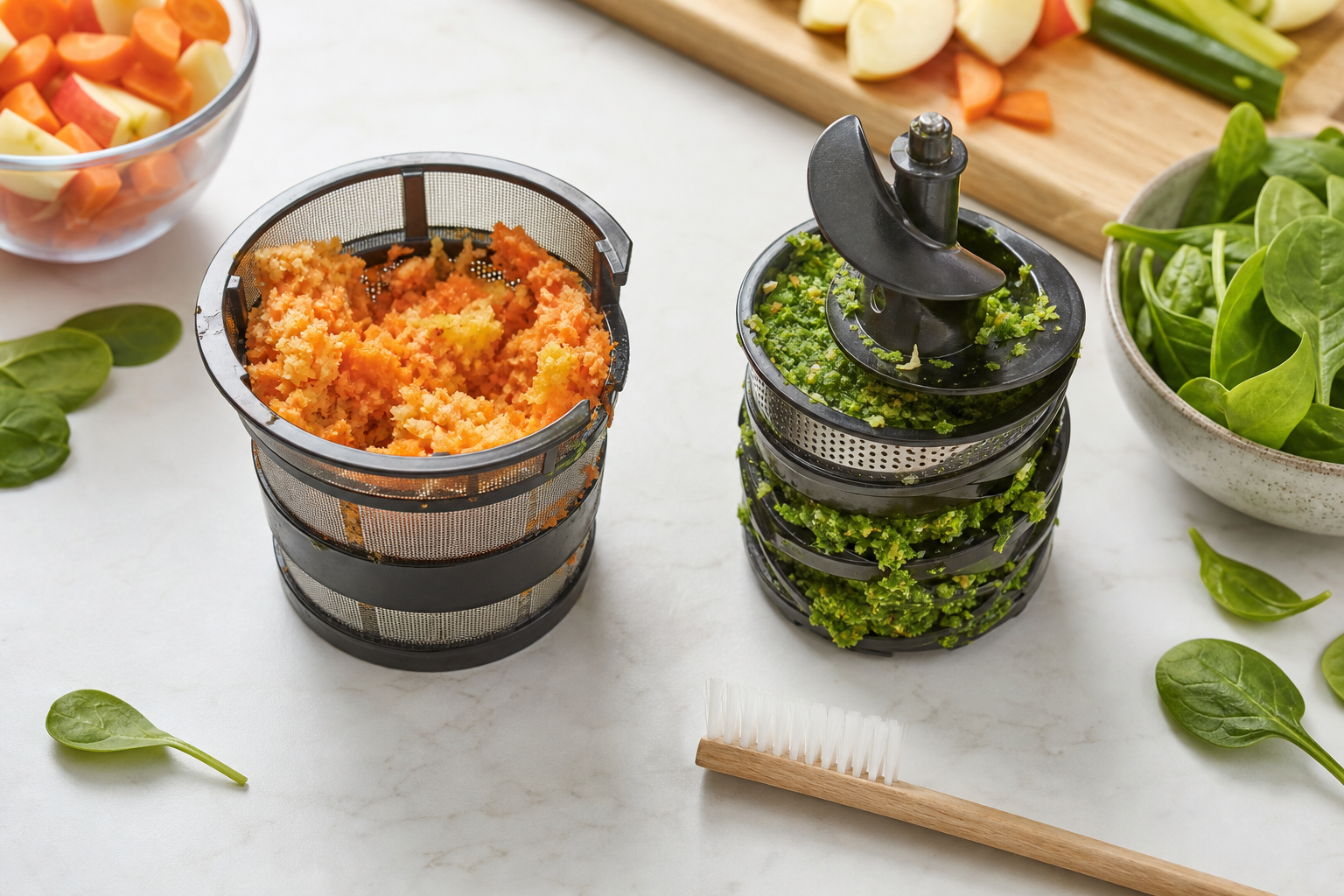
When comparing models, check whether the parts are dishwasher-safe, whether the pulp outlet is easy to clear, and whether a proper brush is included. If you are buying accessories separately, a simple juicer cleaning brushes* search can show the kind of narrow brush that helps with mesh screens and strainers.
Noise and storage matter more than they sound
A juicer that is technically excellent can still be the wrong appliance if it is too loud for your kitchen or too awkward to store. Centrifugal models tend to be noisier because of the high-speed motor. Slow juicers are often quieter, but taller models can be annoying under wall cupboards.
Look beyond the main body. The pulp bin, juice jug, pusher, brush and removable parts all need somewhere to live. If the machine will be stored in a cupboard, check its weight and shape. If it will stay on the worktop, check the footprint with the pulp container attached rather than relying on the base size alone.
Convenience is physical. The best juicer for a small kitchen may be the one you can lift, assemble, clean and put away without rearranging the whole worktop.
When a blender or smoothie maker is the better answer
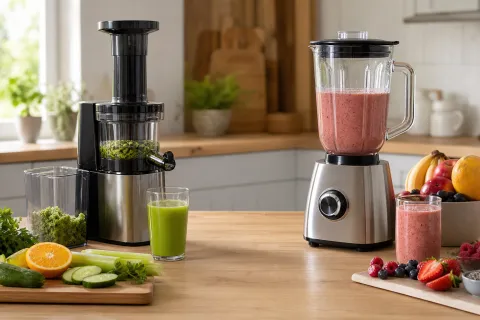
If you want a thicker drink that keeps more of the whole fruit or vegetable in the glass, a blender or smoothie maker may suit you better than either juicer type. Blenders do not separate pulp from juice. They chop and blend the whole ingredient with liquid, which changes the texture, thickness and cleaning routine.
A smoothie maker is usually the compact drinks-focused option: useful for one or two portions and a bottle-style routine, but less flexible than a full jug blender. A jug blender is better for larger batches, frozen fruit, soups, sauces and broader kitchen use.
Choose a juicer when clear juice is the point. Choose a blender or smoothie maker when you want thicker drinks, easier ingredient flexibility and less waste in the pulp bin.
Which juicer type should most people buy?
Most occasional juicing households should start by looking at centrifugal juicers because they are quick, familiar and often less demanding with hard produce. They make sense if you mainly want apple, carrot, cucumber or celery juice and you do not need the quietest appliance in the kitchen.
A slow juicer is worth considering if leafy greens, softer fruit, quieter operation or a more deliberate weekend routine matter more than speed. It can also be the better buy if you dislike foam or want to experiment with a wider range of ingredients, as long as you accept the slower feeding and extra prep.
The real test is not which technology sounds more premium. It is whether the machine matches your ingredients, your mornings, your sink and your storage space. Get those right and the juicer is much more likely to stay in use.
Sources and checks
These links help check two practical points before buying: how juice fits into everyday diet advice, and how current UK juicers present the fast-versus-slow choice.
- NHS 5 A Day guidance: explains how fruit juice, vegetable juice and smoothies count towards 5 A Day, including the combined 150ml daily portion limit.
- Sage UK juicers: compare how a current UK manufacturer separates fast juicers from slow juicers, including feed chute, leafy-green and cleaning claims to check against any model you are considering.