In this article
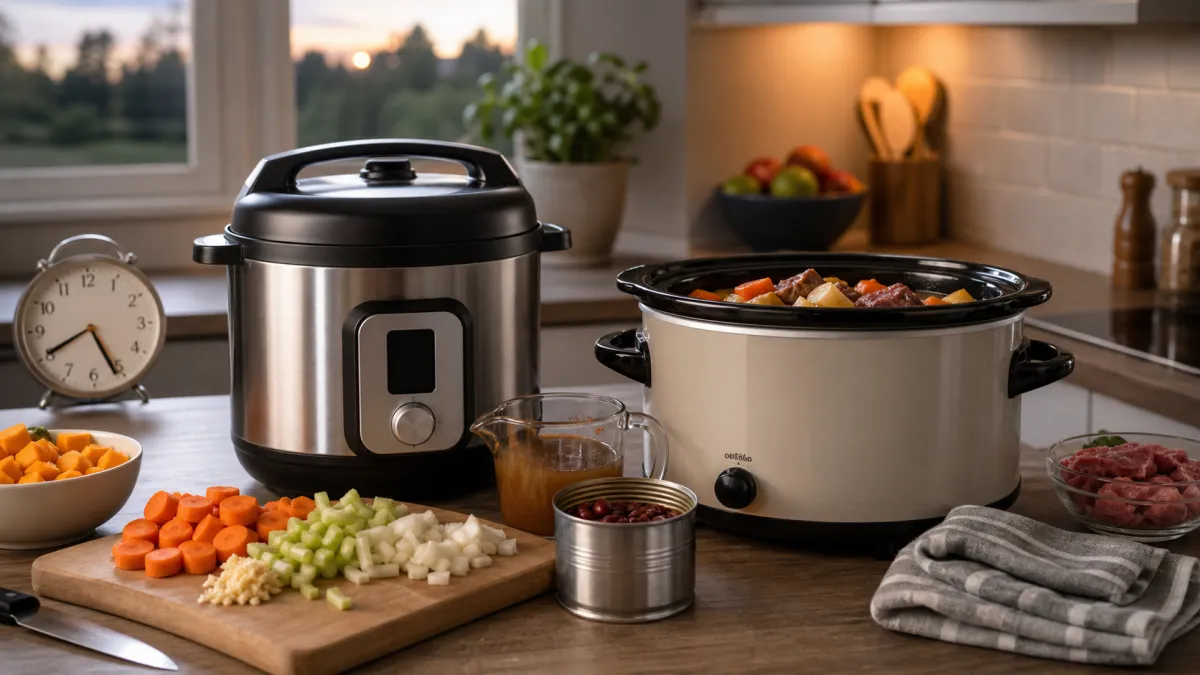
If dinner normally starts after work, the faster choice is usually an electric pressure cooker. If dinner can be loaded before work, school pickup or the evening rush, a slow cooker is usually calmer. The weeknight question is not which appliance is better; it is whether your meal needs speed at 6 pm or patience earlier in the day.
That narrower distinction matters because both appliances can make stews, curries, chilli, pulled meat and one-pot comfort food. They just solve opposite timing problems. A pressure cooker compresses cooking into a shorter evening window, while a slow cooker spreads cooking across the day so dinner is waiting later.
Weeknight rule: choose an electric pressure cooker when you start from cold ingredients after work; choose a slow cooker when you can prep earlier and want dinner to coast until you are ready.
Start with the weeknight clock
| Your evening problem | Better fit | Why it suits the timing |
|---|---|---|
| You get home and still need to start dinner | Electric pressure cooker | It can tenderise wet-cooked food much faster than a slow cooker, even after allowing for heat-up and steam release. |
| You can prep in the morning or at lunchtime | Slow cooker | It turns early prep into a finished meal later, with less evening decision-making. |
| Dinner time moves around by an hour | Slow cooker | Long, gentle cooking and keep-warm settings usually tolerate a shifting evening better than pressure cooking. |
| You forgot to defrost or start early | Electric pressure cooker | It is the more forgiving format when the plan has already slipped, provided the food and recipe are suitable. |
| You want a meal to smell and simmer all afternoon | Slow cooker | That low-and-slow routine is the point of the appliance, not a compromise. |
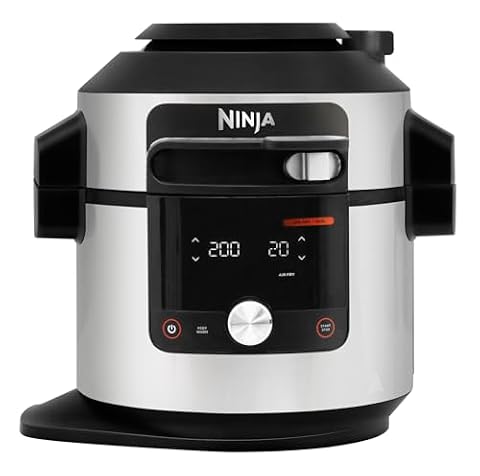
| You want one appliance that can do both jobs | Electric multi-cooker | A good pressure multi-cooker can cover both modes, but only if you will use the extra functions enough to justify the size. |
Compare the right models once the timing is clear
If the table already points one way, use the relevant shortlist: electric pressure cookers for faster after-work cooking, slow cookers for meals that can be loaded earlier, or electric multi-cookers if one appliance genuinely needs to cover both routines.
Electric pressure cookers suit late starts
An electric pressure cooker is the better weeknight fit when you often reach the kitchen with raw ingredients and limited patience. It is strongest for moist cooking: stews, curries, soups, beans, stocks, shredded meat and one-pot meals where tenderness matters more than browning or crisp edges.
The key is that pressure cooking raises the cooking temperature inside a sealed pot. In plain English, that means food can soften faster than it would in a normal simmer. It does not mean every dinner is instant. The appliance still needs time to heat, come up to pressure, cook, release steam and let you open the lid safely.
Build that hidden time into the decision. A recipe that advertises a short pressure-cook time may still need chopping, sautéing, pressurising, natural release and sauce adjustment. For a rushed Tuesday, the best pressure-cooker meals are the ones where that whole sequence still feels easier than watching a hob pan or waiting hours for a slow cooker.
Slow cookers suit meals that can wait
A slow cooker is the calmer choice when you can do the thinking earlier. It suits households that want dinner to take shape while they work, run errands, study, handle childcare or simply avoid another active cooking job at the end of the day.
The best slow-cooker meals are forgiving: casseroles, chilli, pulled pork, braised meat, lentil dishes, soups and sauces that benefit from a long, gentle cook. The appliance is not trying to be fast. It is trying to make the busiest part of the evening less fragile.
The trade-off is that you must start soon enough. If you regularly remember dinner at 5.30pm, a slow cooker will frustrate you. It also does not give much crunch, browning or last-minute flexibility unless you add a pan, grill or oven step elsewhere.
Pressure release changes the real finish time
Pressure release is the part many first-time buyers underestimate. A quick release lets steam out rapidly, while a natural release lets pressure drop more slowly. The right method depends on the food and the recipe. Soups, foamy foods and some meats may need a gentler release than a quick blast of steam.
For weeknight meals, this matters because the timer is not the finish line. You still need to open the lid, check the food, thicken sauce if needed, stir in delicate ingredients and serve. If your evening is tightly scheduled, choose recipes with realistic total times rather than only comparing headline pressure-cook minutes.
Best pressure-cooker weeknight jobs: tenderising meat, speeding up pulses, cooking stews from scratch, making soup quickly and rescuing a late start.
Worst pressure-cooker weeknight jobs: meals where you need crisp skin, dry roasting, delicate vegetables left unattended, or a completely silent cooking routine.
Slow-cooker flexibility is about serving, not starting
A slow cooker feels flexible because dinner can usually wait for a while once cooked, especially on a suitable keep-warm setting. That is useful when trains run late, homework overruns or everyone eats at slightly different times.
It is less flexible at the start. The food needs enough safe cooking time, and some ingredients need proper handling before they go in. Do not treat a slow cooker as a way to warm half-cooked food gently for hours. It is best when the meal is assembled correctly and cooked for the time the recipe and appliance expect.
What this means in practice: a slow cooker can protect dinner from a chaotic evening, but it cannot fix a meal plan that never started.
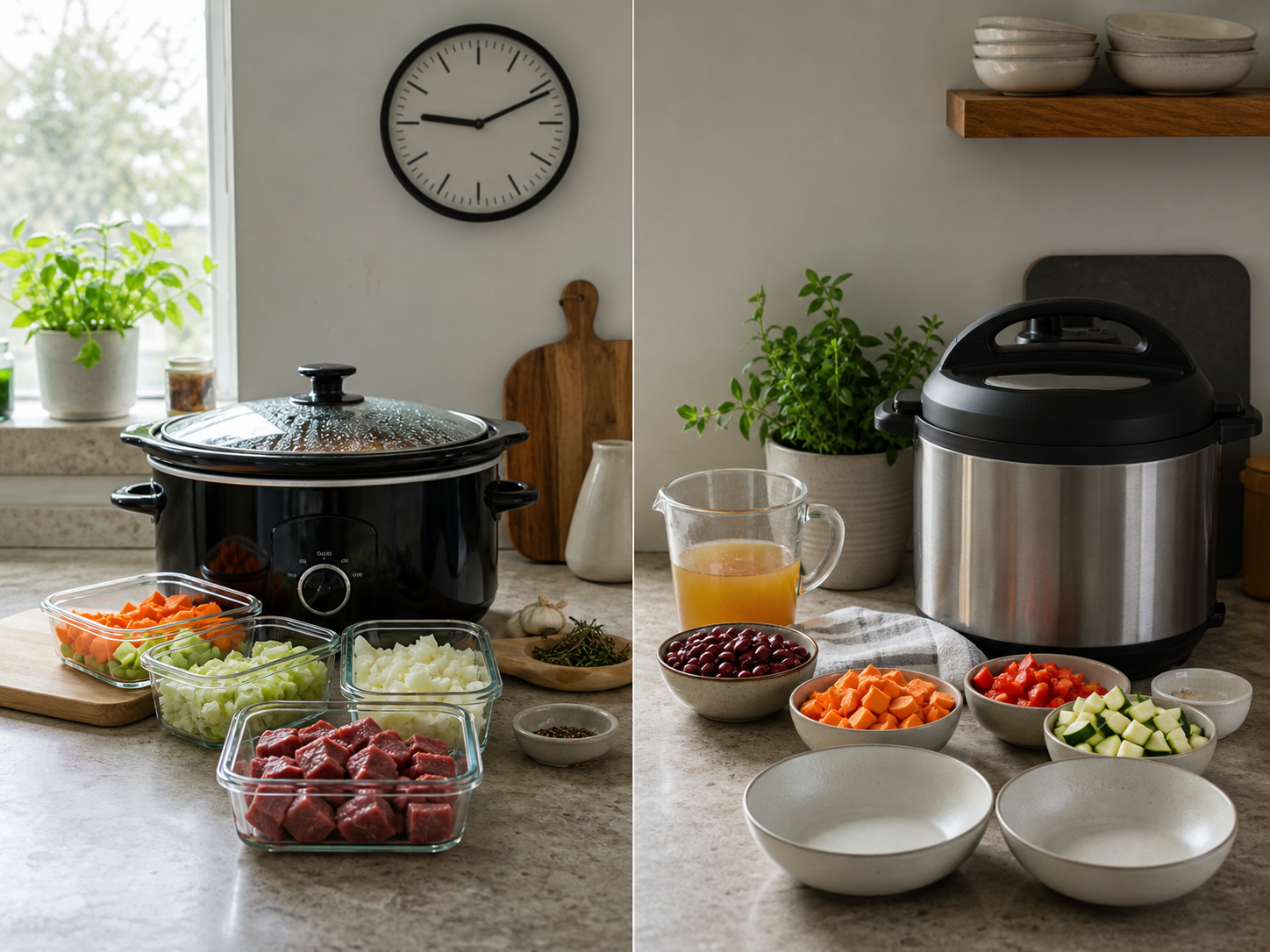
The useful split is timing: a slow cooker rewards earlier prep, while an electric pressure cooker helps when dinner starts after work.
Where an electric multi-cooker fits
An electric multi-cooker is tempting because it appears to settle the argument: pressure cook tonight, slow cook tomorrow, then steam rice or vegetables another day. That can be a good answer for a small kitchen, especially if you already know you want pressure cooking and slow cooking in one body.
The catch is that multi-cookers vary. Some are excellent pressure cookers with a usable slow-cook mode. Others technically offer slow cooking but do not feel as simple as a dedicated slow cooker. Larger models may also bring extra lids, racks, baskets or parts that need somewhere to live.
Buy the multi-cooker for modes you will use every month, not for a feature list you admire once. If you only want low-and-slow stews, a simple slow cooker is easier. If you only want fast curries and beans, an electric pressure cooker may be cleaner. If you genuinely want pressure cooking, slow cooking and browning in one pot, a multi-cooker becomes the stronger weeknight tool.
Cleaning after dinner can decide it
Weeknight convenience does not end when the food is cooked. A slow cooker is usually a ceramic or metal pot, lid and maybe a spoon rest. An electric pressure cooker adds the lid, sealing ring, valve area, condensation collector and sometimes a stainless-steel inner pot that needs a little more attention.
That does not make pressure cookers difficult, but it does change the ownership habit. If the lid parts stay greasy, the sealing ring smells strongly or the valve is ignored, the appliance becomes less pleasant to use. Slow cookers can be easier to wash, though heavy ceramic bowls and baked-on sauces can still be annoying.
| After-dinner check | Pressure cooker | Slow cooker |
|---|---|---|
| Lid care | More important because seals and valves affect safe pressure cooking. | Usually simpler, though glass lids can still trap grease around the rim. |
| Pot handling | Often lighter stainless steel, but food can stick after sautéing. | Ceramic bowls can be heavy, especially when full. |
| Smell control | Sealing rings can hold curry, garlic or stew aromas. | The pot and lid are usually less smell-prone. |
Leftovers favour the appliance that matches your batch size
Both appliances can be useful for batch cooking, but not in the same way. Slow cookers are good when you want a large, gentle cook that turns into dinner plus freezer portions. Electric pressure cookers are good when you want to turn a shorter cooking session into several meals, particularly with beans, shredded meat, soup bases or stews.
Be realistic about the pot size. A slow cooker that is too large for your normal meal can cook shallow portions poorly. A pressure cooker cannot be filled to the top, and foamy foods need extra headroom. If leftovers are part of the plan, check usable capacity rather than just the headline litre figure.
For leftovers, cool food promptly, store it in suitable portions and reheat it until it is steaming hot all the way through. That is not specific to either appliance, but it matters more when batch cooking is one of the reasons you are buying.
So, which suits weeknight meals?
Choose an electric pressure cooker if your weeknight problem is starting late. It is the better fit for after-work meals where you still want tender meat, pulses, soup or one-pot dinners without waiting all evening.
Choose a slow cooker if your weeknight problem is decision fatigue. It is the better fit when you can load the pot earlier and want the evening meal to survive a messy schedule.
Choose an electric multi-cooker only when it solves a real space or routine problem. It can bridge both habits, but the best choice for weeknights is still the one that matches when you actually have time to prep.
Sources and checks
These links are worth checking when the buying decision includes food safety, leftovers or older appliances.
Food Standards Agency cooking guidance: check current UK advice on cooking food thoroughly, reheating leftovers and making sure food is hot all the way through.
GOV.UK product safety alerts, reports and recalls: search for product alerts before buying a used appliance or continuing to use an older pressure-cooking model.