In this article
Start with the jobs the pan must do
A good non-stick frying pan is not the one with the boldest coating claim. It is the one that gives you enough flat cooking space, steady heat, the right hob compatibility and a coating you can realistically look after. If those basics are wrong, a longer guarantee or tougher-sounding surface will not rescue it.
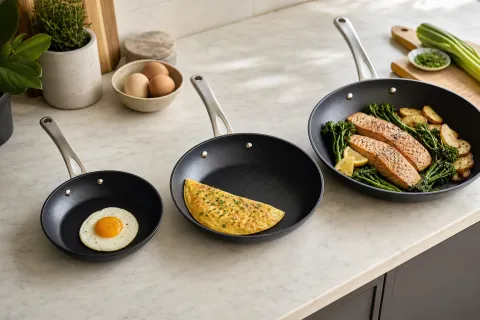
For most UK kitchens, the useful middle ground is a 24-28cm pan with a stable base, a comfortable handle and care instructions you are willing to follow. Smaller pans suit eggs and single portions; larger pans help with family breakfasts, pancakes and fish fillets, but only if the usable flat base is large enough and your hob zone can drive it properly.
| Buying check | Why it matters | What to look for |
|---|---|---|
| Flat cooking area | The rim diameter can exaggerate how much food actually touches the pan. | A broad, flat centre for omelettes, fish, pancakes and two-person portions. |
| Base and heat control | Thin or uneven bases can create hot spots that shorten coating life and brown food patchily. | A flat, stable base with enough weight to feel controlled without being awkward. |
| Hob fit | Induction pans need a suitable magnetic base, and the base diameter should suit the ring. | Check the maker's stated hob compatibility and any induction-ring size note. |
| Care rules | Dishwasher and metal-utensil claims vary by model, and rough treatment can still reduce release. | Choose instructions that match how you actually cook, wash and store pans. |
If you already know the size and hob fit you need, our best non-stick frying pans guide is the natural next step. Use the rest of this article to sanity-check the claims before you pick a model.
Rim size is not the same as cooking space
A frying pan sold as 28cm is usually measured across the top rim. The flat base where food actually sits can be much smaller, especially on pans with steeply sloped sides. That shape can be useful for tossing vegetables or sliding food out, but it is less helpful if you want two fillets, several rashers of bacon or a round omelette to sit flat.
Before buying, picture the food you cook most often. Eggs and pancakes want a smooth, even base. Stir-fried vegetables and folded omelettes can use sloped sides. Fish, chicken pieces and breakfast food need more uninterrupted surface than the headline diameter suggests.
Practical rule: choose the pan by the food that must lie flat, not by the biggest number in the product title.
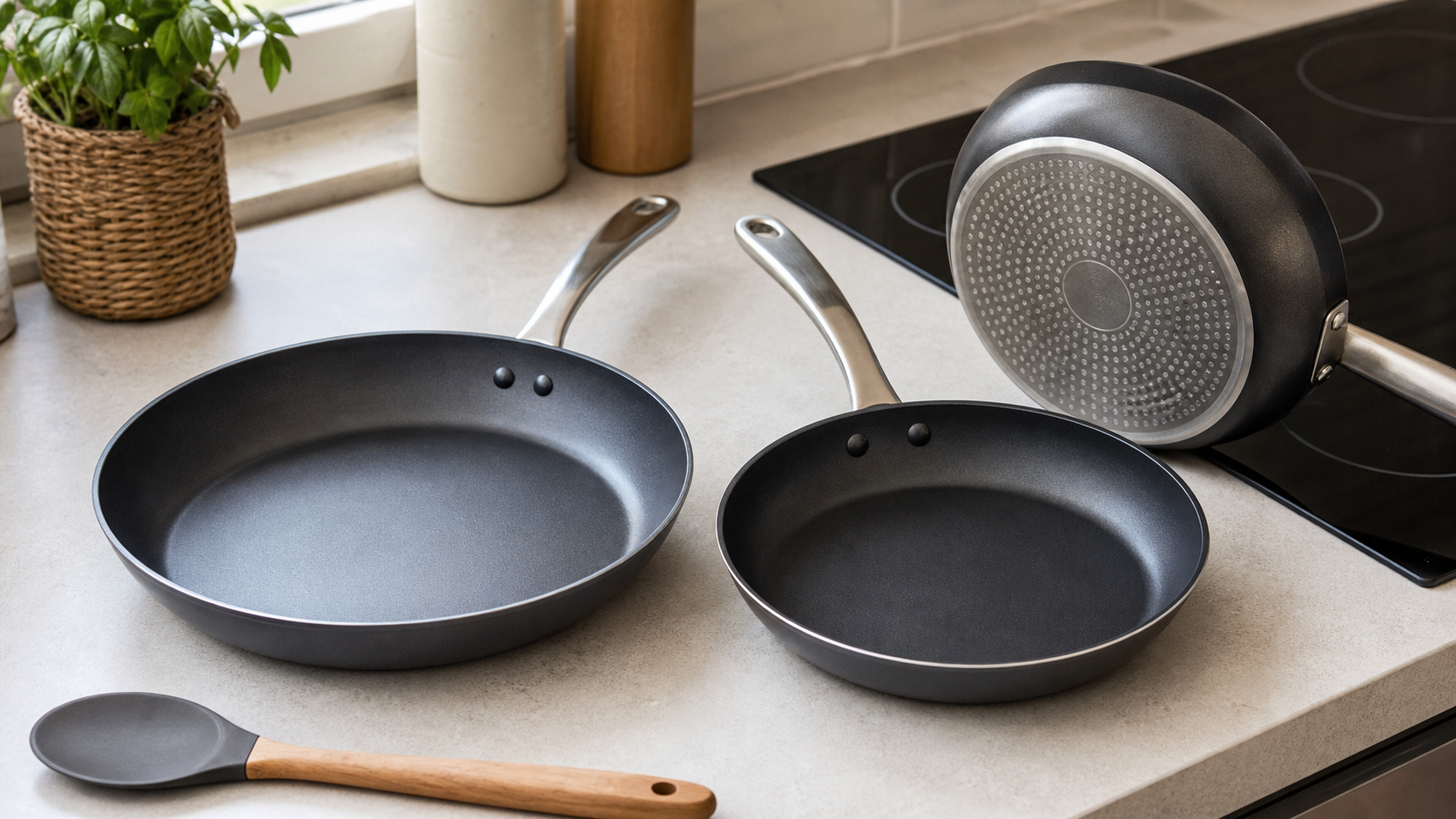 Headline diameter is only part of the decision: check the flat cooking surface and the induction base that actually contacts the hob.
The base matters as much as the coating
Non-stick coating gets most of the marketing, but the pan body decides how forgiving the pan feels. A very thin pan can heat quickly and feel light, yet it is easier to overheat and may brown unevenly. A heavier pan can hold heat better, but it should not feel clumsy when full or put strain on your wrist.
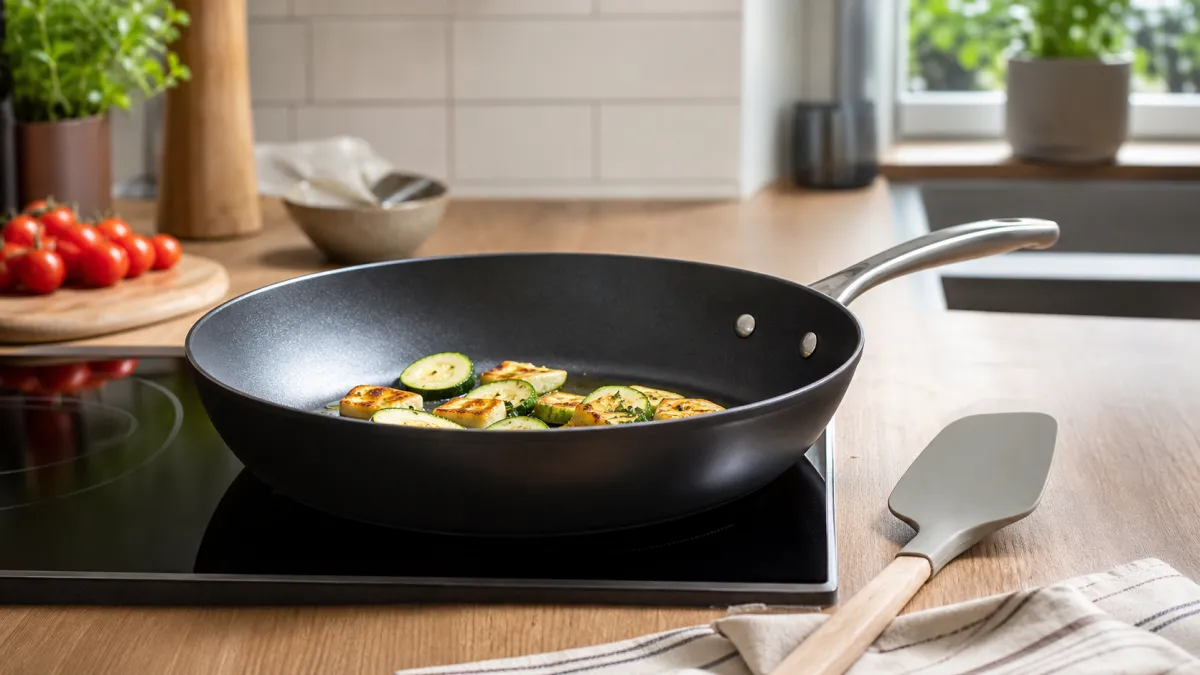
Look for a base that sits flat on the hob and feels stable when you press the handle lightly. Wobble is annoying on any hob and especially frustrating on flat ceramic or induction glass. If the pan is meant for everyday eggs, omelettes and quick frying, controlled medium heat matters more than aggressive searing power.
High-heat searing is where non-stick becomes a compromise. Some premium pans are built for higher temperatures than basic non-stick, but an uncoated stainless steel, cast-iron or carbon-steel pan is often the better tool if you mainly want steakhouse-style heat. For a non-stick frying pan, value usually comes from reliable release at moderate heat, not from treating it like a grill pan.
Coating labels need careful reading
Non-stick pans are often described with terms such as ceramic, titanium, hard-anodised, reinforced, stone-effect, PFOA-free or scratch-resistant. Some of those details can be useful, but they do not all describe the same thing. Some refer to the non-stick surface, some to particles or texture within a coating, and some to the pan body underneath.
Do not assume that one label automatically means longer life. A pan can have a durable body and still lose its easiest release if it is overheated, cleaned harshly or stacked badly. Equally, a ceramic-style coating can feel slick at first but still needs gentle heat and suitable tools.
The most useful coating information is the plainest: what utensils the maker permits, what heat range it recommends, whether dishwasher use affects the guarantee, and what damage is excluded. Treat broad durability claims as a reason to read the care notes, not as permission to ignore them.
Induction buyers should check the base, not just the badge
An induction-compatible badge tells you the pan should work on induction, but it does not tell you whether the base suits your favourite hob zone. A pan with a wide rim and a smaller magnetic plate may still need a smaller induction ring than its headline size suggests. If the base is too small for a large zone, performance can be weaker or the hob may not recognise the pan consistently.
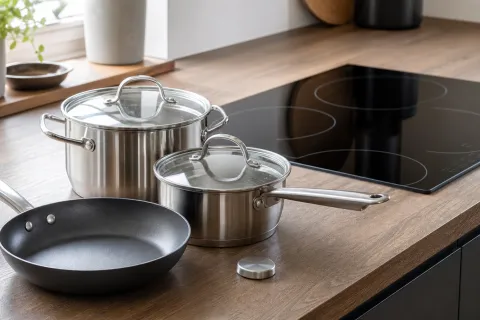
This also affects buying for sets. A bundled non-stick frying pan in a saucepan set may be good enough for occasional eggs, but a dedicated frying pan is often worth buying separately if you care about base size, surface area, handle feel or coating quality.
Handle, oven and lid details change everyday use
A frying pan handle should feel secure, stay comfortable in normal hob use and balance the weight of the pan. Metal handles can unlock oven use on some models, but they may become hot and usually need an oven glove. Soft-touch or removable handles can be convenient, yet they may lower the oven limit or need extra cleaning around the fixing point.
Oven-safe claims are never a blanket promise. Check the exact temperature limit, whether the lid is included in that limit, and whether grill use is allowed. A pan that can move from hob to oven is useful for frittatas and finishing thicker food, but only if the handle and any lid are rated for the way you plan to cook.
Dishwasher-safe does not always mean dishwasher-best
Many modern non-stick pans are sold as dishwasher safe. That is convenient, but it should not be read as a promise that regular dishwasher use is the best way to preserve the coating's release. Manufacturer care notes commonly still favour cooling the pan, washing gently and avoiding abrasive pads.
If you will put the pan in the dishwasher after every meal, buy a model whose care instructions explicitly allow that and accept that appearance or release may still change over time. If you want the pan to stay slick for as long as possible, hand washing in warm soapy water is usually the more cautious routine.
Utensil claims are not all-or-nothing
Some pans are marketed as metal-utensil safe, while others ask for wood, silicone or heat-resistant plastic. Even where metal tools are permitted, sharp knives, fork tips, electric mixers and aggressive scraping are a different matter. The risk is not just visible scratches; rough use can make food release worse and may affect the guarantee.
If in doubt, use silicone utensils* or wood for everyday cooking. They are cheaper than replacing a pan early and suit the gentle cooking style most non-stick pans are bought for.
Replace the pan by condition, not the calendar
There is no honest universal replacement cycle for non-stick frying pans. A lightly used breakfast pan that is hand-washed and stored carefully can last far longer than a daily workhorse that is overheated, stacked bare and scraped with metal tools. Instead of counting years, look at how it cooks and whether it is still sound.
Replace it if the coating is peeling, flaking or lifting. That is different from light cosmetic marks and should not be ignored.
Replace it if food sticks badly despite normal oil, heat and cleaning. Once the release has gone, the pan no longer does its main job.
Replace it if the base is warped. Poor contact makes heat control worse and can be especially irritating on flat hobs.
Replace it if the handle is loose or damaged. A frying pan is often lifted one-handed while hot, so handle security is not optional.
Verdict: buy the pan you can use gently and often
The best non-stick frying pan is not necessarily the toughest-sounding one. It is the pan whose real cooking surface fits your food, whose base matches your hob, whose handle suits your grip, and whose care rules fit your kitchen habits. For most shoppers, that means choosing a stable 24-28cm pan, using moderate heat, washing gently and avoiding tools that turn everyday cooking into coating damage.
Spend more when the extra money buys a better base, a more comfortable handle, clearer oven or induction suitability, and care instructions you trust. Spend less when the premium claim is only a coating slogan. Non-stick is at its best as a practical everyday pan, not a forever pan, so buy one that earns frequent use and replace it when the cooking surface stops doing its job.
Sources and checks
These links can help you check the kind of model-specific details that matter before buying.
Ninja UK ZEROSTICK frying pan details: useful for seeing how one manufacturer states induction-ring size, oven limit, dishwasher suitability, utensil claims and care cautions on a specific non-stick frying pan.
Le Creuset UK care and use guidance: useful for checking practical cookware care points around induction base matching, empty-pan heating, gentle cleaning, utensil choice and dishwasher trade-offs.