In this article
The most useful non-stick frying pan size for many UK kitchens is 24cm. It is big enough for a two-egg omelette, a couple of chicken thighs or a modest stir-fry, but not so large that it becomes heavy, awkward to wash or hard to store.
That does not make 24cm the right answer for everyone. A 20cm pan can be the pan you reach for every morning, while a 28cm pan earns its space when you regularly cook for more than two people. The trick is to buy around the food you actually cook, not the largest pan that looks good in a product photo.
Start with what you cook most often
Before comparing sizes, think about your most repeated pan jobs. A frying pan used for eggs and pancakes has a different ideal size from one used for salmon fillets, four burgers or a heap of vegetables.
Buy the smallest pan that comfortably handles your normal meal. Oversized non-stick pans are slower to heat, harder to control and easier to leave half-used.
Also check whether the measurement is the top rim or the flat cooking base. A pan sold as 28cm may have a noticeably smaller flat area once the sides curve upwards. That matters if you want fish fillets or omelettes to sit flat rather than crowding the pan.
20cm, 24cm and 28cm frying pans compared
| Pan size | Best for | Watch-outs |
|---|---|---|
| 20cm | One egg, a small omelette, reheating a single portion, toasting nuts or making a quick breakfast for one. | Too cramped for batch cooking, larger pancakes or browning several pieces of food without steaming them. |
| 24cm | Everyday cooking for one or two: omelettes, pancakes, bacon, small stir-fries, two portions of fish or vegetables. | May still feel small for family meals, large tortillas or anything that needs a lot of surface area. |
| 28cm | Family portions, larger pancakes, several burgers, bigger fish fillets, more vegetables and food that needs space to brown. | Heavier, harder to store, more awkward in the sink and often less practical on small hob zones. |
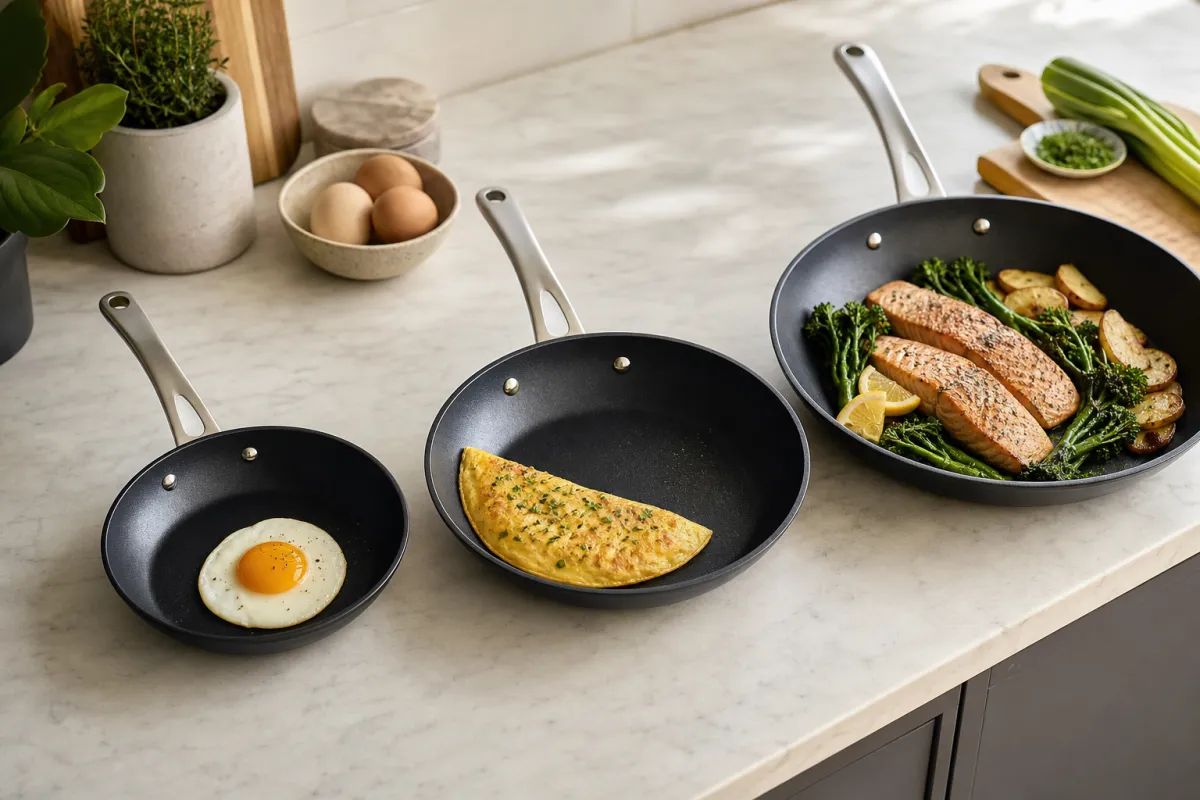
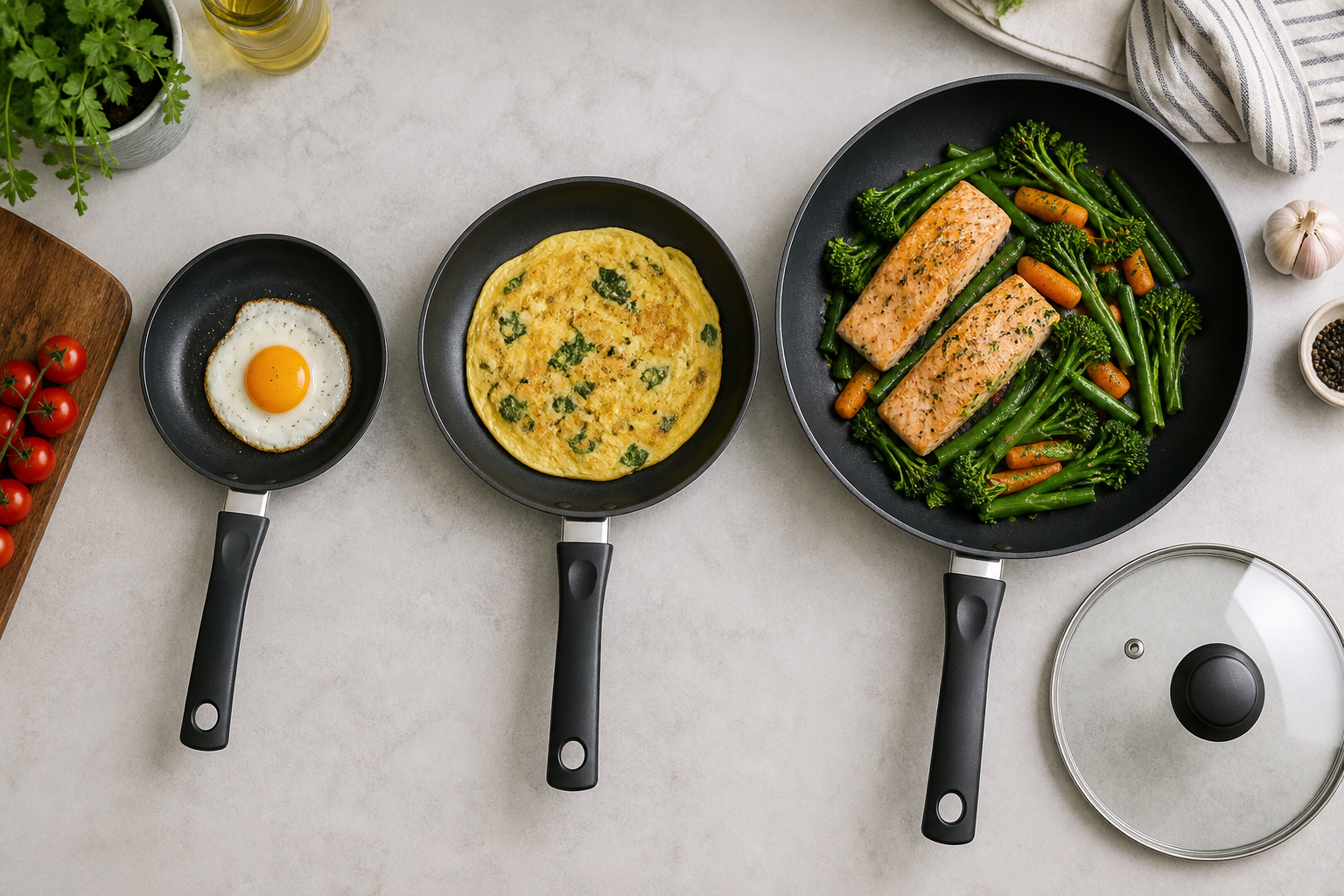 The smallest pan suits single portions, the middle pan is the everyday all-rounder, and the largest pan gives food more room to brown.
If you are replacing your main pan, use this table as a starting point rather than a rule. A shallow 28cm pan can feel manageable; a deep, thick-based 28cm pan may feel like a small saute pan once it is full.
When 20cm is enough
A 20cm non-stick pan is not just a miniature pan for people with tiny kitchens. It is genuinely useful when you often cook one small thing and want fast heat-up, easy washing and simple storage.
Choose 20cm if breakfast is the main job. It is a sensible size for one fried egg, a small omelette, a single pancake or warming a small portion without leaving a large pan half empty.
It also suits buyers who already own larger stainless steel or cast-iron cookware and only want non-stick for delicate foods. If you rarely cook more than one portion in non-stick, a smaller pan can be cheaper, lighter and less annoying to care for.
The drawback is crowding. Once food overlaps, it traps steam and browns less evenly. A 20cm pan can make sense as a second pan, but it is usually too limiting as the only frying pan in a busy household.
Why 24cm is the safest single-pan size
A 24cm pan is the most forgiving single size because it handles small meals without feeling ridiculous and still gives enough space for a proper two-person meal. It is usually easier to lift than a large pan and fits more cupboards, drawers and sinks.
If you are buying one non-stick frying pan and you are unsure, start at 24cm. It covers the widest set of everyday jobs without pushing you into the weight and storage compromises of a large pan.
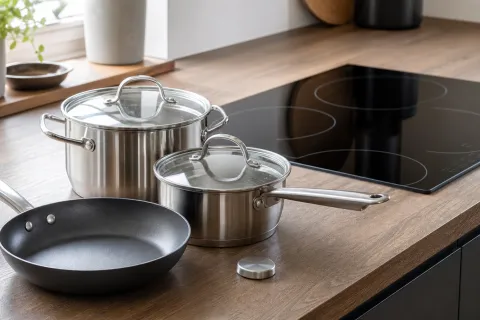
It is also a useful size for mixed cookware cupboards. A 24cm non-stick pan can handle eggs, pancakes and delicate fish while your saucepan set handles boiling pasta, simmering sauces and cooking vegetables with a lid.
When 28cm is worth the extra space
A 28cm frying pan earns its keep when surface area is the point. If you want to cook four portions of vegetables, sear several pieces of chicken, make larger pancakes or avoid batch cooking in two rounds, the bigger pan can save time.
The extra space is not free. A larger non-stick pan can feel awkward once it has food in it, especially if the handle is long or the base is heavy. It can also overhang a small hob ring, leaving the outside cooler than the centre. If you use an induction hob, which heats through a magnetic pan base, check that the pan base suits your hob zone rather than judging by the rim diameter alone.
For family cooking, 28cm can be the right main pan. For a small flat, narrow cupboard or single-person kitchen, it can become the pan you avoid because it is a nuisance to wash and store.
Do you need more than one frying pan?
Two non-stick pans are useful only when they do different jobs. A 20cm and 28cm pairing makes sense if you cook small breakfasts but also want a larger pan for family meals. A 24cm and 28cm pairing works if you often cook two parts of a meal at once.
- Best one-pan setup: 24cm for most buyers.
- Best compact two-pan setup: 20cm plus 24cm if you cook mostly for one or two.
- Best family two-pan setup: 24cm plus 28cm if bigger evening meals are common.
Try not to buy a three-pan bundle just because the price looks attractive. If the smallest pan is too tiny and the largest pan is too awkward, the middle one may end up doing nearly all the work.
Storage, weight and lids can change the answer
Pan size affects more than what fits in the cooking surface. A larger pan takes more cupboard width, needs more sink space and may not sit neatly with your existing lids. It is also easier to damage non-stick coating if several pans are stacked tightly without protection.
Weight matters because frying pans are moved more than saucepans. You lift them to swirl batter, slide food out, shake vegetables and carry them to the sink. If a 28cm pan feels heavy when empty, it will feel worse when it is full.
Lids are worth checking before you buy. Many frying pans are sold without one, and a matching lid can be surprisingly useful for steam-frying vegetables, melting cheese or finishing food gently. If you already own a lid that fits, that may make a lidless pan more practical. If not, universal pan lids* can be a simple way to add that flexibility without buying a whole new pan set.
Where saucepan sets fit
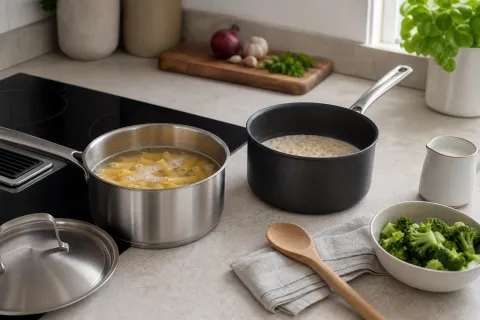
A frying pan is not a replacement for a saucepan. If you need lids, depth and controlled simmering, a saucepan set may solve the real problem better than another non-stick skillet.
Use a frying pan for foods that benefit from direct surface contact: eggs, pancakes, fish, bacon, burgers, halloumi and vegetables that need browning. Use saucepans for boiling, steaming, reheating soup, cooking grains and making sauces where depth and a fitted lid matter more than a broad flat base.
If your cookware cupboard is sparse, it may be better to buy one good 24cm non-stick frying pan and put the rest of the budget into a practical saucepan set. If you already have covered pans, focus your frying-pan budget on the size you will genuinely use most. For pan-specific shortlists, start with Product Inspector's non-stick frying pan guide.
Choose the pan you will actually lift, store and use
For most people, the sensible answer is simple: choose 24cm as the everyday non-stick pan, add 20cm if you cook small breakfasts often, and move up to 28cm only when you regularly need the extra surface area.
The best size is not the biggest pan you can fit on the hob. It is the pan that makes your normal meals easier without becoming heavy, awkward to clean or annoying to store.
Sources and checks
These checks are useful if you want to compare pan materials, hob compatibility, lids and handles before ordering.
- John Lewis cookware buying guide: compare UK retailer guidance on cookware materials, hob suitability, lids, handles and care points before choosing a pan or set.