In this article
A wine fridge is worth it when you keep more bottles than a normal fridge can handle, want wine ready at different serving temperatures, or need a stable place for bottles that will stay unopened for months. It is much harder to justify for a few everyday bottles bought shortly before drinking.
The real benefit is controlled, repeatable storage. A dedicated cabinet keeps wine away from the warmer conditions and daily temperature swings common in kitchens, sheds and spare rooms. What it does not do is improve an ordinary bottle simply by chilling it, nor does every household need separate zones for red and white wine.
Run four tests before looking at models
Stock: do you regularly have at least a shelf or two of bottles waiting to be opened?
Time: will some of those bottles remain at home for several months rather than several days?
Conditions: is your current storage warm, brightly lit or prone to noticeable temperature changes?
Space: can you give a permanently running appliance the correct measured and ventilated position?
Three or four confident yes answers point to a useful specialist appliance. One yes usually means a normal fridge and a cool, dark cupboard can divide the work more economically.
Already know your current storage is not good enough?
Compare our best wine fridges when you are ready to choose between compact, dual-zone, freestanding and built-under cabinets.
Decide whether you need storage or serving convenience
Long-term storage and ready-to-pour temperature are related, but they are not the same job. For steady maturation, The Wine Society recommends a cool environment around 10-13C and warns against places with large daily changes. A single-zone cabinet can provide that consistent home for red, white and sparkling bottles together.
Serving preferences cover a wider range. Many white and sparkling wines are enjoyed cooler than many reds, so a second independently controlled zone lets two groups wait at different temperatures. That is convenient when you entertain often or want several styles ready without moving bottles into a food fridge before serving.
One stable zone is enough for storage. Two zones are mainly worth paying for when ready-to-serve temperatures are part of your routine.
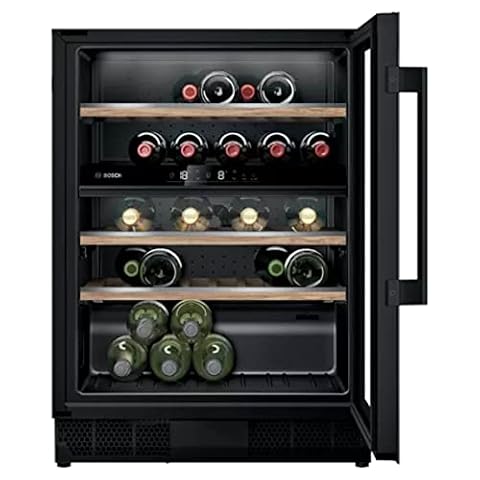
Do not choose a dual-zone model from the label alone. Check the usable capacity of each zone, its permitted temperature range and whether the divider genuinely matches the mix you keep. A small upper compartment can become awkward if most of your bottles need the other setting.
Headline bottle capacity is a best-case comparison
Manufacturers normally state capacity using standard 75 cl Bordeaux bottles arranged in a specified pattern. Real collections also contain wider Burgundy bottles, long-necked Riesling bottles, Champagne bottles, magnums and gift boxes. Those shapes can reduce usable capacity or require a shelf to be moved.
A nominal 44-bottle cabinet may be the right size for a much smaller mixed collection if you want easy label visibility and do not want to restack several bottles whenever one is removed. Before buying, count what you actually own and note the widest and tallest shapes.
Inspect the shelf layout as carefully as the total:
fully extending shelves make bottles at the back easier to reach;
closely spaced fixed shelves may maximise the test capacity but restrict wider bottles;
wooden shelves can reduce clatter, but their load and finish still matter;
a display shelf looks attractive but normally sacrifices efficient storage;
removing shelves creates flexibility while lowering the honest bottle count.
Measure the appliance in use, not just the empty gap
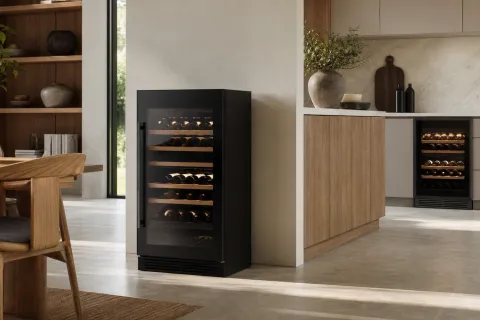
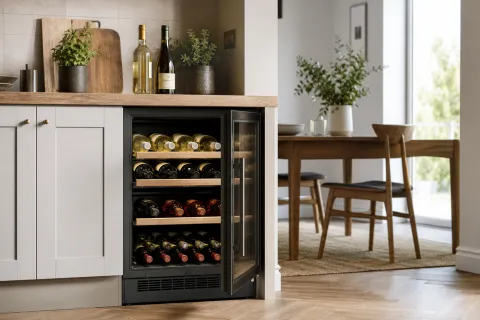
A wine fridge needs more than a rectangle of floor or cabinet space. Freestanding models require the clearances stated in their manual, while built-under designs depend on a correctly sized niche and unobstructed ventilation, often at the front plinth. These formats are not interchangeable simply because their external dimensions look similar.
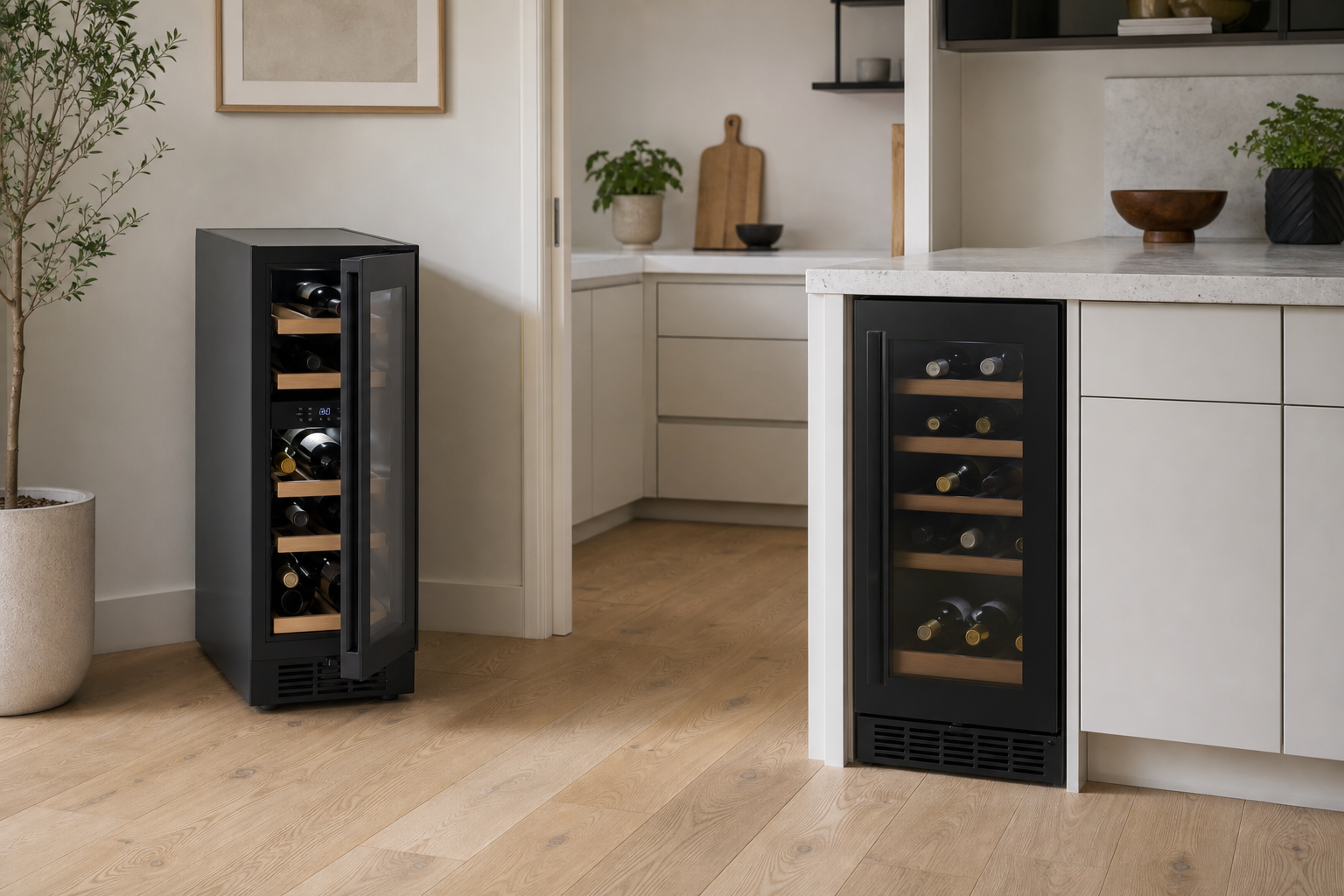 Freestanding and built-under cabinets need different installation checks: allow for the door and shelves to open, and keep every model's specified ventilation path clear.
Add the door handle, hinge side and full opening arc to your measurements. Shelves may not pull out properly if the door hits a wall, island or adjacent handle. Include the plug and cable route, levelling feet, skirting boards and the extra depth of a door that sits proud of surrounding cabinets.
Ambient conditions matter too. Check the model's climate class and operating-temperature limits before placing it in a cold garage, conservatory or outbuilding. Avoid direct sunlight and nearby ovens, radiators or other heat sources. A compressor working against a hot room is likely to cycle more often and use more energy.
Noise matters more in an open-plan room
Wine fridges contain a compressor, fan or both. Even a model with a modest published decibel figure will not be silent: it can hum while cooling, move air through the cabinet and make small clicks as controls switch. The pattern is more noticeable late at night than it is during a busy meal.
Current UK manufacturer examples publish figures around the high 30s in dB(A), but compare like with like and remember that installation affects what you hear. An uneven floor, bottles touching, a shelf that is not seated correctly or a cabinet panel that resonates can make a quiet specification sound less convincing in practice.
If the appliance will sit beside a dining table, sofa, home-working desk or bedroom wall, prioritise the declared noise level and a stable installation over app controls or decorative lighting. Reviews can help identify irritating sound character, but they cannot reproduce the acoustics of your room.
Use annual kWh to estimate the running cost
Energy classes are useful for comparing similar appliances, but the annual energy consumption on the product sheet gives the clearer household calculation. Multiply the stated kWh per year by the electricity unit rate on your tariff.
Annual running cost = annual kWh x electricity price per kWh.
For example, a cabinet rated at 130 kWh a year costs about £32.50 a year at 25p per kWh. A 152 kWh model costs about £38 at the same illustrative rate. Your result will differ with the appliance, room temperature, door opening, selected temperature and tariff, so use the current rate from your own bill rather than treating either figure as a promise.
The standing charge should not be added to this appliance calculation because you pay it for the household supply whether or not you own a wine fridge. The useful comparison is the extra electricity consumed by the cabinet.
A normal fridge is enough for short-term chilling
If you buy one or two bottles for the coming week, a food fridge handles the final chill without another appliance. Reds that need a slight cool-down can spend a shorter period inside before serving, while a dark cupboard in a stable, cool part of the home can hold everyday unopened bottles.
A normal fridge becomes less convincing as long-term storage. It is designed around food, commonly runs colder than a wine-storage cabinet and is opened frequently. Space is shared with strongly scented ingredients and bottles compete with normal groceries. The Wine Society also cautions that lengthy food-fridge storage can harden corks.
Before buying a cabinet, monitor the place you already use. A simple room thermometer can show whether the temperature remains reasonably cool and steady across the day. If it does, and bottles turn over quickly, specialist refrigeration may solve no meaningful problem.
Which households get genuine value?
| Household pattern | Likely answer | Reason |
|---|---|---|
| A growing mixed collection | Wine fridge | Stable storage and organised access become useful every day |
| Frequent red, white and sparkling entertaining | Dual-zone may be worthwhile | Two serving-temperature groups can stay ready together |
| Long-term storage at one steady temperature | Single-zone is often sufficient | More usable space and simpler control may beat a divided cabinet |
| A few supermarket bottles for the weekend | Normal fridge and cupboard | Short turnover does not justify another permanent appliance |
| A hot kitchen with no suitable cool storage | Wine fridge | Temperature stability solves a real environmental problem |
Five buying checks prevent expensive mistakes
Count real bottles: base capacity on your mix of shapes, not only the Bordeaux-bottle headline.
Choose zones for a job: pay for two only when separate serving temperatures will be used regularly.
Measure operation: include ventilation, door swing, shelf extension, plug and surrounding heat sources.
Calculate energy: multiply annual kWh by your own electricity unit rate.
Listen to the room: treat compressor and fan noise as a living-space decision, not a footnote.
Verdict: worth it when stable storage has a purpose
A wine fridge is a worthwhile specialist appliance for a collection that turns over slowly, a home without naturally cool storage, or a household that regularly wants different styles ready to serve. It provides control, organisation and capacity that a crowded food fridge cannot.
For long-term storage, a well-sized single-zone cabinet is often the most rational choice. A dual-zone model earns its extra complexity when mixed serving temperatures are used often, not merely because two displays look more sophisticated.
Skip the purchase when you keep only a handful of bottles and drink them soon. The best value comes from solving a repeated storage problem. If the cabinet would mainly fill an empty kitchen gap, the running cost, hum and lost cupboard space are difficult to defend.
Sources and checks
These UK sources help you check the storage, fitting, noise and energy details that determine whether a wine fridge will work in your home.
The Wine Society storage guidance: understand the value of a cool, steady environment and the limitations of long-term storage in a normal food fridge.
Bosch UK built-under wine cooler: see how a current product page presents standard-bottle capacity, zones, dimensions, noise and annual energy consumption.
Haier UK freestanding wine cooler: compare a current freestanding cabinet's bottle count, climate class, dimensions, noise and annual kWh.
Ofgem energy price-cap guidance: check current electricity unit-rate context before calculating annual running cost from the product's kWh figure.