In this article
Most households do not need a countertop ice maker. Freezer trays* are cheaper, silent and take up no worktop space, while a bag of ice is simpler for the occasional large party. A machine becomes worthwhile when you need fresh ice repeatedly, have limited freezer room and are prepared to run it ahead of demand.
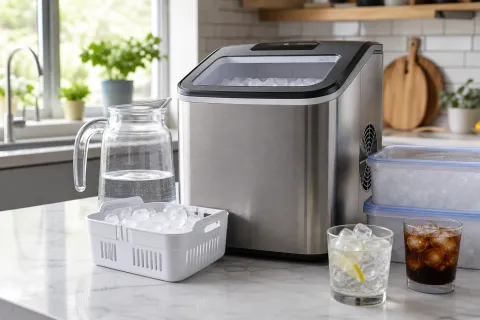
The important distinction is that a countertop ice maker makes ice quickly but usually does not keep it frozen. Its collection basket is a short-term staging area, not a substitute for a freezer. If you need a full drinks cooler or several kilograms ready at once, you must transfer batches to an insulated container or freezer as they are made.
Start with the problem you are actually trying to solve
| Your situation | Likely best answer | Why |
|---|---|---|
| Iced drinks most days | Countertop ice maker | Repeat batches remove the need to refill and empty several trays continually |
| Regular summer entertaining | Countertop machine, run in advance | It can build a supply through the afternoon, provided each batch is transferred |
| One or two drinks in the evening | Freezer trays | The freezer stores the finished ice without compressor noise, cleaning or another appliance |
| A few large parties each year | Bagged ice | You receive the whole quantity at once and avoid year-round storage of a specialist machine |
| Caravan with mains hook-up | Possibly a compact machine | It can save freezer space, but only after checking power, ventilation, transport and campsite rules |
Already know repeat batches would help?
Compare our best ice cube makers for compact models, faster production and features that make regular cleaning easier.
Fast first ice is not the same as a ready party supply
Many domestic machines form a small batch of hollow bullet-shaped ice in roughly 6-12 minutes. That sounds almost instant beside a freezer tray, but a typical batch may contain only nine pieces. The first cycles can also be smaller or slower while the machine and water cool down.
A headline such as 12 kg in 24 hours describes sustained production under the manufacturer's test conditions. It does not mean the machine holds 12 kg. Domestic collection baskets commonly hold only a fraction of that amount, and production pauses when the basket sensor says it is full.
For a gathering, work backwards from serving time:
start the machine early enough to cool down and complete several cycles;
move finished batches into an insulated ice bucket or freezer container;
keep the basket sensor clear so production can continue;
allow extra time in a warm room, where ice forms and melts less favourably;
do not expect a domestic machine to fill a large party cooler at the last minute.
Buy for the quantity you need at one moment, not the biggest 24-hour figure on the box.
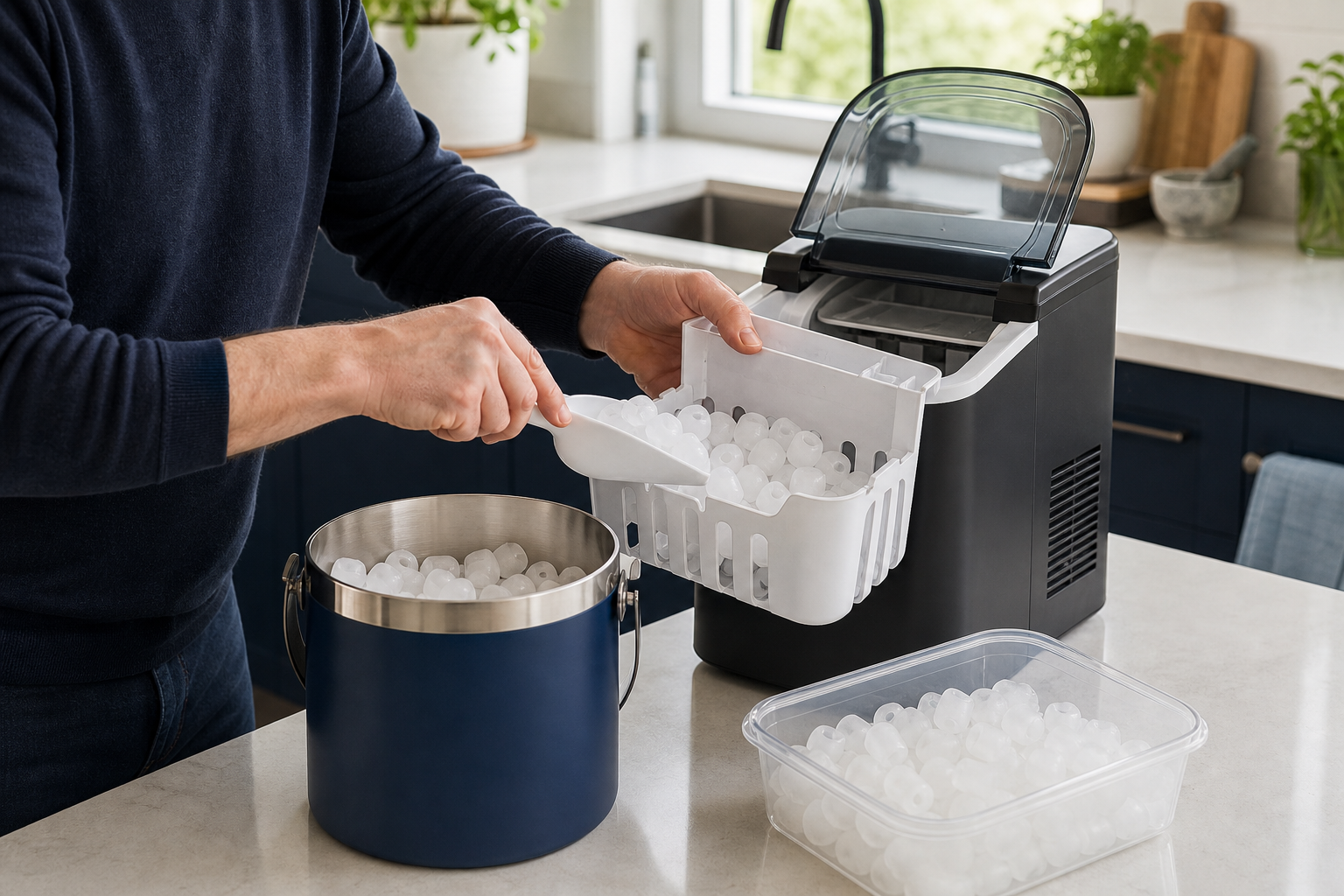 Plan where each batch will go. The collection basket is a staging point, so party quantities need regular transfer to an insulated bucket or freezer.
The basket is not a freezer
Countertop machines are designed to freeze water around chilled metal fingers, release the pieces and repeat. Most do not refrigerate the collection basket like a freezer compartment. Ice left inside gradually softens and melts; on many designs the water returns to the reservoir and is made into a later batch.
That recycling is convenient, but it does not give you permanent storage. Pieces can wet together, lose their shape or bridge into a clump before serving. If you transfer soft bullet ice straight into a freezer, spread it in a shallow container or bag and separate it as it firms so that it does not become one solid block.
This is also why basket capacity matters more than it first appears. A small basket is fine when someone is nearby to empty it. It is less useful when you hoped to switch the machine on, leave the house and return to a day's production.
Bullet ice is quick and practical, not the hardest cocktail ice
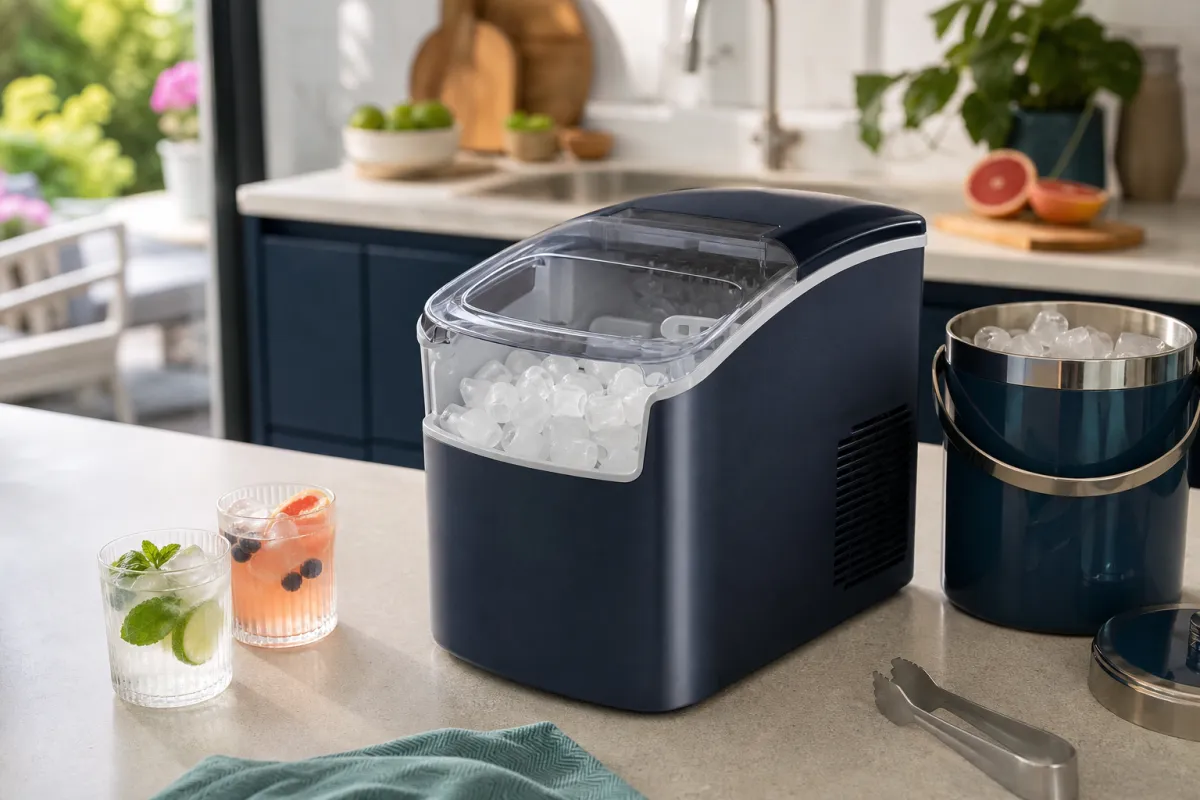
Most compact machines make rounded, hollow bullets rather than dense freezer cubes. Their large surface area helps them form quickly and makes them easy to scoop into water, soft drinks and iced coffee. The trade-off is faster melting, particularly when the first batches are thin or the drink starts warm.
For everyday cold drinks, that is usually acceptable. For slow-sipping spirits or cocktails where dilution matters, large solid freezer cubes may perform better. Clear-cube machines and nugget-ice machines are different formats with different prices, cleaning routines and output, so do not assume every product listed as an ice maker produces the same texture.
Measure the operating space, not just the machine
A compact product photograph can hide the clearance a compressor needs. The machine must sit level on a stable surface with its ventilation openings unobstructed. One Lakeland manual specifies 150 mm around its model; the correct distance for any purchase is the one in that model's instructions.
Add room above the lid, space to lift out the basket, access to the drain and somewhere to place a wet scoop. Check the full depth with the cable rather than measuring only the cabinet. If the machine has to be dragged from a cupboard for every use, its filled weight and the need to keep it upright become part of the buying decision.
Compressor, fan, water pump and falling ice all make sound. Some models publish a decibel figure, but the pattern matters as much as the number: a low hum interrupted by water movement and pieces dropping into a plastic basket is more noticeable in a quiet kitchen than at a party. Avoid placing it beside a desk, bed or dining seat if repeated cycling will irritate you.
Cleaning is the price of convenient ice
Water sits in the reservoir, passes through internal channels and touches surfaces you cannot always remove. A self-clean programme can circulate water around part of that path, but it does not remove the need to wash the basket and scoop, wipe accessible food-contact surfaces, drain old water and let the machine dry.
Before buying, read the cleaning section of the manual rather than relying on a self-clean badge. Check:
whether the drain is accessible without lifting a full machine over the sink;
which cleaning solution, if any, the manufacturer permits;
whether the basket and scoop can be removed and washed easily;
how scale should be treated in a hard-water area;
how the reservoir and internals are dried before storage;
whether a long idle period requires a cleaning cycle before the next use.
Use fresh drinking water and clean the machine with the plug disconnected as instructed. Do not reach into the mechanism or improvise with strong acidic or abrasive cleaners. A machine that is awkward to drain and dry is a poor seasonal purchase, however impressive its output.
Caravan and camping use needs more than a carrying handle
A compact ice maker can make sense in a caravan or holiday home because freezer space is scarce and cold drinks are frequent. Portability in a listing does not automatically mean the appliance is suitable for every pitch, awning or off-grid setup.
Check the input wattage on the rating plate and count it with every other appliance using the hook-up. UK campsite supplies vary, and the total load matters. Use the caravan's proper mains installation and suitable hook-up equipment rather than running an improvised lead through a window. The Caravan and Motorhome Club advises checking the site's current limit and fully unwinding the hook-up cable.
Keep a mains ice maker indoors in a dry, ventilated position unless its instructions explicitly permit another environment. After transport, compressor appliances commonly need to stand upright before switching on; the exact settling period is model-specific. Off-grid battery or inverter use needs a separate calculation that includes compressor start-up demand, not just the average wattage printed in a product table.
Freezer trays and bagged ice remain strong alternatives
| Option | Best at | Main weakness |
|---|---|---|
| Silicone or lidded freezer trays | Small daily quantities, solid cubes and silent storage | Slow refill cycle and permanent demand for level freezer space |
| Bagged ice | Large occasional quantities available at once | Needs transport and enough freezer or cooler capacity |
| Countertop ice maker | Repeated same-day batches with little freezer-tray space | Worktop space, noise, cleaning and no true frozen storage |
A useful compromise is to improve the tray system first. Lidded stackable trays prevent spills, release more cleanly and let you build a reserve in a freezer bag. If that still cannot keep up with a measured week of drinks, a machine is solving a real capacity problem rather than an imagined one.
Take four measurements before spending
Peak ice: count how much you need at the busiest moment, not across a whole day.
Production window: decide how many hours you can realistically run and empty the machine before serving.
Operating footprint: measure the worktop with ventilation, lid, basket, scoop, cable and drain access included.
Use frequency: record how often trays or bought ice fail you over a month, including outside summer.
If the peak quantity can be built during the available window, the measured footprint has a permanent home and the problem recurs several times a week, a countertop machine is likely to earn its space. If any of those answers depends on a party that happens twice a year, buy the ice when you need it.
Verdict: useful for a recurring supply problem
Buy a countertop ice maker when ice is part of your routine, not merely part of summer. It suits households making frequent iced coffees and cold drinks, regular hosts who can run it before guests arrive, and caravans or small kitchens where freezer trays consume scarce space.
Skip it when you want a silent appliance, hard slow-melting cubes, unattended frozen storage or a party-sized quantity immediately. Freezer trays cover modest daily needs more neatly, and bagged ice remains the efficient answer to occasional volume.
The best machine will not be the one with the boldest daily output. It will be the one whose batch rate, basket, cleaning routine and measured operating space fit the way you will actually use it.
Sources and checks
These UK sources help you verify the output, setup, cleaning and power details that vary between ice makers.
Klarstein UK countertop ice maker: compare a current model's cycle time, pieces per batch, daily output, basket, tank and dimensions.
Lakeland ice maker instruction manual: see the model-specific checks for ventilation clearance, settling after transport, first batches, cleaning, draining and dry storage.
Electrical Safety First kitchen guidance: check safe positioning around water, ventilation, socket loading and unplugging before cleaning.
Caravan and Motorhome Club mains guidance: check campsite current limits, total appliance load and safe hook-up practice before travelling with a mains machine.