In this article
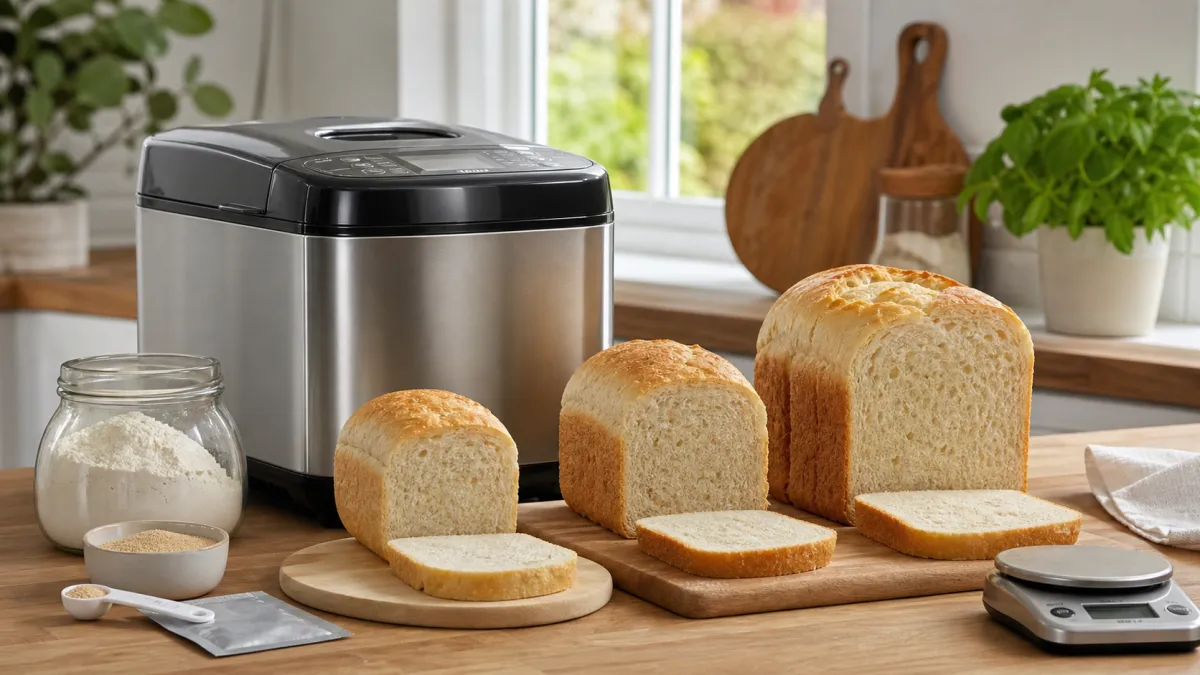
The useful breadmaker question is not whether the machine can make the biggest loaf. It is whether the loaf size, programme and ingredient routine match the way your household actually eats bread. A large machine can still disappoint if half the loaf goes stale, and a compact one can become annoying if you are baking every day for toast, lunches and weekend sandwiches.
Most shoppers see capacity labels such as 500g, 750g or 1kg and treat them as a simple ladder. In practice, those numbers are only a starting point. The shape of the pan, the recipe, the crust setting and the way you store bread all change how useful each size feels. Start with the loaf you will finish while it is still at its best, then choose programmes that support your usual routine.
Choose the loaf size by eating speed, not pride
Breadmaker loaves are usually best when they are eaten within a sensible window or sliced and frozen. If your household only eats occasional toast, a 1kg loaf can be more wasteful than generous. If bread disappears quickly at breakfast and lunch, a smaller loaf may make the machine feel like it is always running.
| Household habit | Likely best fit | What to check before buying |
|---|---|---|
| One person or light toast use | Small loaf setting, often around 500g to 600g. | Whether the machine genuinely supports a smaller loaf, not just one full-size recipe. |
| Couple or small household | Medium loaf setting, often around 750g. | Whether a medium loaf gives enough slices without leaving bread hanging around too long. |
| Family breakfasts and packed lunches | Large loaf setting, often around 900g to 1kg. | Pan size, machine footprint, slice height and whether the loaf fits your storage box or freezer bags. |
| Batch baking for the freezer | Large loaf or dough programme. | Whether you prefer machine-baked loaves or dough mixed in the breadmaker and baked in your oven. |
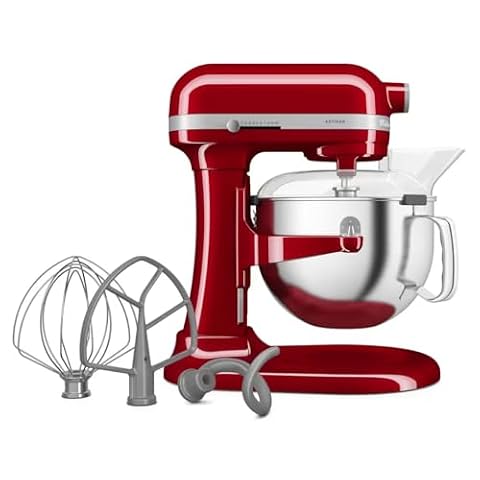
If the table already points you towards a capacity range, compare current machines in our breadmaker guide. If you bake many shapes of bread, rolls or enriched doughs rather than one everyday loaf, a stand mixer may still be the more flexible buy.
Small, medium and large settings do not all behave the same
A machine with three loaf sizes is more flexible than a single-size model, but it is not magic. The smaller setting usually adjusts the programme for a smaller recipe; it does not make the pan narrower. That can mean a smaller loaf bakes lower or differently shaped than the hero photo on the box.
That is not a problem if the bread tastes good and slices well. It is a problem if you expect bakery-style uniform slices from every setting. For everyday toast, a slightly shorter small loaf can be completely fine; for neat sandwiches, pan shape and slice height matter more.
Check the manual before you buy if loaf shape matters to you. A good manual should show recipe quantities for each size, crust settings and any programme restrictions. If the listing talks about several capacities but the manual only gives clear instructions for one, treat the flexibility claim cautiously.
Programmes matter when they change the routine
The most useful breadmaker programmes are the ones that change what you can do reliably. Basic white bread, wholemeal bread, dough and bake-only modes are usually more important than a long menu of novelty settings. Quick bread can be handy, but it often asks you to accept a different texture or a less developed loaf.
Basic white: the everyday programme for simple loaves, toast and packed lunches.
Wholemeal: useful because wholemeal dough often needs different timing from white bread.
Dough: lets the machine mix and prove while you shape rolls, pizza bases or oven-baked loaves yourself.
Bake only: helpful for finishing or custom routines, but less important if you want one-button bread.
Jam, cake and extra modes: nice to have only if you will genuinely use them and clean up afterwards.
Do not pay extra just because the programme count is high. A clear set of reliable bread and dough modes is usually better than a crowded control panel full of settings you will never trust.
Delay timers are useful, but choose recipes carefully
A delay timer is one of the most tempting breadmaker features because it promises fresh bread in the morning. It can be brilliant for simple recipes where the ingredients can sit safely in the pan before the programme starts. It is less suitable for recipes with fresh milk, eggs, cheese or other ingredients that should not sit at room temperature for hours.
The practical routine matters. Put liquids, flour, salt, sugar and yeast in the order the manual asks for, and keep the yeast away from liquid and salt until the machine starts mixing. If the yeast activates too early, the loaf can rise badly before the programme even begins.
Use the delay timer for simple loaves you have already tested during the day. Do not make the first attempt an overnight breakfast plan.
Noise is worth considering too. A breadmaker may knead, beep or release a dispenser while the house is quiet. If the machine will sit near bedrooms or an open-plan living space, check whether morning bread is worth the sound of overnight mixing.
Gluten-free programmes are about mixing and timing
A gluten-free programme is useful if someone in the household regularly bakes gluten-free bread, but it should not be treated as a guarantee of perfect results. Gluten-free dough behaves differently from ordinary wheat dough because it does not stretch and trap gas in the same way. The programme usually changes the mixing, resting and baking pattern to suit that style of loaf.
That means the recipe matters as much as the button. Use the machine's own gluten-free recipes first, weigh ingredients carefully and resist judging the programme after one improvised loaf. Texture can vary more than ordinary bread, and small changes in liquid or flour blend can make a noticeable difference.
If gluten-free bread is the main reason you are buying, check the manual before the product page. You want clear gluten-free recipes, ingredient order and any notes on loaf size, not just a single icon on the control panel.
Ingredient routine is where good loaves become repeatable
A breadmaker removes the kneading and timing, but it does not remove the need to measure properly. Bread is less forgiving than many everyday recipes because flour, water, yeast and salt need to stay in balance. A spooned cup of flour can vary a lot; a weighed amount is much easier to repeat.
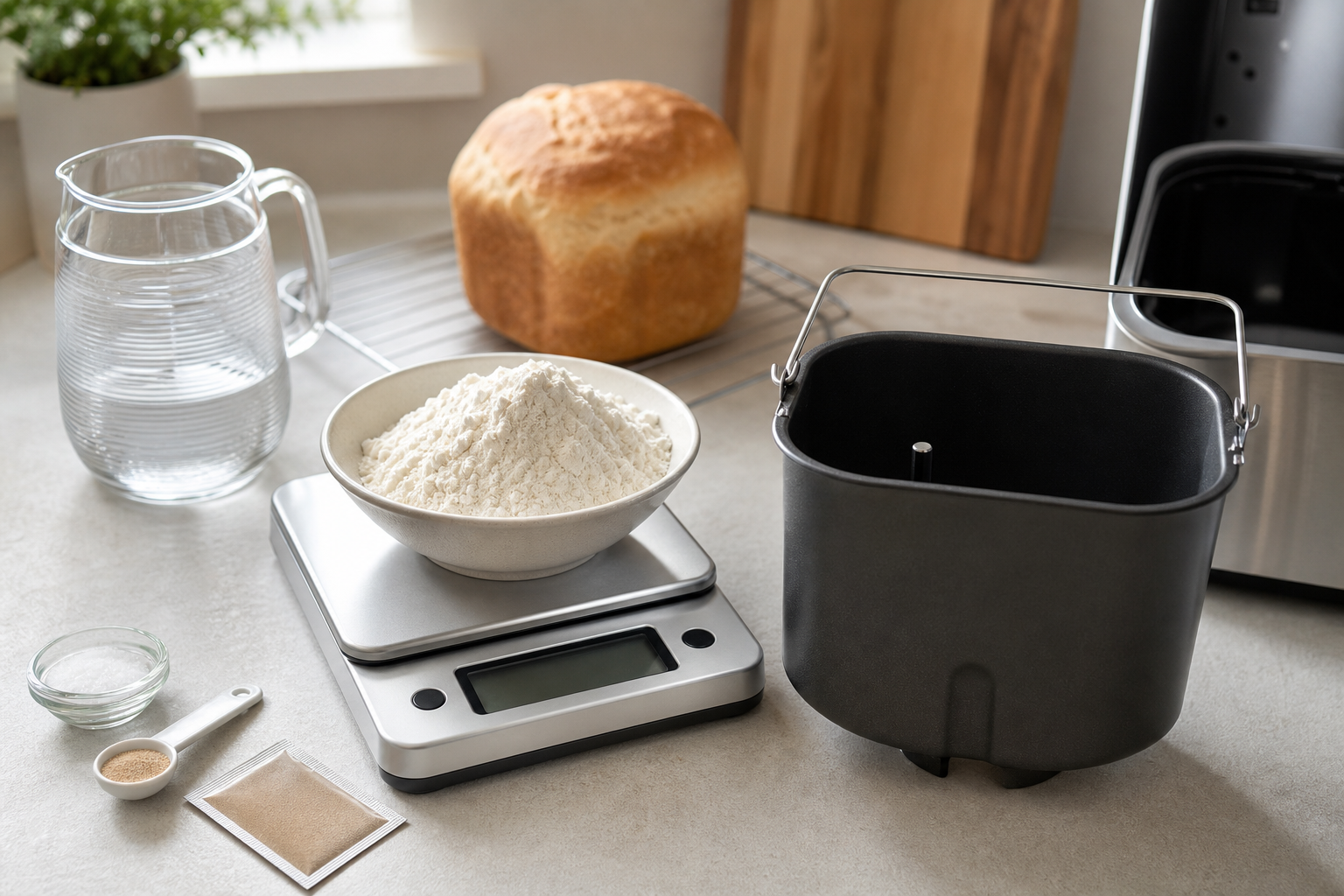
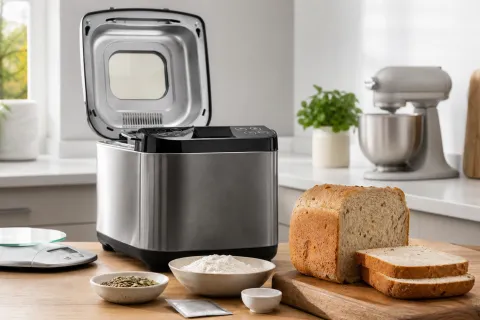
A digital scale is one of the best breadmaker accessories because it helps you repeat the same loaf without guessing. If your current scales are awkward with a mixing bowl or large bread pan, compare models in our kitchen scales guide before blaming the breadmaker.
Weigh flour and water: this gives you a repeatable starting point.
Follow the manual's order: many machines depend on ingredients being layered correctly.
Keep yeast fresh: tired yeast can make a good programme look bad.
Write down changes: if you adjust water, flour or crust level, note the result before changing something else.
Slice and store quickly: a good loaf still needs a storage plan once it has cooled.
When a stand mixer is the better answer
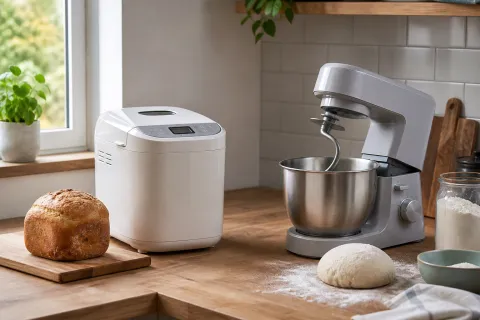
A breadmaker is strongest when you want the appliance to mix, prove and bake a regular loaf with minimal attention. It is less strong when you care about shaping, crust style, enriched dough, rolls, pizza, brioche-style bakes or using your oven for the final result.
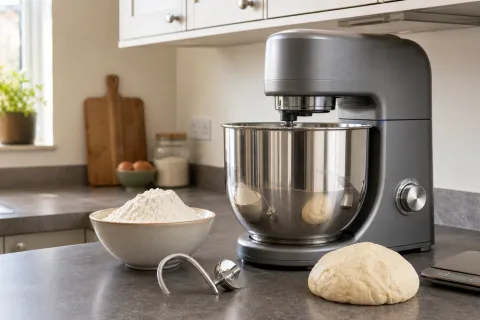
If you want breadmaking to become part of wider baking, a stand mixer can be a better long-term appliance. It will not automate the whole loaf, but it gives you more control over dough and more flexibility beyond bread. If you mainly want reliable sandwich bread with the least effort, the breadmaker remains the simpler choice.
Choose the breadmaker for routine loaves; choose the stand mixer when dough is only one part of the baking you want to do.
The settings I would prioritise
For most homes, the strongest breadmaker spec is not the longest programme list. It is a machine with the loaf size you will actually finish, a basic and wholemeal programme you trust, a dough mode, a delay timer you can use safely, and clear recipes for any gluten-free baking you need.
Pay attention to the unglamorous details: pan shape, machine footprint, recipe clarity, scale-friendly ingredients, removable parts and where the loaf will cool, slice and store. Those details decide whether the breadmaker becomes a weekly habit or a cupboard appliance.
If your household eats bread quickly and wants low-effort fresh loaves, a breadmaker with sensible size settings is a good fit. If your real ambition is varied baking, shaped loaves and dough work beyond a tin loaf, put more weight on a stand mixer and good scales.
Sources and checks
These manufacturer pages are useful when checking how real UK breadmakers describe loaf sizes, programmes, timers and dimensions before buying.
Panasonic SD-YR2540 breadmaker information: compare programme range, gluten-free modes, timer, loaf-size labels and appliance dimensions on a current UK breadmaker.
Sage Custom Loaf breadmaker details: check how another UK breadmaker presents automatic programmes, custom settings, a dispenser, collapsible paddle and machine size.