In this article
A four-slice toaster sounds like the obvious upgrade if you eat toast often, but capacity is only part of the decision. The better question is how many people need toast at the same time, what bread you buy, and how much permanent counter space you are happy to lose.
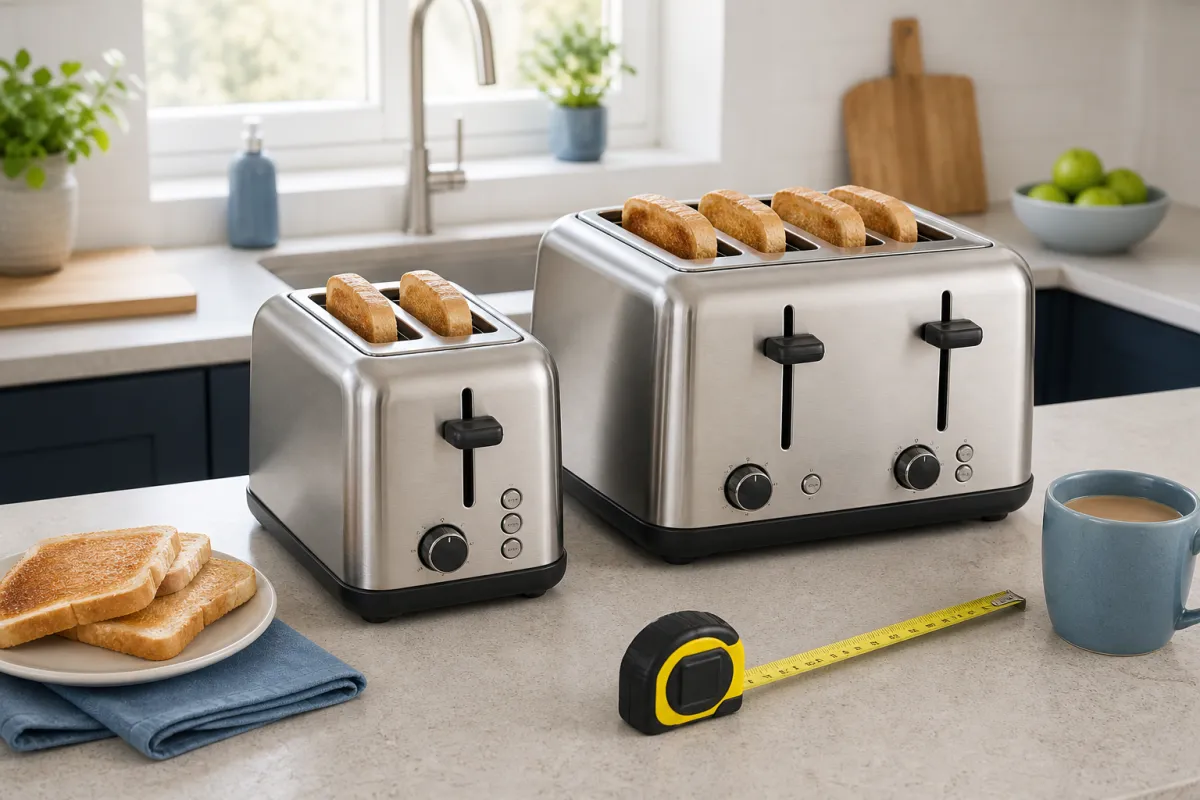
Most small households should buy a good two-slice toaster. It is cheaper, easier to store and usually enough if toast is a one-person or staggered-breakfast habit. A four-slice toaster earns its place when two or more people regularly eat together, when you batch toast for children, or when you want separate browning controls for different tastes.
The decision at a glance
| Question | Two-slice toaster | Four-slice toaster |
|---|---|---|
| Best fit | One or two people, small kitchens, occasional toast. | Families, shared breakfasts, busy mornings and batch toast. |
| Worktop space | Usually compact and easier to put away. | Wider or deeper, and more likely to live out permanently. |
| Speed | Fine for one round, slower if everyone wants toast together. | Twice the capacity when all four slots are useful. |
| Controls | One browning setting is normally enough. | Best when each pair of slots has separate controls. |
| Bread flexibility | Can be excellent if you choose a long-slot or wide-slot design. | Good for volume, but still check slot length and width. |
If you already know which size suits your kitchen, start with our best toasters guide and compare the models that match your routine.
When a two-slice toaster is the better buy
Choose a two-slice toaster if breakfast is usually staggered, you live alone or as a couple, or your kitchen already has too many permanent countertop appliances. A smaller toaster is easier to tuck into a cupboard, easier to wipe down, and less annoying in a narrow kitchen where the kettle, coffee machine and toaster all compete for the same socket corner.
A two-slice model is also the safer default when you care more about bread fit than raw capacity. A long-slot two-slice toaster can handle taller sourdough-style slices or two standard slices side by side, depending on the design. A compact four-slot toaster can still be frustrating if the slots are too short or narrow for the bread you actually buy.
Do not pay for four slots if you will mostly use two. Put the money into better slot design, clearer controls and easier cleaning instead.
When four slices are worth the space
A four-slice toaster makes sense when the bottleneck is time. If two adults are making toast before work, children want breakfast together, or you regularly toast bread for bacon sandwiches, scrambled eggs or weekend breakfasts, four slots can make the appliance feel less like a queue.
The best four-slice models are not just bigger. Look for two independent control pairs, so one side can be darker, lighter, frozen or bagel-friendly without forcing every slice through the same setting. Without that split control, a four-slice toaster is mostly a larger two-slice toaster with extra slots.
Four slots can also be useful if your household has mixed bread habits: standard sliced bread on one side, bagels or crumpets on the other. But this only works if the slots are wide enough and the controls are clear enough that people do not have to guess which lever runs which side.
Check the slots before the slice count
Capacity is easy to compare; slot shape is where many poor toaster choices happen. Before choosing between two and four slices, check these details:
- Slot length: important for taller supermarket slices, sourdough and irregular loaves. Long-slot designs can be more flexible than four short slots.
- Slot width: useful for bagels, crumpets, thick toastie bread and fruit loaf. Narrow slots can squash thicker bread or toast unevenly.
- Lift height: an extra-lift lever helps smaller items come out without digging near hot slots.
- Crumb tray access: front-access trays are easier if the toaster sits under a wall cabinet or close to a splashback.
- Control labels: bagel, defrost and reheat settings are only useful if the controls are obvious on a rushed morning.
If your main frustration is that bread does not fit, a better-shaped two-slice toaster may beat a cheap four-slice model. If your frustration is waiting for the second round, choose four slots.
Think about the breakfast zone
The toaster rarely sits alone. In many UK kitchens it shares space with a kettle, coffee machine or bread bin, so measure the whole breakfast area rather than the appliance by itself. Leave room to lift bread out safely, pull the crumb tray forward, and keep packaging or tea towels away from hot sides and slots.
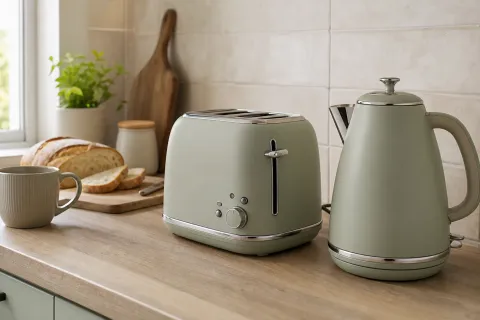
If you are replacing several appliances at once, a matching kettle and toaster set can make sense, but do not let the set decide the capacity for you. A good-looking four-slice toaster that crowds the worktop will annoy you every day; a neat two-slice model that cannot keep up with family breakfast will do the same.
The features that matter more than four slots
Once you have chosen the size, spend your attention on the everyday details. Browning consistency, clear controls and easy cleaning matter more than decorative extras.
- Separate browning controls are worth having on four-slice models if people like different toast levels.
- A cancel button should be obvious and easy to hit.
- Defrost is useful if you keep bread in the freezer.
- Bagel mode is useful only if the slots are wide enough and the toaster makes clear which side faces in.
- Removable crumb trays make cleaning easier and reduce burnt-crumb smells.
- Cord storage helps if the toaster is stored away between uses.
For compact kitchens, also look at footprint shape. Some two-slice toasters are long and narrow; some four-slice toasters are wide and shallow. The better choice is the one that fits your actual counter run, not the one that looks smallest in a product photo.
What should different households buy?
Single-person homes and compact flats
Buy a two-slice toaster unless you regularly batch toast. Prioritise a compact footprint, a crumb tray you can reach easily, and slots that fit the bread you buy most often.
Couples
A two-slice toaster is usually enough if breakfast times are staggered. Choose four slices if you often eat together, make weekend breakfasts, or both want toast hot at the same time.
Families
A four-slice toaster is usually the more practical choice. Independent controls matter here, because one pair of slots can handle lighter toast or frozen bread while the other side runs darker.
Bagel, crumpet and sourdough buyers
Do not choose by slice count first. Check slot width and length. A long-slot two-slice toaster may be the neatest answer for awkward bread, while a four-slice model is better if you need awkward bread and higher volume.
Toastie and grilled-sandwich fans
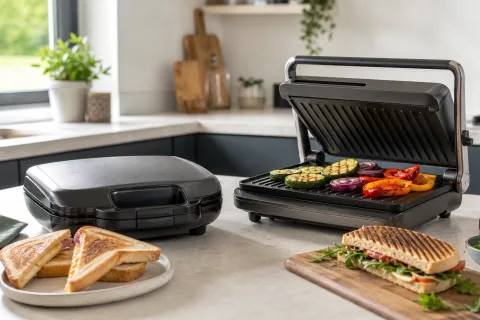
A normal toaster is not the same thing as a sandwich toaster. If filled toasties are the real goal, compare sandwich toasters separately rather than trying to make a slot toaster do the wrong job.
Verdict: buy for your routine, not one busy morning
A two-slice toaster is the right choice for most small kitchens, couples and occasional toast eaters. It saves space, costs less, and can still handle interesting bread if you choose the right slot shape.
A four-slice toaster is worth buying when your household regularly needs toast at the same time. The upgrade is most useful when it comes with independent controls, wide enough slots and cleaning access that suits where the toaster will live.
The simplest rule is this: choose two slices for space and simplicity; choose four slices for shared breakfasts and fewer queues. Then judge individual models by slot fit, controls and cleaning, because those details decide whether the toaster is pleasant to use after the first week.