A stand mixer can look like the start of an attachment collection. Pasta rollers, mincers, food-prep bowls and blender jars all promise to turn one expensive machine into a whole kitchen system. For most home cooks, that is where overspending starts.
The useful attachments are the ones that solve a baking job you already do often. The flat beater, dough hook and balloon whisk matter first. After that, an extra bowl or a well-fitting splash guard can be more valuable than a shiny specialist attachment that lives in a cupboard.
If you are still choosing the main machine, compare bowl size, working limits, included tools and stability in Product Inspector's stand mixer guide before budgeting for extras.
Start with the tools that should already earn their place
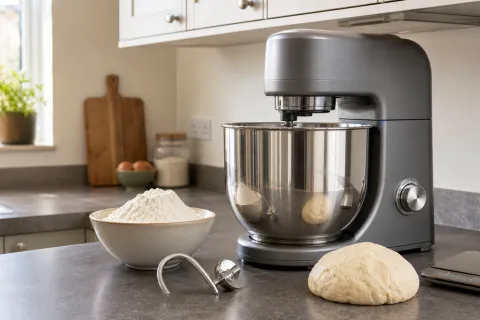
Most stand mixers are bought for mixing, whisking and kneading. A flat beater, sometimes called a K-beater on some machines, handles cake batters, biscuit doughs, buttercream and mashed mixtures. A dough hook kneads bread and enriched doughs. A balloon whisk is for airier jobs such as cream, meringue and sponge mixtures.
Those three tools are not glamorous, but they decide whether the mixer is useful every week. If they feel flimsy, hard to clean or poorly matched to the bowl, a pasta roller will not rescue the purchase.
- Flat beater or K-beater: Essential.
Best for: Cakes, biscuits, buttercream, mashed mixtures.
Think twice if: The coating looks delicate or the shape misses the bowl sides badly. - Dough hook: Essential for bread bakers.
Best for: Bread dough, pizza dough, enriched doughs.
Think twice if: You only bake occasional cakes and never knead dough. - Balloon whisk: Essential for light mixtures.
Best for: Cream, egg whites, meringue, whisked sponge.
Think twice if: You rarely make whisked recipes and already own a good hand mixer. - Flex-edge or scraper beater: Useful upgrade.
Best for: Buttercream, creamed cakes, mixtures that cling to the side.
Think twice if: It costs a lot and your standard beater already reaches the bowl well. - Extra bowl: Very useful for regular bakers.
Best for: Layer cakes, meringue plus batter, batch baking.
Think twice if: You bake one simple recipe at a time and have limited storage. - Splash guard or pouring shield: Useful but not decisive.
Best for: Floury mixtures, icing sugar, adding ingredients while mixing.
Think twice if: It is awkward to fit or blocks access to the bowl. - Pasta roller or cutter: Worth it for a real pasta habit.
Best for: Fresh pasta sheets, tagliatelle, ravioli prep.
Think twice if: You like the idea more than the routine. - Mincer or grinder: Niche.
Best for: Meat mincing, coarse breadcrumbs, some stuffing mixes.
Think twice if: You would not want to dismantle and clean it straight after use. - Food processor or blender attachment: Often a compromise.
Best for: Occasional chopping or blending when space is tight.
Think twice if: You prep vegetables, sauces or smoothies often enough to justify a separate appliance.
For capacity and small-batch questions, check our bowl size and power guide alongside the exact tool bundle.
The flat beater, dough hook and whisk matter most
A stand mixer attachment decision starts with the bundle in the box. A cheaper mixer that includes poor core tools can be less useful than a dearer one with fewer but better-made pieces. Check whether the beater and dough hook are coated, dishwasher-safe, hand-wash only, or prone to chipping if scraped against a hard bowl.
Planetary mixing simply means the tool moves around the bowl rather than spinning in one fixed spot. It helps reach more of the mixture, but you may still need to stop and scrape the bowl for buttercream, dense cake batter or small quantities.
Do not buy specialist attachments until the basic beater, hook and whisk already suit the recipes you make most.
An extra bowl is boring but often brilliant
An extra bowl is the attachment many regular bakers use more than expected. It lets you make sponge batter and frosting without washing up halfway through, hold whipped egg whites separately, or switch between dry and wet mixes when batch baking.
For cakes, meringues and weekend baking, a second bowl can beat a showier accessory. The catch is storage: stand mixer bowls are bulky, and glass bowls can be heavy. Check whether the spare bowl is genuinely compatible with your exact model and whether it stacks or stores neatly.
A flex-edge beater is useful when scraping slows you down
A flex-edge beater has a soft edge designed to wipe more of the bowl wall as it turns. It can help with buttercream, creamed cake mixtures and soft batters that otherwise need frequent scraping.
It is not a miracle tool. If you often make small quantities, very stiff doughs or mixtures that climb the tool, you may still need a spatula. It is worth considering when you bake cakes regularly, less convincing if your mixer is mostly for bread dough.

Check what is already supplied before adding anything. The Smeg SMF05 includes a flex-edge beater, while the Kenwood Titanium Chef Patissier XL has 7L and 5L bowls. The simpler KitchenAid Artisan 125 package should not be assumed to include the extra bowl and flex-edge tool found in some Artisan 175 bundles.
Cleaning rules can differ within one set. On the Ooni Halo Core, the removable bowl and tools are dishwasher-safe except for the whisk gearbox, which must be wiped clean and kept out of water. Its breaker bar belongs with the spiral dough hook, not the beater.
Pasta attachments are worth it only if fresh pasta is already your thing
Pasta rollers and cutters are some of the most tempting stand mixer extras because they feel like a proper upgrade. They can be excellent if you already make pasta by hand, want more consistent sheets, and have space to dry, cut and store the results.
The problem is that fresh pasta is a habit, not a single attachment. You need flour, eggs or water, resting time, a floured work surface, somewhere to put the sheets, and the patience to clean the rollers properly. If that sounds like a project you will enjoy, browsing stand mixer pasta attachments* can make sense once you have checked exact model compatibility. If not, the money is better kept for the mixer itself.
Mincers and grinders suit confident, specific cooks
A mincer or grinder attachment can be useful for cooks who already want to control mince texture, make burgers or sausages, or process stale bread into coarse breadcrumbs. It is less useful as a vague promise that you might cook more from scratch.
Cleaning is the real test. Meat and soft foods mean careful dismantling, washing and drying straight after use. If that chore would make you avoid the attachment, a separate mincer or a food processor may be a clearer buy.
Food processor and blender attachments are where value gets murky
Some stand mixer systems offer food processor, chopper, slicing, grating, citrus, liquidiser or blender-style attachments. They can save space if you only need occasional prep and want one motor base.
They are not automatically better value than separate appliances. A dedicated food processor usually gives you a bowl, feed tube and blade system designed around chopping, slicing and grating. A dedicated blender is usually easier to judge for liquid capacity, hot-liquid guidance, ice, smoothies and cleaning.
Choose a mixer attachment for prep only when cupboard space is tight, the attachment is clearly compatible, and the job is occasional. If you chop vegetables, make dips, blend soup or make smoothies every week, compare the separate appliance first.
Compatibility matters more than the accessory list
Stand mixer attachments are not universal. Even within one brand, bowl-lift and tilt-head machines, older ranges, power-hub formats and bowl sizes can change what fits. The safest check is the exact model code, not just the mixer colour or bowl capacity.
- Check the model code: match the attachment to the full mixer model, not just the brand.
- Check the bowl size: beaters and whisks can be bowl-specific.
- Check cleaning rules: some coated or metal parts are hand-wash only.
- Check storage: pasta rollers, bowls and processor kits take real cupboard space.
- Check the returns policy: compatibility mistakes are easier to fix when bought from a retailer with clear returns.
What I would buy first
For most home bakers, start with the best mixer bundle you can justify: sturdy bowl, flat beater, dough hook and whisk. Add an extra bowl if you bake layered cakes, meringues, frosting or several batches in one session. Add a flex-edge beater if cake batter and buttercream are your regular jobs.
Pasta rollers are worth considering for cooks who already make pasta or genuinely want that weekend ritual. Mincers, grinders and processor-style attachments should be bought only for specific repeated jobs. If the job is mainly chopping, slicing or blending, a separate food processor or blender is usually easier to choose, use and replace.
Spend on the attachment you will wash without resentment
A useful stand mixer attachment earns its space because it removes a real point of friction: kneading dough, scraping cake batter, switching bowls or rolling pasta you already want to make. An expensive nice-to-have mostly creates a new washing-up routine.
The practical order is simple: get the main mixer and core tools right, add a second bowl or scraper beater if they fit your baking, and treat pasta or prep attachments as specialist purchases. That keeps the stand mixer as a helpful baking appliance rather than an expensive storage system.
Return to our stand mixer guide to compare the complete machines and their included tools. Buy a separate accessory when a regular recipe gives it a job, rather than filling a cupboard in advance.
Sources and checks
Use the exact model’s official information to check supplied tools and the parts that need different cleaning.
- Smeg SMF05PGUK included accessories identify the flex-edge beater supplied with this exact mixer.
- Ooni Halo Core cleaning guidance and manual explain the whisk gearbox exception and correct tool use.