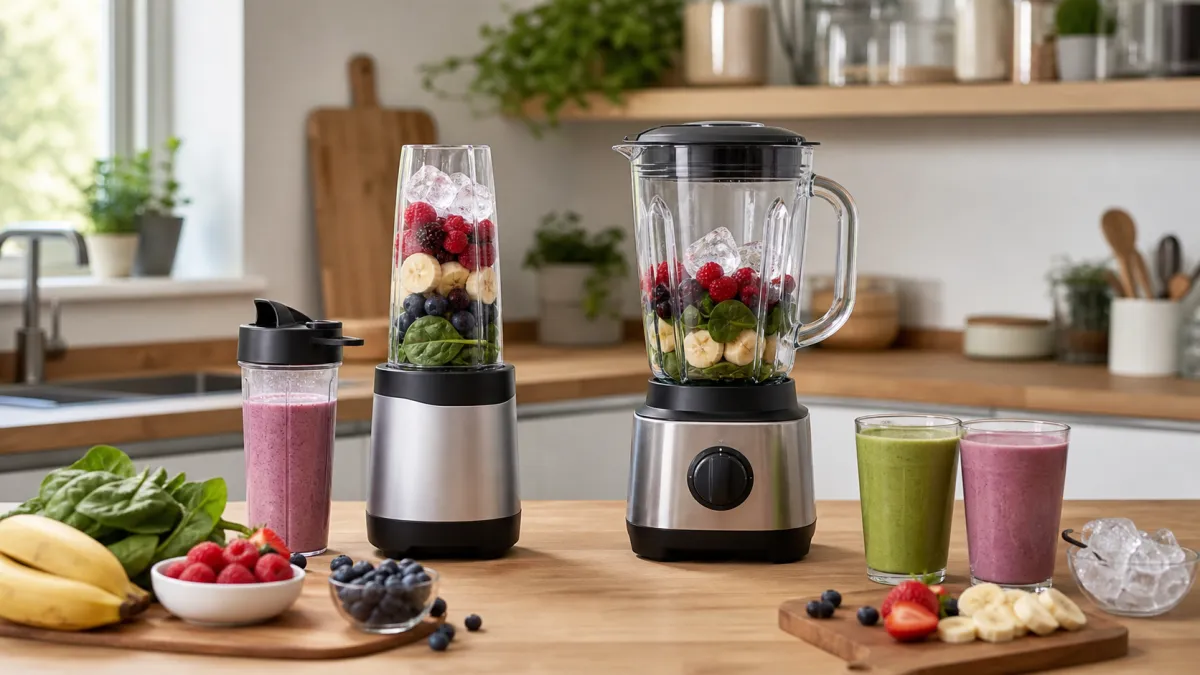
Choose a bottle blender when your normal job is one drink to take out; choose a jug when you regularly share drinks or make larger batches. Choose a specialist bowl for spoon-thick breakfasts, and a cordless model only if you need to blend away from a socket. A bigger machine is not automatically smoother, and some jug blenders include a personal cup that covers both routines.
A smoothie maker is a type of blender, usually with a bottle you blend and drink from. The buying decision is about vessel size, recipe, controls and what happens afterwards, rather than a firm divide between two technologies. Match the machine to the quantity you make and the ingredients you use.
Start with the drink you actually make
| What you want | Better first buy | Why it fits |
|---|---|---|
| One breakfast smoothie to take out | Smoothie maker | The blending cup becomes the drinking bottle, so there is less washing up and no need to decant. |
| Two or more drinks at once | Full-size blender | A larger jug gives ingredients more space and usually handles family or batch portions more comfortably. |
| Very smooth, thick drinks | A model proven for your recipe | Fine drinks and thick bowls need different circulation. Vessel shape, blade design and a suitable paddle or tamper matter more than size alone. |
| Protein shakes or simple fruit smoothies | Smoothie maker | A smaller cup is quick, tidy and sized around single servings. |
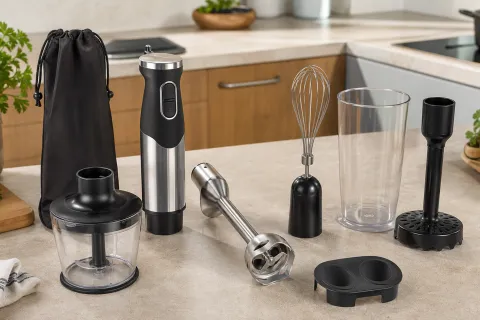
| Soup, sauces and small pan jobs | Hand blender | A stick blender works directly in a pan or beaker, but it is not as convenient as a bottle machine for travel drinks. |
| Crushed ice or frozen drinks | A blender rated for the job | Check permitted ice quantities, liquid requirements and recipe instructions on the particular model. |
Compare the right shortlist
If the table already settles it, use the relevant buying guide rather than trying to make one appliance do the other one's job. Start with smoothie makers for bottle-first daily drinks, or blenders for shared batches and different recipe formats. A hand blender is worth comparing when soups, sauces and occasional small blending jobs matter as much as smoothies.
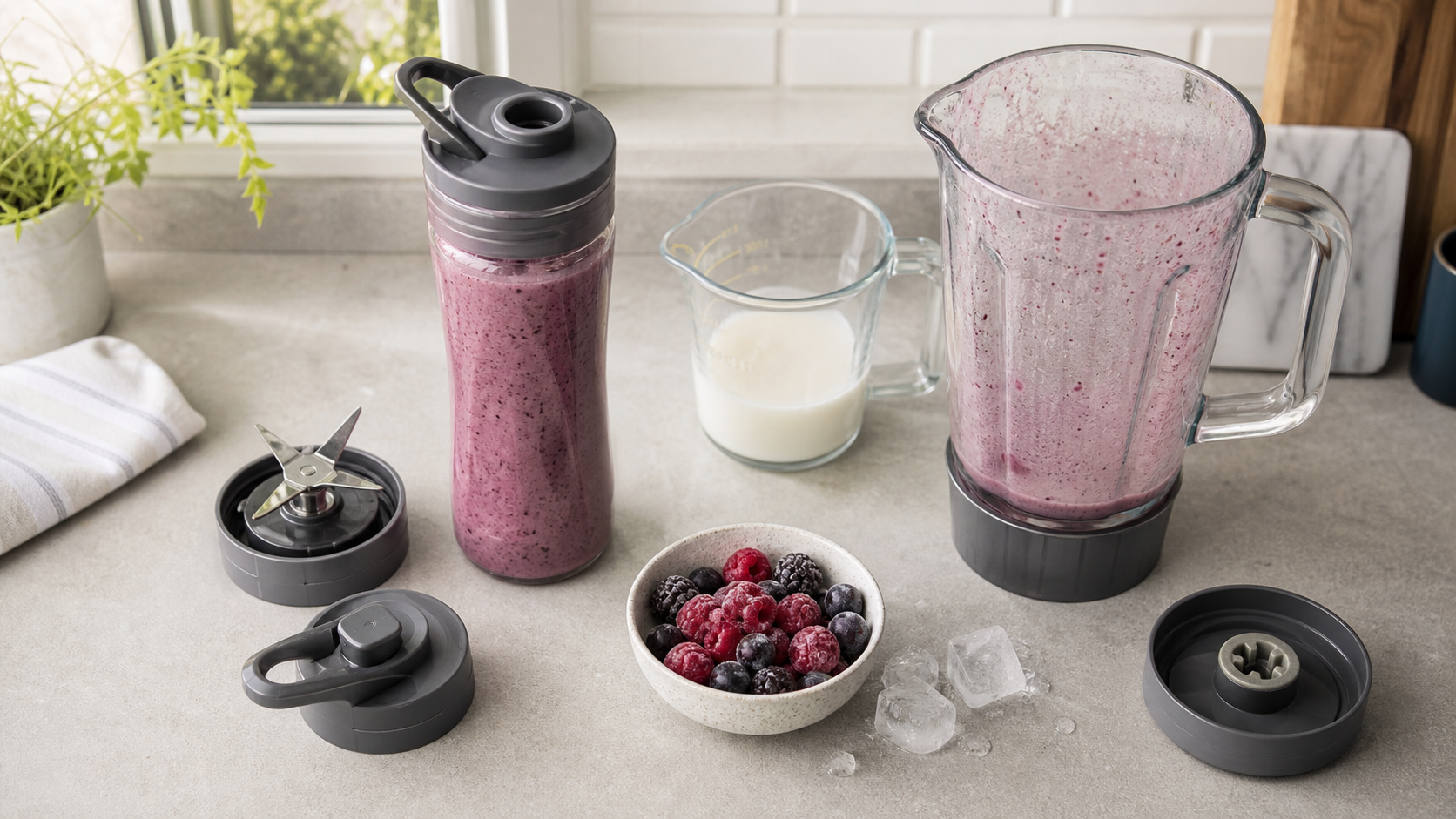
Bottle convenience, frozen ingredients, batch size and cleaning are the trade-offs that usually decide this choice.
Match texture to the vessel and recipe
A bottle blender can make good everyday smoothies when the ingredients and liquid level suit it. Salter Kuro Actifusion EK6133MBLKS is useful for fresh berries and soft fruit, but fibrous recipes can need several stages because blending stops after 30 seconds. More time is not the same as continuous running: follow the permitted cycle and rest periods. Switch off before moving the vessel or redistributing food, and unplug a mains-powered base before opening or scraping it.
A large jug helps with shared quantities, but a small portion can sit outside the useful blade path. The Ninja CB100UK takes another approach: a manually turned paddle in its 400ml bowl keeps thick mixtures moving without simply adding more liquid. It is a small-portion specialist, with loud operation and extra paddle cleaning. Buy for the result and portion you repeat, not the largest vessel.
The simplest test is this: if you usually drink it on the way out, the bottle matters. If bits, seeds or leafy texture annoy you, the model’s actual blending results matter more than the label on the box.
The bottle is the smoothie maker's real advantage
A personal blender’s bottle is often its most useful feature. Its main promise is that the cup you blend in becomes the bottle you drink from. That makes it useful for work bags, school runs, gym routines and small kitchens where you do not want a large jug on the draining board every morning.
That convenience comes with limits. Bottles are usually narrower than jugs, so ingredients need cutting smaller and loading sensibly. Put liquid in early, leave space for the blades to move the drink, and check whether the bottle, cap and blade assembly are dishwasher-safe on the model you are considering. Replacement bottles are also worth checking before you buy, because a smoothie maker is much less useful if the only bottle cracks or disappears.
A take-away bottle does not make the blender cordless. Salter blends at a socket; Ninja Blast BC151UKNV blends from a rechargeable base. Blast makes smooth single drinks in a 30-second cycle, with a 470ml maximum fill and roughly two hours needed for a full charge. Its short USB-C lead and lack of a supplied mains plug affect the charging routine. It is for cold drinks, not hot soup.
Ice and frozen fruit need a manual check
Do not assume every smoothie maker is happy with hard ice cubes or large frozen chunks. Some personal blenders are sold with ice and frozen-fruit claims, but others ask for smaller pieces, more liquid or softer ingredients. A jug blender may be the stronger choice for regular frozen drinks, but even then the manual matters: some models have an ice programme, while others restrict how much ice can be added at once.
If frozen fruit is part of your normal drink, check three things before buying: whether the model allows frozen ingredients, whether it needs added liquid first, and whether ice-crushing is a stated feature rather than a hopeful assumption.
Batch size changes the right answer
Single-serve bottles are brilliant when one person makes one drink and leaves. They are less brilliant when two people want different smoothies, or when a household wants a jug on the table. Making three drinks in a smoothie maker can mean three separate blends, three bottles, and more repeated rinsing than you expected.
A jug is useful for shared milkshakes, sauces and pancake batter. Thick smoothie bowls need a design that moves a dense mixture at the portion size you make; extra capacity alone is no advantage. The trade-off is storage and washing. A large jug takes more cupboard space and is more awkward in a small sink, even when the removable parts are technically easy to rinse.
Cleaning: fewer parts beats clever promises
The easiest appliance to clean is the one you can rinse before the smoothie dries. Smoothie makers score well here because there is no separate jug to decant from, but the blade cap, bottle threads and drinking lid still need attention. Seeds and oats can sit around seals, and a travel lid can become unpleasant if it is only given a quick splash under the tap.
A jug is another vessel and lid to wash, though a wider opening may be easier to reach. Use a cleaning programme only as its manual instructs. Do not put warm cleaning water into a sealed personal cup that prohibits it, and keep powered parts out of water. A rinse cycle still leaves seals, lids and blade areas to check after dairy, protein powder or sticky fruit.
Where a hand blender fits
A hand blender is another option when cooking matters as much as drinks. It is not as neat as a smoothie maker for taking drinks out, and it may not give the same finish as a strong jug blender. It can still make sense if you mainly blend soup in a pan, make small sauces, or want one compact tool for occasional smoothies in a beaker.
For drink-first buying, put it third. Choose a hand blender when cooking jobs matter as much as smoothies; choose a smoothie maker or blender when the drink itself is the reason you are buying.
So, which should you buy?
Buy a smoothie maker if your normal drink is a single smoothie or shake, you like the bottle format, and you want the smallest, quickest appliance you will actually use on a weekday. It is the most convenient choice, not always the most powerful one.
Buy a jug blender for shared quantities and broader blending jobs, choosing a model whose results suit your ingredients. A jug-and-cup kit can cover both family recipes and single drinks. For small thick bowls, compare a dedicated paddle bowl instead of assuming a bigger jug will be better.
Buy a hand blender if smoothies are only part of the story and you also want soups, sauces and small blending jobs with minimal storage. It is the practical compromise, not the most polished drink maker.
NHS guidance limits fruit juice, vegetable juice and smoothies to a combined 150ml a day, counting as no more than one of your 5 A Day. Have them with meals rather than between meals to reduce the risk of tooth decay. Choose bottle size for practical convenience, rather than assuming a larger daily drink is healthier.
Sources and checks
These links help you check details that can affect the buying decision before choosing a model.
- NHS 5 A Day guidance: useful for checking how smoothies and fruit juice are treated in UK portion advice.