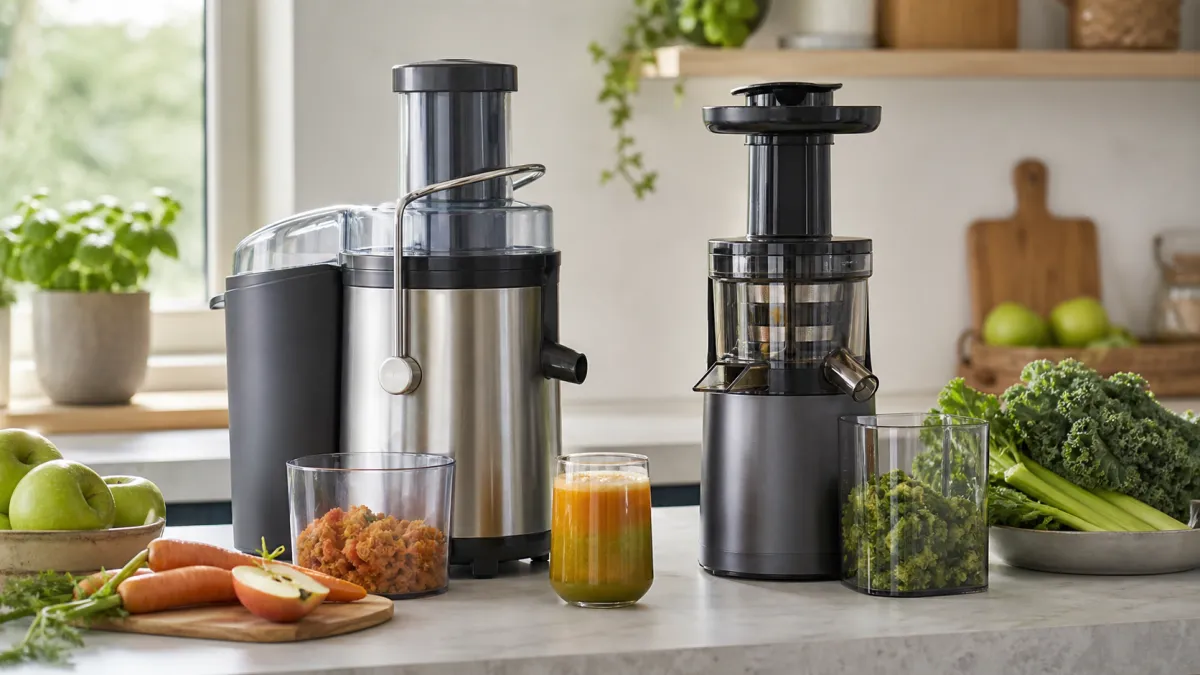
Choose a centrifugal juicer for quick fruit-led drinks and a slow juicer when leafy greens and pulp control matter more. Neither type wins on every ingredient, and neither label guarantees quiet operation or easy cleaning.
The useful comparison is the whole routine: chopping, feeding, collecting juice, emptying pulp and washing the screen. A wide-feed centrifugal machine may save preparation; a self-feeding slow juicer reduces repeated loading. Both still need cleaning after the drink.
The practical difference at a glance
A centrifugal juicer uses a fast-spinning cutting disc and mesh basket to shred produce and separate its juice. A slow juicer, also called a cold-press or masticating juicer, uses an auger: a turning screw that presses ingredients through a filter.
| What matters | Centrifugal juicer | Slow juicer |
|---|---|---|
| Speed | Usually faster for apples, carrots and other firm ingredients. | Slower extraction; a hopper can reduce time spent feeding. |
| Preparation | Many have wide chutes, though model and ingredient still matter. | Narrow-feed models need more chopping; wide-feed and hopper models can reduce it. |
| Texture | Can produce more foam; pulp and sediment vary with the filter and produce. | Often gives smoother, less foamy juice, but results vary. |
| Leafy greens | Often a weakness, particularly loose kale or spinach. | Often a better fit, without guaranteeing good extraction from every leaf or herb. |
| Noise | High-speed operation is often loud. | Can be quieter, but some motors whine and some hopper models are noisy. |
| Cleaning | Fine mesh needs prompt rinsing and brushing. | Auger, filter, seals and pulp outlet can add several cleaning jobs. |
| Storage | Allow room for the pulp bin and jug beside the body. | Tall vertical designs need clearance above the lid as well as space for cups. |
Our best juicers guide compares the actual machines. If a thick drink with the pulp kept in sounds more useful, read juicer versus blender before buying either type.
What centrifugal juicers do well
Speed and reduced chopping are the main reasons to choose one. The Nutribullet Juicer Pro combines a 76mm chute with an 800ml lidded jug. Independent testing found smooth fruit-led juice, but foam and poor kale extraction were drawbacks. It is a better fit for quick apple or carrot drinks than a routine built around greens.
For several drinks, the Sage Nutri Juicer Cold Plus pairs an 88mm chute with a 2L jug. Despite its name, it is centrifugal. Tests found straightforward controls and useful results with apples, carrots and ginger, alongside noise, bulk and weak kale performance.
Do not dismiss a smaller machine if you only make one drink. Philips Viva HR1832/01 earned particular praise for assembly and filter cleaning, while the Magic Bullet Mini supplies a 470ml lidded cup. Both are less convincing for leafy greens. The Philips jug holds 500ml; its larger processing claim does not describe the jug.
Where a slow juicer earns the extra effort
The pressing mechanism can suit mixed vegetables and leafy ingredients better than a fast basket. The Ninja JC151UK balances smooth results and two pulp filters with dishwasher-safe removable parts. Its narrow 45mm chute still asks for substantial chopping and hand feeding. Noise is model-specific: one test measured it as relatively quiet, while another found it whiny.
For frequent celery and carrot juice, the Kuvings REVO830S has separate fruit and long-vegetable feeds and good independent mixed-vegetable findings. Its high cost, tall body and hand-wash parts are harder to justify for occasional use. The cheaper Ninja is a more balanced starting point for most mixed-produce routines.
A low purchase price can shift effort back onto the user. The AMZCHEF ZM1501 has a narrow feed, no drip stop and an unlidded cup. Current parts require hand washing, and review testing found lower extraction than premium alternatives. Buy it for an inexpensive slow-juicing routine you are prepared to manage.
A hopper changes feeding, not the whole job
A self-feeding machine lets you load ingredients together instead of presenting each piece to the chute. The Cooks Professional K888 has a 1.8L hopper and smooth apple and celery results in independent testing. It is a useful value option, but stands about 44cm tall, needs hand washing and was noisier than premium rivals.
The Kuvings AUTO10S increases hopper space to 3L at a much higher price. Smooth results and a rotating screen brush are useful conveniences, but preparation, emptying and washing remain. Neither hopper figure promises that much finished juice: check the supplied collection cup separately.
Pulp is a clue, not a score
Dry-looking pulp can suggest effective extraction, but it does not establish the best drink or the best purchase. The same machine can behave differently with apple, carrot, celery, pineapple, berries and spinach. Taste, foam, clogging and the amount you actually collect all matter.
If expensive greens are your main ingredient, extraction deserves more attention than it might for an occasional apple juice. Compare useful tests of those ingredients rather than assuming every slow machine beats every centrifugal one. Alternate suitable soft and firm ingredients where the manual advises it; forcing produce into a jam does not improve yield.
Cleaning is the habit test
Rinse the screen immediately, before pulp dries into the mesh. Slow juicers can add an auger, cap, seals and pulp outlet to the washing-up; a centrifugal machine concentrates much of the work in its basket. Neither design wins automatically.
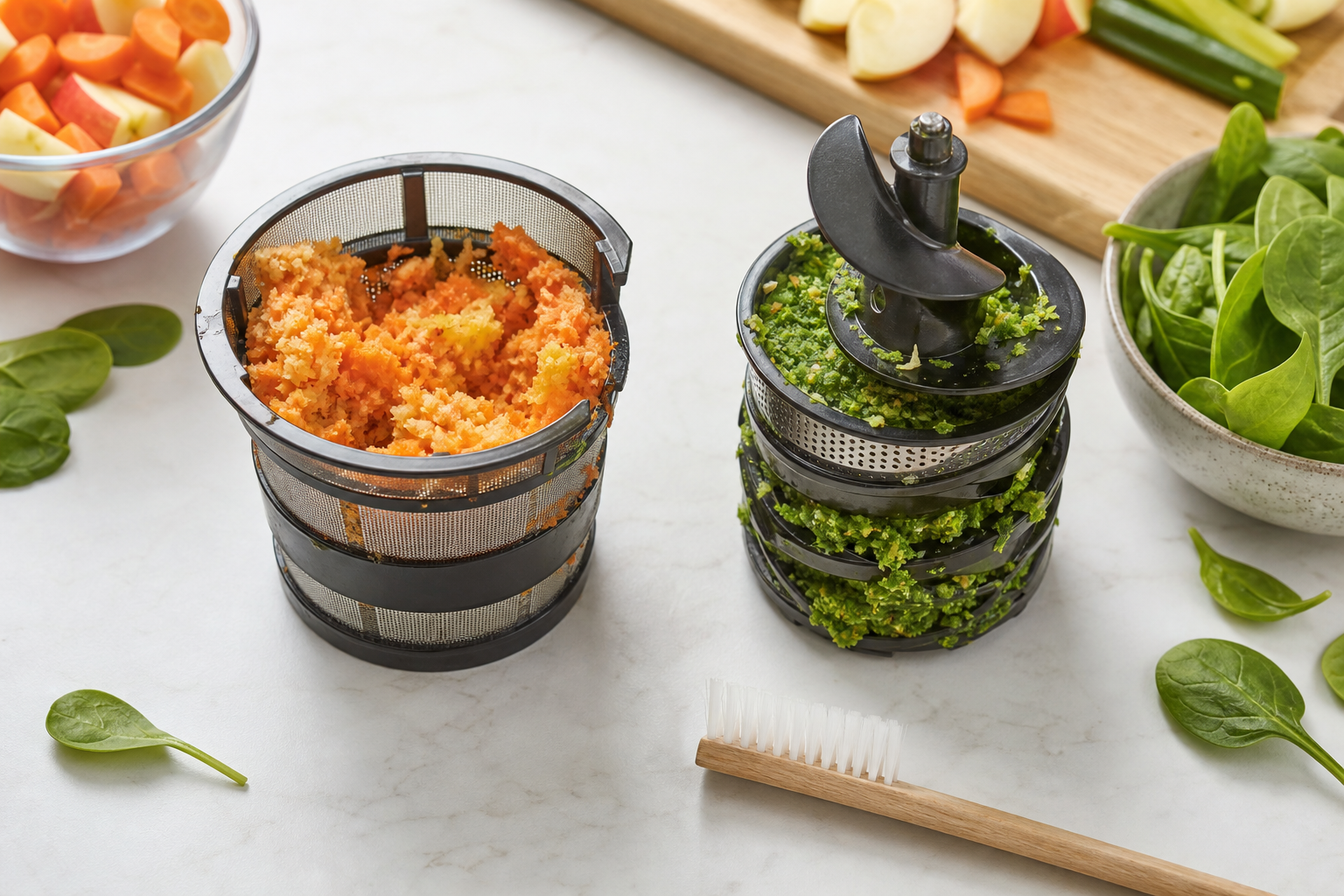 Pulp texture, mesh screens and small strainers decide how quickly a juicer cleans up after use.
Check care for the exact model and component. Ninja’s removable parts can go in the dishwasher, while the Cooks, Fridja, AMZCHEF and Kuvings models selected here require hand washing. Never immerse the motor base. A supplied brush often does the job: only consider a replacement juicer cleaning brush* if yours is missing or unsuitable, and check that it can reach the screen without damaging it.
Measure the machine you will live with
Include the pulp bin, collector and space to open the lid when measuring the worktop. Fridja’s roughly 49.6cm height is awkward beneath low cupboards, and a heavy body is less attractive if you must lift it out for every drink. Check whether large parts fit your sink as well as your cupboard.
If orange or lemon juice is the whole job, neither general type is necessary. The small Braun CJ3000 is inexpensive and simple, while the Sage Citrus Press uses an assisted arm for more comfortable repeated pressing. Both are limited to halved citrus.
Cold press is not a nutrition shortcut
Buy for ingredients, texture and convenience. The mechanism alone does not prove a meaningfully healthier drink. Juicing separates out pulp, while blending keeps prepared edible ingredients together; both can make it easy to consume fruit quickly.
NHS guidance limits fruit juice, vegetable juice and smoothies together to 150ml a day, counting as at most one of your 5 A Day, and recommends having them with meals. A larger jug is a convenience for sharing, not a recommended individual serving.
Which type should you buy?
For quick fruit-led drinks, start with a centrifugal machine sized to your household. For regular mixed-produce juice with greens, the Ninja is a useful slow-juicer starting point. Choose a hopper because less active feeding will improve your routine, and pay premium prices only when the extra convenience will get frequent use.
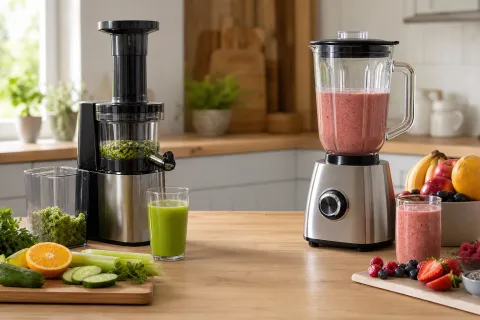
If you really want thick smoothies, compare jug blenders and smoothie makers instead. Frozen fruit, hot liquids and difficult mixtures depend on the particular appliance and vessel instructions. The right machine is the one that suits your drink and remains tolerable to prepare, clean and store.
Sources and checks
- Good Food juicer testing: practical extraction, preparation, noise and cleaning findings.
- The Guardian’s juicer comparison: ingredient-specific testing and assembly and cleaning observations.
- The Independent’s juicer tests: loading, texture and handling across compact and self-feeding models.
- NHS 5 A Day guidance: combined juice and smoothie portions.