In this article
If you are moving into halls or a shared house, the best student kitchen appliance is not always the cleverest gadget. It is the one you are allowed to use, have space to store, and will still reach for on a tired weeknight.
Start by checking your accommodation rules before buying anything with heat, exposed elements or a large plug-in power draw. Halls often provide some shared appliances, and private landlords may have their own rules about what can be used in bedrooms, kitchens and communal areas.
What is worth buying first?
For most UK students, the sensible first shop is deliberately small. Buy the daily essentials, share the bulky extras, and wait on anything that depends on your actual kitchen.
| Appliance | Student verdict | Why it earns or loses space |
|---|---|---|
| Microwave | Worth having access to | Best for leftovers, ready meals, porridge, soup, rice pouches and quick reheating. Check whether one is already provided before buying your own. |
| Kettle | Usually worth buying | Cheap, compact and used daily for drinks, instant noodles and hot-water prep. One shared kettle may be enough in a flat. |
| Toaster | Useful if allowed | Good for fast breakfasts, but some halls restrict personal toasters because they can trigger alarms or be misused outside kitchens. |
| Air fryer | Wait until you know the kitchen | Useful for cheap freezer meals and small portions, but it needs counter space, ventilation, cleaning effort and clear permission. |
| Sandwich toaster | Nice-to-have, not essential | Great for toasties, but it is single-purpose, often awkward to clean, and easy to duplicate in a shared kitchen. |
If you already know the kitchen is short on basics, start with our microwave guide or kettle guide. If the kitchen is reasonably equipped, hold back on larger gadgets until you have seen how much storage, plug space and cleaning discipline the household really has.
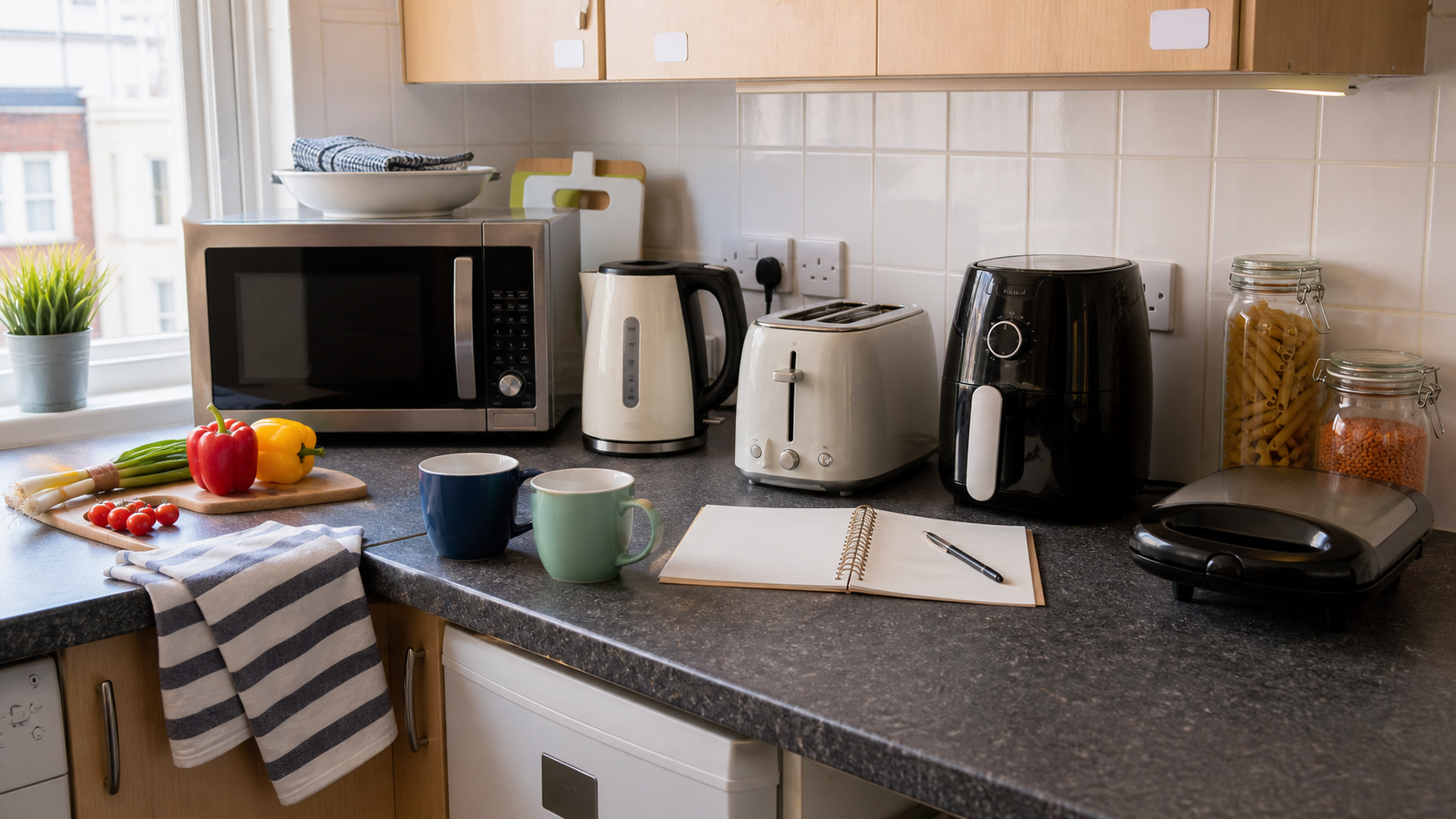
Microwave: the most useful shared-kitchen appliance
A microwave is the most practical student-kitchen appliance if your accommodation does not already provide one. It covers the meals students actually make when time, money and energy are short: reheated batch cooking, jacket potatoes, porridge, scrambled eggs, soup, rice pouches and basic ready meals.
For a shared kitchen, a simple solo microwave is usually enough. Combination microwaves add oven or grill functions, but they cost more, take more space and are easier to misuse if several people share them. A straightforward model with a clear interior, easy-clean controls and enough room for normal dinner plates is usually a better student buy than a feature-heavy machine.
Do not buy a personal microwave for a bedroom unless your accommodation explicitly allows it. Even if the appliance itself is ordinary, cooking smells, heat, sockets and fire-alarm rules can make bedroom use a problem.
Kettle: cheap, compact and used every day
A kettle is one of the safest student purchases because it is affordable, easy to store and useful even if you barely cook. Tea, coffee, instant noodles, hot-water bottles, porridge pots and quick washing-up all make it earn its place.
That does not mean everyone in a flat needs one. In halls, a shared kitchen may already have a kettle, and three identical kettles on one counter just waste space. If you do buy one, look for a visible water level, a stable base, a comfortable handle and a capacity that suits your kitchen. A huge kettle is not automatically better if you usually boil water for one mug.
For one student, the best kettle is often the one that is easy to fill, easy to pour and not too big to leave out.
Toaster: useful, but check the rules
A toaster can make student breakfasts much easier, especially if you keep bread, bagels, crumpets or frozen slices around. A basic two-slot toaster is usually enough for one or two people; a four-slot model only makes sense if the whole flat will use it.
The catch is accommodation policy. Some halls allow toasters only in shared kitchens, some provide them, and some restrict personal cooking appliances that create smoke, crumbs or fire-alarm risk. If you are buying one for a shared kitchen, favour a removable crumb tray, stable feet and slots wide enough for the bread you actually eat.
If you are choosing between breakfast appliances, a toaster is more useful than a sandwich toaster for most students because it handles more everyday food with less cleaning.
Air fryer: useful, but rarely the first thing to buy
An air fryer can be a good student appliance in the right shared house. It cooks small portions quickly, handles freezer food better than many microwaves, and can be cheaper and less faff than heating a full oven for one person.
It is still a bad impulse buy before move-in day. Air fryers need clear counter space around them, a heat-safe surface, regular basket cleaning and somewhere to store the bulky body. In halls, you also need to know whether they are allowed at all.
- Buy later if you have seen the kitchen, know the rules and will use it several times a week.
- Share one if the flat cooks freezer food, wraps, vegetables or quick dinners often.
- Skip it if the kitchen already has a decent oven, the counters are cramped, or nobody wants to clean the basket.
If you do decide it suits your kitchen, choose capacity carefully. A very small basket can be frustrating for two people, but a large dual-zone model may be too bulky for student storage. Our air fryer guide is the better next step once you know the space and household routine.
Sandwich toaster: fun, cheap and easy to regret
A sandwich toaster feels like a classic student buy, and it can be genuinely useful if you love toasties. It turns bread, cheese and leftovers into a quick meal, and the cheapest models are not expensive.
The problem is that it does one job, takes cupboard space, and can become unpleasant quickly if melted cheese and sauce are left in the plates. Removable plates are easier to clean, but they usually cost more. Deep-fill plates are better for generous fillings, but they are still not a replacement for a toaster, grill or air fryer.
Buy one only if you know you will use it often, have somewhere to store it, and are prepared to clean it properly after each use. Otherwise, put the money towards a better kettle, a shared toaster, or the first grocery shop.
What not to buy before you move in
The biggest student-kitchen mistakes are not usually about buying the wrong brand. They are about buying too much before seeing the room, the kitchen and the flatmates.
- Do not buy duplicate bulky appliances until you know what the accommodation provides.
- Do not rely on extension leads for kitchen appliances that use a lot of power. A crowded block adaptor is a warning sign, not a storage solution.
- Do not buy deep-fat fryers for student accommodation. They are messy, risky in shared kitchens and commonly restricted.
- Do not take appliances for bedroom cooking unless the rules clearly allow it.
- Do not buy anything you cannot clean easily. Shared kitchens punish awkward baskets, plates, trays and crumb traps.
How to choose for halls, shared houses and studios
In halls, keep it simple: check what is provided, buy only what is allowed, and avoid anything that belongs in a private kitchen unless the accommodation rules say otherwise. A kettle, basic cooking kit and access to a microwave matter more than a personal gadget collection.
In a shared house, make a quick flat list before everyone buys the same thing. One decent microwave, one kettle, one toaster and possibly one air fryer can cover a lot of meals. Agree who owns what, where it lives and how it gets cleaned.
In a studio, you have more control but less room to hide bad decisions. Choose compact appliances you will use weekly, leave clear space around anything hot, and avoid turning every socket into a permanent appliance station.
Verdict: buy less first, then upgrade what you actually use
The most worthwhile student kitchen appliances are usually the boring ones: access to a microwave, a reliable kettle and, if allowed, a simple toaster. They solve real daily meals without taking over the kitchen.
An air fryer can be worth buying once you know the rules, space and cooking habits. A sandwich toaster is best treated as a cheap extra, not a starter essential. For most students, the smart move is to buy the everyday basics, share anything bulky, and wait a few weeks before spending on gadgets.
Sources and checks
These references are useful when checking whether a student kitchen can safely support extra plug-in appliances.
- Electrical Safety First socket overloading advice explains how socket load can become unsafe when several appliances are run from the same point.
- Electrical Safety First extension lead guidance is worth reading before using block adaptors or extension leads around kitchen appliances.