In this article
A small kitchen does not need a smaller version of every appliance. It needs a short list of tools that cover repeated jobs without swallowing the worktop, blocking sockets or creating more washing-up than they save.
For most small kitchens, the strongest appliance types are a microwave, an air fryer or mini oven, a hand blender, and one carefully chosen drinks or breakfast setup. The exact mix depends on whether you reheat more than you cook, cook crisp meals for one or two, blend soups and sauces, or need better morning routine equipment.
Start with the job each appliance will own
Before comparing models, give each appliance a job title. If two appliances both claim the same job, the smaller kitchen should keep the one that does it more often, more safely or with less cleaning.
| Appliance type | Best small-kitchen job | Space trade-off | Best next step |
|---|---|---|---|
| Microwave | Fast reheating, defrosting and simple cooking | Needs permanent worktop room and ventilation clearance | Choose first if leftovers, batch cooking or ready meals are normal |
| Air fryer | Crisp small meals, sides and quick portions | Basket and drawer need room to pull out safely | Choose when you often cook for one to three people |
| Mini oven | Toast, baking, grilling and small oven-style meals | Usually takes more height and clearance than it first appears | Choose when you need oven functions more than air-fryer speed |
| Hand blender | Soup, sauces, smoothies and small prep jobs | Stores in a drawer or narrow cupboard | Choose before a bulky blender if space is tight |
| Kettle and toaster set | Tea, instant drinks and breakfast basics | Two appliances can crowd one socket area | Choose when the matching finish and daily routine justify both pieces |
| Coffee machine | Better coffee without leaving the house | Needs capsule, bean, milk or cleaning storage as well as the machine | Choose only if the drink habit is frequent enough |
Go straight to the type you already need
If the job is clear, compare our microwaves for reheating, air fryers for crisp small meals, or hand blenders for compact prep. If you need oven-style cooking instead, start with mini ovens.
Microwaves earn space when reheating is daily
A microwave is not the most exciting small-kitchen appliance, but it is often the most useful. It reheats leftovers, softens butter, warms milk, defrosts ingredients and handles simple meals without preheating a larger oven. In a flat, studio or narrow galley kitchen, that reliability can matter more than another cooking gadget.
The compromise is that a microwave usually wants a fixed position. You need enough depth for the door, enough clearance around the vents, and a socket that does not force the lead across a sink, hob or walkway. A compact model can still be awkward if the door opens into your prep space.
Choose a microwave first when reheating is part of how you eat. If you batch cook, save leftovers, work from home or share a kitchen with different meal times, it solves a daily problem that an air fryer or mini oven does not solve as quickly.
Air fryers suit crisp meals in smaller portions
An air fryer is strongest when you want quick crisp food without heating a full oven. Chips, chicken pieces, vegetables, reheated pastries and small frozen portions are the obvious wins. For one or two people, it can make a small kitchen feel more capable without adding a large oven-style appliance.
Do not judge the size only by the litre number. Basket shape, drawer depth and the room needed to pull the drawer out all affect whether it fits. A dual-drawer model may cook two foods at once, but it can dominate a narrow worktop. A smaller single-basket model may be easier to store and clean if you cook modest portions.
The small-kitchen test is simple: can the appliance stay out without stealing the only prep space, or can it be lifted and stored without becoming a chore?
If the answer is no, size down or choose a format that stores better. A useful air fryer is one you can use safely on an ordinary evening, not the largest one that fits on paper.
Mini ovens are for oven jobs, not just compact cooking
A mini oven, or compact countertop oven, makes sense when you need toast, baking, grilling or tray-style cooking more than basket-style crisping. It can be a better fit than an air fryer for open sandwiches, small pizzas, pastries, gratins or food that needs a flat tray rather than a deep basket.
The space demand is different. Mini ovens often need more clearance above and around the appliance because the casing and door can get hot. They also need a heat-safe position away from wall cupboards, packaging, tea towels and anything that could be damaged by warm air.
Choose a mini oven when the missing job is oven-style cooking. If you mainly want quick chips, wings and reheated frozen sides, an air fryer is usually the simpler small-kitchen buy. If you often toast, bake and grill small portions, a mini oven can justify its larger worktop footprint.
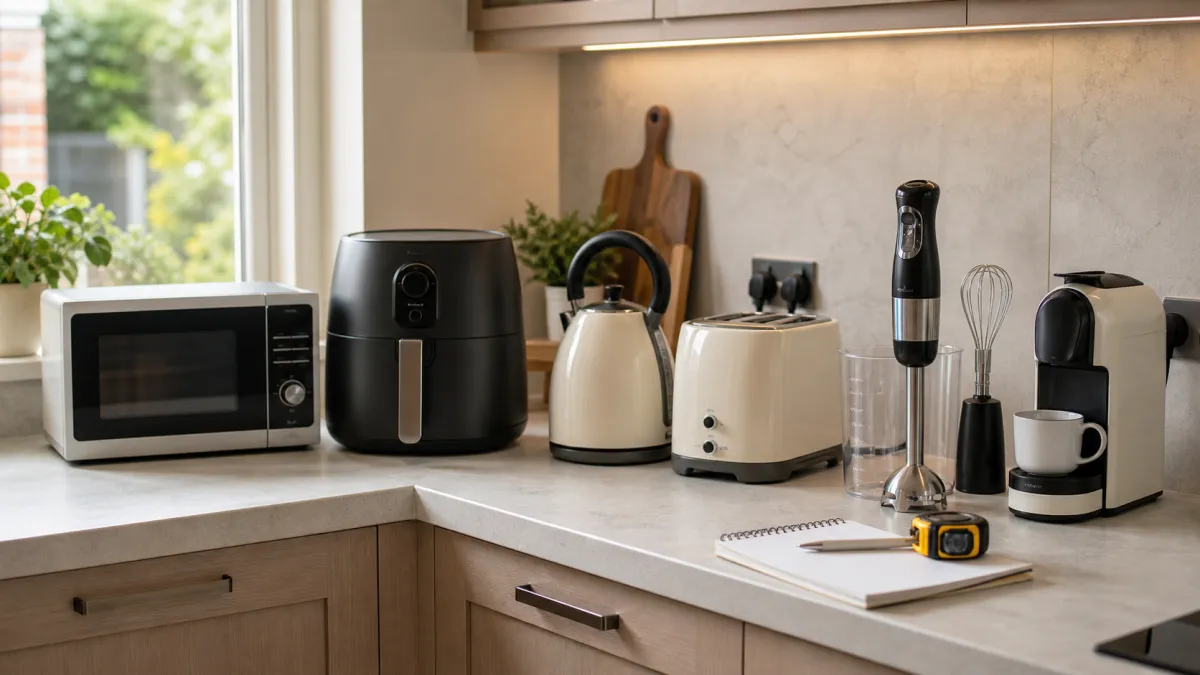
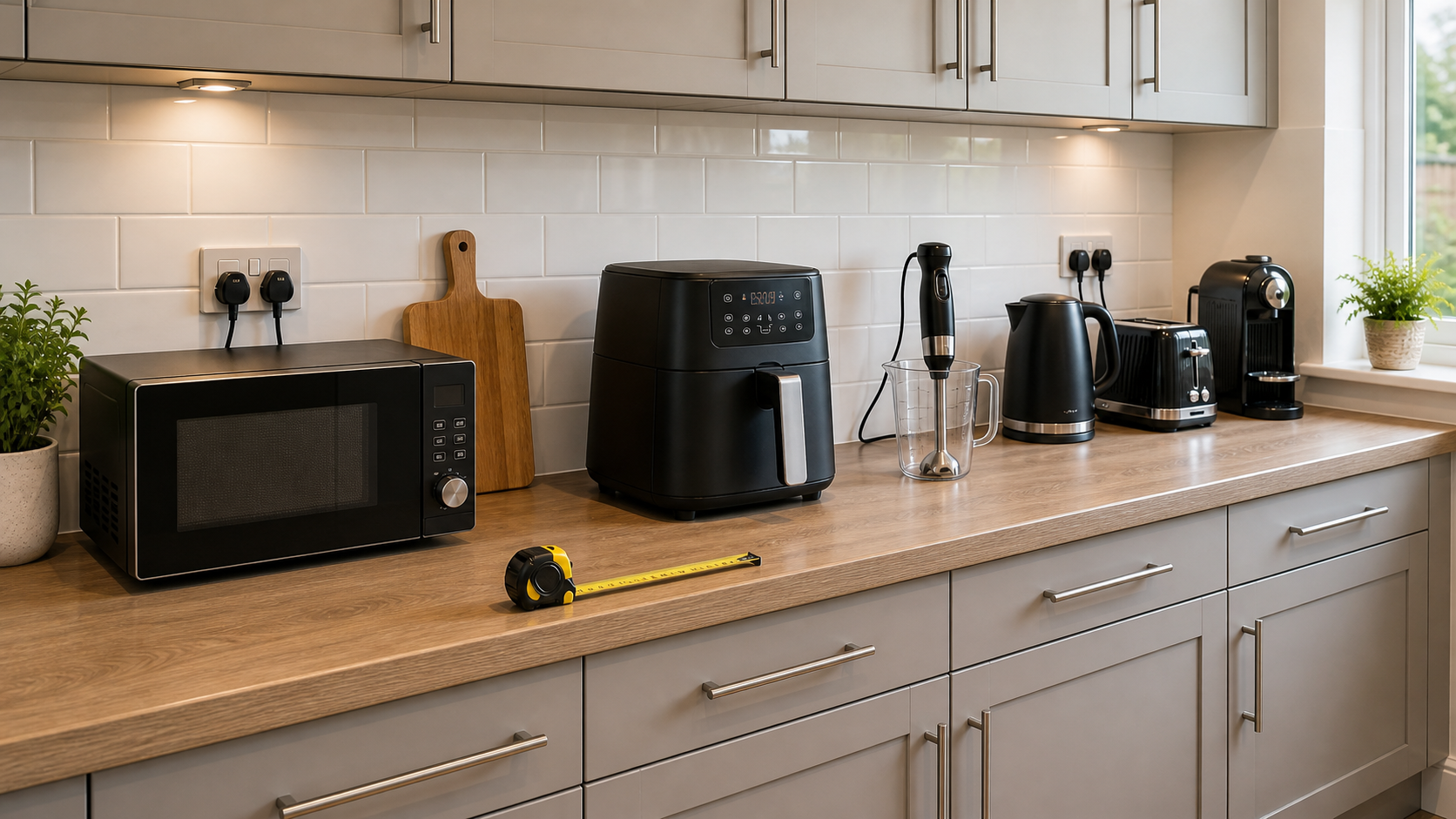 A realistic small-kitchen setup works better when each appliance has a clear job, safe socket access and enough usable worktop left for prep.
Hand blenders are the best compact prep tool
A hand blender, sometimes called a stick blender, is one of the easiest appliances to justify in a small kitchen. It can blend soup in a pan, make sauces, smooth baby food, blitz soft fruit and handle small batches without claiming permanent counter space.
The key advantage is storage. A hand blender body, blending wand and beaker can usually live in a drawer or narrow cupboard. That makes it a better first prep appliance than a full-size blender if you do not make large smoothies or crush ice regularly.
Watch the attachments. Whisks, mini choppers and mashers can be useful, but too many accessories turn a compact tool into a box of loose parts. Buy the attachment set around the jobs you repeat, not around the largest bundle on the shelf.
Kettle and toaster sets should fix the breakfast zone
A matching kettle and toaster set can make a small kitchen feel calmer because two visible appliances share the same finish. That matters when there is no room to hide things away. It is also practical if the kettle and toaster already sit together and are used every morning.
The risk is buying two compromised appliances for the sake of a matching look. Check the kettle capacity and minimum fill, the toaster slot length, crumb-tray access and whether both items can sit near suitable sockets without crowding the only prep area. A beautiful set is still a poor buy if the toaster cannot take your usual bread or the kettle is heavy when full.
If you already own a good kettle or toaster, replacing both may be wasteful. A set is most convincing when both old appliances are tired, mismatched appliances make the worktop feel busy, and the new pair genuinely suits your breakfast routine.
Coffee machines need a whole habit, not just a corner
A compact pod machine can look small, but the real space includes capsules, mugs, a water tank, used-pod storage and cleaning access. Bean-to-cup machines add beans, drip trays, grounds containers and milk-system cleaning. Manual espresso setups may need a grinder, tamper and accessories.
That does not mean a small kitchen should avoid coffee machines. It means the machine has to earn a dedicated drinks zone. If you make coffee every day, the convenience and quality can be worth more than a toaster or second cooking appliance. If coffee is occasional, the machine may become a permanent object that solves an infrequent problem.
Choose the simplest coffee format that matches your real routine. Pod machines suit speed and low mess. Bean-to-cup machines suit frequent fresh coffee if you can handle the size and cleaning. Manual espresso is rarely the easiest small-kitchen route unless the ritual is part of the appeal.
Run the three-space audit before buying
Small-kitchen mistakes usually happen because the appliance fits in one measurement but fails in use. Before buying, check three spaces.
Worktop space: include door swing, drawer pull-out, steam, heat, ventilation and the room needed to plate food or prepare ingredients beside the appliance.
Storage space: include baskets, trays, jugs, blades, beaters, capsule holders, filters, cleaning brushes and the plug. Accessories that live separately are easier to lose and harder to use.
Socket space: high-power appliances should use suitable sockets without overloaded adaptors, trailing leads or extension blocks hidden behind other appliances.
Electrical Safety First warns that extension leads and adaptors can be overloaded, and its socket calculator is a useful check when several appliances compete for one area. If your small kitchen regularly relies on extension leads, the safer answer may be fewer permanent appliances or properly installed extra sockets rather than another gadget.
Energy labels help, but size and use still matter
For appliance categories that carry energy labels, compare the rating and the annual energy consumption rather than choosing by headline size alone. Energy Saving Trust notes that the label helps compare running costs and performance, and that bigger appliances can use more energy than smaller versions.
Small countertop appliances are not all labelled in the same way, and a label does not tell you whether the appliance suits your routine. A compact appliance used daily can be more worthwhile than a larger, more efficient-looking appliance that replaces nothing. The useful question is how often it will do a real job in your kitchen.
Build the kitchen around jobs, not gadgets
The best small-kitchen appliance mix is usually practical rather than glamorous. A microwave earns its place when reheating is frequent. An air fryer earns it when crisp small meals are common. A mini oven earns it when you need compact baking, grilling or tray cooking. A hand blender is the easiest prep upgrade because it stores so well.
Kettle and toaster sets, and coffee machines, should be chosen around habits rather than display. They can make a small kitchen feel better every day, but only when the routine is real and the appliance does not crowd the worktop.
If space is tight, buy fewer appliance types and choose better within the ones you will use most. The right small-kitchen setup is not the one with the longest feature list. It is the one that leaves enough room to cook, clean and move safely.
Sources and checks
These UK sources help you check the safety and efficiency details that matter when several appliances share a compact kitchen.
Electrical Safety First socket-overload guidance: check adaptor, extension-lead and socket-loading advice before grouping several appliances around one plug point.
Energy Saving Trust home-appliance guidance: compare how energy ratings, appliance size and usage affect running costs where energy labels apply.