
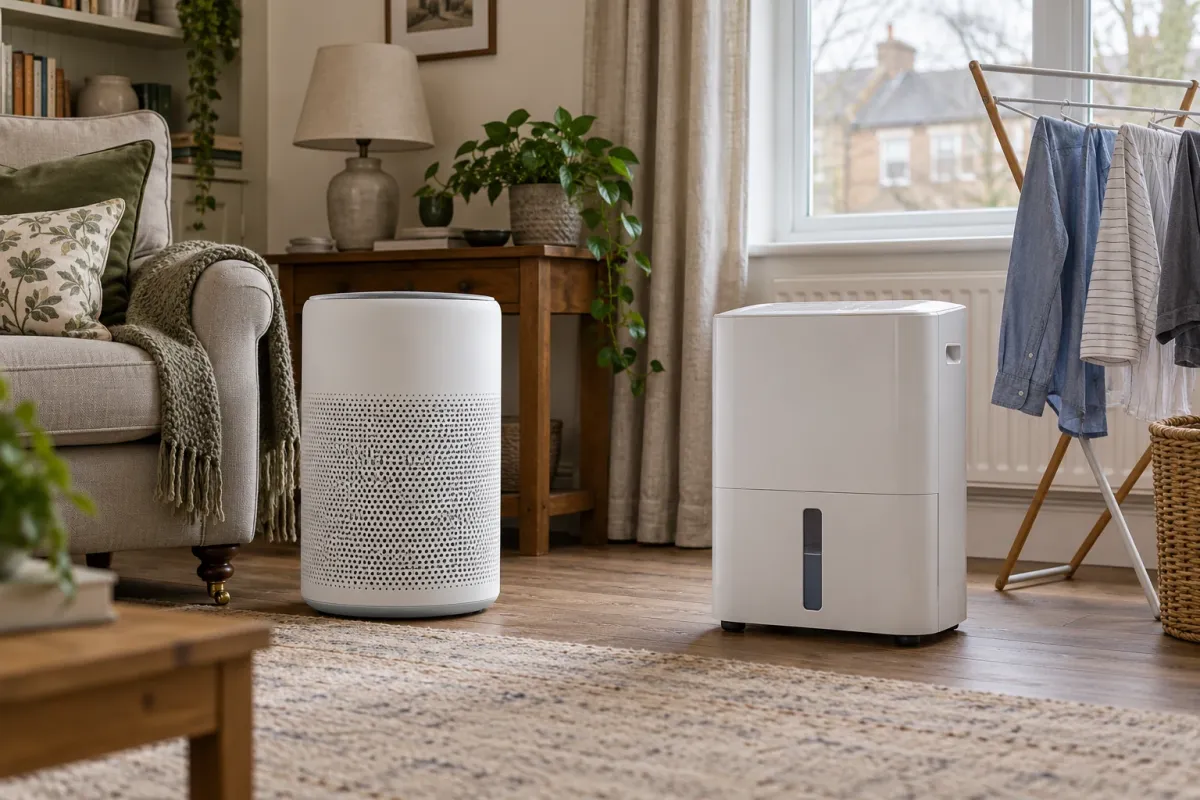
An air purifier filters particles from the air; a dehumidifier removes excess moisture. If your main problem is pollen or airborne dust, start with filtration. If it is persistent condensation or moisture from drying clothes indoors, check the humidity and consider a dehumidifier. A room can need both jobs, but buying one appliance does not automatically cover the other.
What are you trying to change?
The most useful starting point is what is happening in the room. A musty smell, misted window or dusty shelf is a clue, rather than a diagnosis.
- Water on windows or clothes drying slowly: investigate moisture and ventilation. A dehumidifier can help remove water from the room air, but recurring damp still needs its cause checked.
- Pollen, pet-related particles or airborne dust: an air purifier with suitable particle filtration is the relevant appliance. It will not collect dust that has already settled on furniture.
- A room that feels damp and also needs particle filtering: assess both needs. A combined model may be convenient, provided its filtering performance suits the room.
- A persistent smell without a clear cause: find the source before buying. A particle filter alone does not establish useful odour removal, and neither appliance repairs a leak.
Once you know the job, our air purifier recommendations compare filtering options, while our dehumidifier recommendations cover moisture removal, laundry drying and room suitability.
How the two appliances differ
| Check | Air purifier | Dehumidifier |
|---|---|---|
| Main job | Pass room air through filters to capture airborne particles; some models also have filters for certain gases and smells. | Remove water vapour from room air and collect it in a tank or send it through a drain hose. |
| Useful performance measure | CADR, or clean air delivery rate: how much particle-filtered air the appliance supplies over time. Match it to the room and the fan setting you expect to use. | Water removal in litres per day, together with the temperature and humidity used for the rating. Tank capacity is a separate figure. |
| What it cannot establish | A cleaner-looking filter does not show that excess moisture or a damp problem has been resolved. | A falling humidity reading does not show that airborne particles have been filtered effectively. |
| Everyday upkeep | Clean accessible outer dust filters and replace other filters as the exact manual requires. | Empty and clean the tank, or arrange suitable drainage; maintain any dust or particle filters too. |
| Costs to compare | Electricity at a usable fan speed, plus replacement filters. | Electricity in the conditions you will use it, plus any replacement filters and drainage accessories. |
Do not compare a purifier’s airflow figure directly with its clean air delivery rate. Moving air and delivering particle-filtered air are different measurements. Likewise, a large water tank tells you how much a dehumidifier holds before emptying, rather than how quickly it removes moisture.
Check moisture before treating the room as damp
A hygrometer, a meter that measures humidity, can help you see whether moisture levels change through the day. A combined digital thermometer and hygrometer* also shows room temperature. You may already have a useful reading on a dehumidifier or another household monitor, so there is no need to buy a separate meter automatically.
Humidity readings are often labelled RH, meaning relative humidity: the amount of water vapour in the air compared with what it could hold at that temperature. Temperature matters, so compare readings with the room conditions as well as the number. A meter cannot tell you whether a damp patch comes from condensation, a leak or a building defect.
If windows repeatedly run with water, walls remain damp or mould returns, investigate the cause. In rented accommodation, report persistent damp or mould to your landlord or managing agent. Elsewhere, seek suitable building or repair advice when the cause is unclear. An appliance should not become a substitute for putting the underlying problem right.
Can a dehumidifier with a filter replace an air purifier?
Some dehumidifiers add a HEPA filter, a fine particle filter, and can filter air while removing moisture. Some also offer a separate air-cleaning mode, so filtering can continue without asking for more moisture removal. That can be useful when floor space is tight or the room needs different help at different times.
The MeacoDry Arete Two 20L and Dryzone 12L Dehumidifier & Air Purifier FG-A00042-001 are examples with included particle filters. They are worth considering when moisture removal is the main purchase and extra filtration would be useful.
A HEPA label alone does not tell you how quickly the whole appliance cleans a room. Look for a comparable clean air delivery rate before treating a combined machine as a replacement for a dedicated purifier. Without that figure, we would choose it for its dehumidifying ability and regard the filtering as an additional benefit, rather than assume equal room-cleaning performance.
If filtration is your main priority, a dedicated purifier with a suitable clean air delivery rate is the clearer starting point. If both needs are important, compare a combined machine against two separate appliances on room suitability, noise, space and the cost of maintaining both functions.
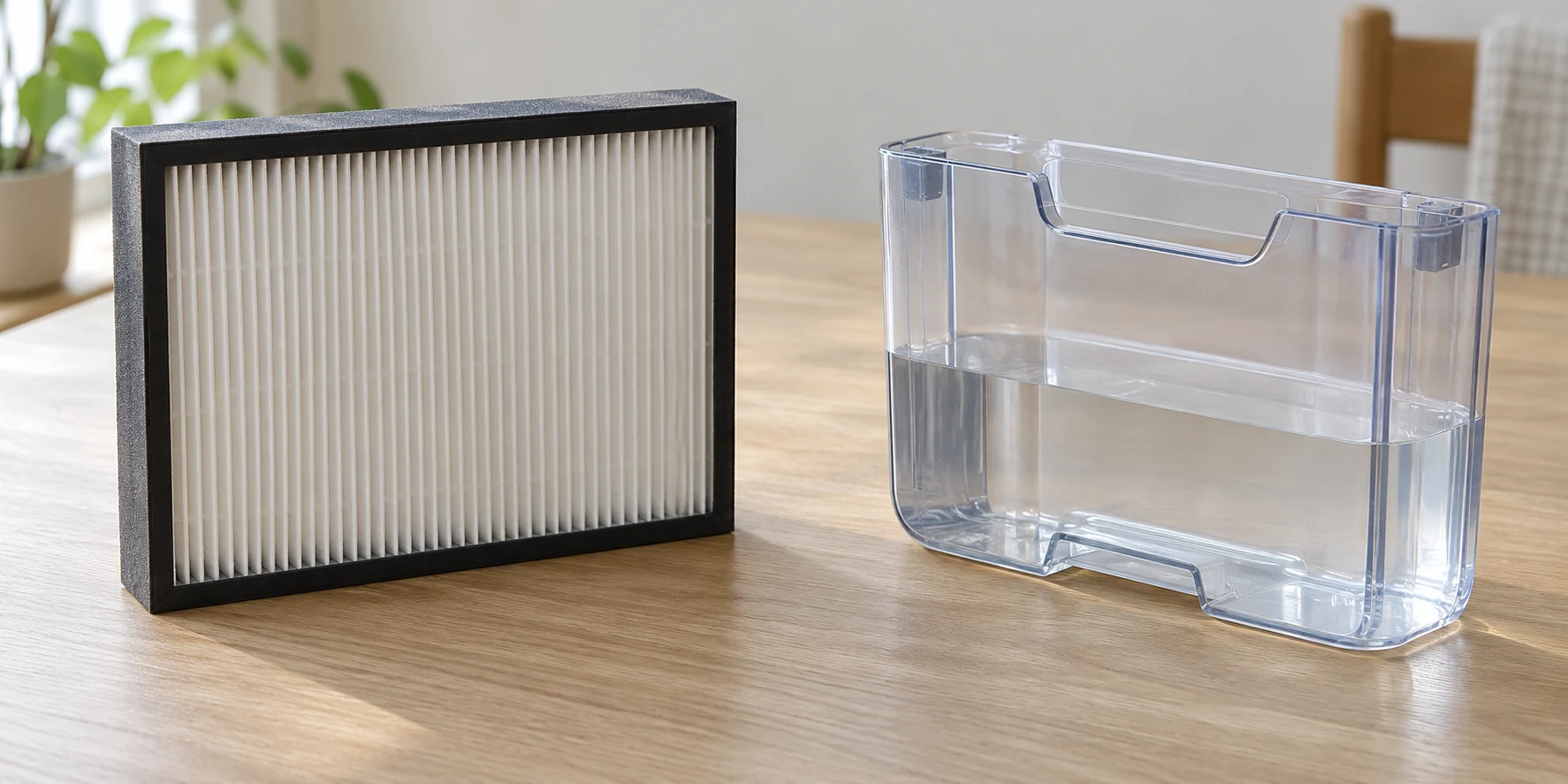 A filter collects particles; a dehumidifier tank collects water. Neither shows that the other job has been done. Credit: Product Inspector.
What neither appliance fixes
An air purifier does not remove the moisture that allows mould to keep returning. A dehumidifier can reduce moisture in the air, but it does not stop water getting into the building, improve inadequate ventilation or repair damaged building materials. Neither replaces dealing with pollution at its source and providing suitable ventilation.
Smells need particular care. Particle filtration and gas filtering are different jobs; some purifiers add activated carbon, a material used to trap certain gases. Do not assume that a HEPA filter will remove a persistent smell. Check the appliance’s stated gas-filtering capability, and investigate the source rather than using scent or filtered air to hide it.
Choose a machine you can comfortably keep using
- Check the room conditions. Dehumidifier output changes with temperature and humidity. A headline litres-per-day rating may be measured in much warmer, damper air than your room.
- Compare noise at a useful setting. A purifier’s quietest speed may move less filtered air. A dehumidifier’s laundry setting may be more noticeable beside a desk or bed.
- Allow space for airflow and access. Follow the exact manual’s clearances, and make sure you can reach the tank or filter without moving furniture.
- Price the ongoing upkeep. Check exact replacement-filter availability and compatibility, including whether the first filter is included. Filters for different capacities within the same range may differ.
- Compare electricity fairly. Use the power consumption for the relevant mode, the hours you expect to run it and your own electricity unit rate. A low hourly figure is less useful if it assumes a setting that cannot do the job.
Check filter care rather than guessing. A washable outer dust filter does not mean that every filter behind it can be rinsed. For example, clean the Dryzone 12L’s HEPA filter with a soft brush rather than rinsing it, following the manual.
Buy for the job that matters most
Choose an air purifier for particle filtering and a dehumidifier for excess moisture. Consider a combined machine when moisture removal comes first and its extra filtering is useful, but check comparable performance before expecting it to replace a dedicated purifier. If persistent damp is the concern, understanding and fixing the cause takes priority over adding another appliance.
Sources and checks
- GOV.UK guidance on damp and mould explains why the underlying cause needs attention. This guidance is written for housing providers in England.
- MeacoDry Arete Two 20L specifications show the included filter and how water removal changes with temperature and humidity.
- Dryzone 12L instruction manual covers filter care and operating requirements.

