In this article
Most home vacuum sealers need textured bags or rolls, not any plastic bag that fits. Rolls give you cut-to-size packs, pre-cut bags save time, zipper bags suit some handheld or accessory ports, and reusable containers are best for fridge leftovers you expect to open again.
The right format depends on what you store, how often you freeze food, and which sealer you own. A neat-looking bargain pack can be poor value if it is the wrong width, too smooth for your machine, awkward for liquids or not approved for the temperature you plan to use.
Start with the format, not the pack size
Before comparing accessory bundles, separate the main formats. They are not interchangeable in everyday use.
| Format | Best for | Watch out for |
|---|---|---|
| Textured roll | Long, awkward or mixed-size portions where you want to cut the bag length yourself. | Needs an extra end seal, can waste material if you cut too generously, and must match your machine width. |
| Pre-cut textured bag | Repeat portions such as steaks, fish fillets, grated cheese, vegetables and batch-cooked solids. | Fastest to use, but less flexible if the food is longer, taller or much smaller than the bag. |
| Vacuum zipper bag | Shorter fridge storage, marinating and food you may open and reseal. | Usually needs a handheld sealer or accessory hose, and may not suit heat sealing or sous-vide cooking. |
| Reusable vacuum container | Fragile foods, liquids, leftovers, berries, salad ingredients and repeat fridge use. | Bulky in the fridge, often system-specific, and not a substitute for safe chilled storage times. |
If you still need the machine itself, start with our vacuum sealer guide. Look for the bag width, whether it has a cutter or roll store, and whether it supports accessories such as containers or zipper bags.
Textured bags matter for most domestic sealers
The common home appliance is an external vacuum sealer: you place the open end of the bag in the machine, it draws air out, then it heat-seals the end. Those machines usually need textured or embossed material, which simply means the plastic has tiny channels that let air travel towards the pump while the bag is being clamped.
Smooth bags can collapse against themselves before the pump has removed enough air. That is why many accessory packs mention channels, embossing or compatibility with external vacuum sealers. A chamber vacuum sealer works differently; compact machines sold for home use are usually the external type.
Compatibility comes before price. Check bag texture, roll width, food-contact suitability and freezer or cooking claims before buying a large accessory pack.
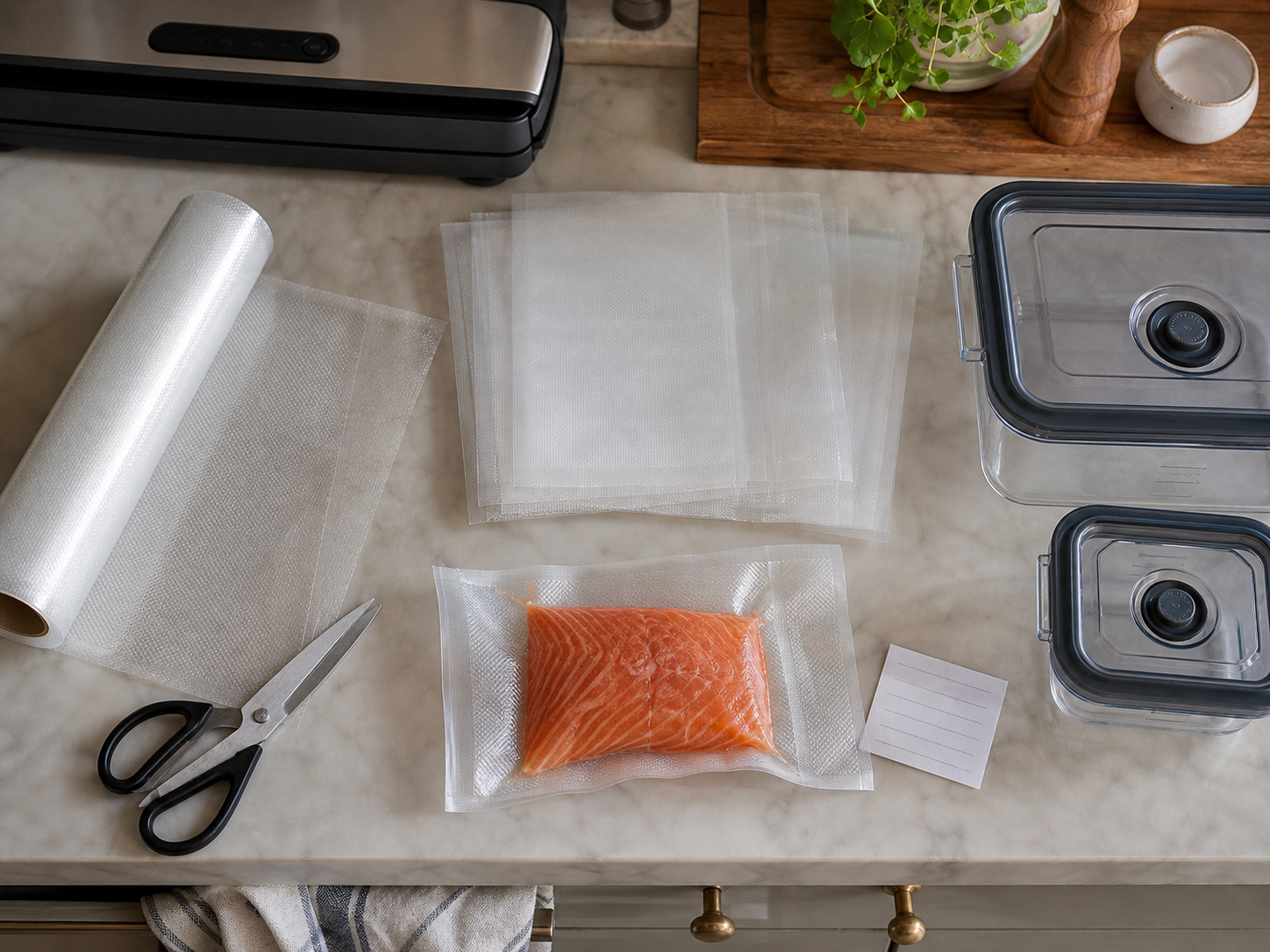 Rolls are flexible, pre-cut bags save preparation time, and containers are better for food you expect to open again soon.
Rolls are flexible, but slower
A roll is useful when your food does not behave like a standard portion. Long fish fillets, a row of sausages, half loaves, awkward meat cuts and batch-prepped ingredients can all fit better when you choose the length yourself. Rolls also let you make smaller bags for small portions instead of wasting a large pre-cut pouch.
The trade-off is time. You normally seal one end, cut the roll, fill the bag, then seal the open end. If you do that for several portions, a built-in cutter and roll storage can save faff, but it also makes the machine bigger. For frequent repeat portions, pre-cut bags can feel much less irritating.
If you buy rolls, check the maximum roll width your machine accepts. A 28cm roll is common on larger domestic machines, while compact models may suit narrower rolls. Buying too wide is not a harmless mistake if the material will not sit neatly in the sealing channel.
Pre-cut bags are best for repeat portions
Pre-cut bags are the tidy choice when you already know your usual portion sizes. They suit steaks, chops, fish portions, grated cheese, chopped vegetables, dry goods and firm batch-cooked food once it is cold. You fill the bag, keep the seal area clean and make one seal.
They are less useful when every job is a different shape. A bag that is much too big wastes material and leaves excess plastic around the food; a bag that is too small forces food into the sealing area or fails before the pump can do its job. A mixed-size starter pack is often more practical than a bulk box of one size unless you already know your routine.
If you are buying consumables separately, compare vacuum sealer bags and rolls* only after checking your machine width, textured-channel requirement and whether the pack is suitable for freezer or cooking use.
Reusable containers solve a different problem
Containers are not just expensive bags. They are useful when a bag would crush the food, leak awkwardly or be opened repeatedly. Think berries, salad leaves, sliced cheese, leftovers, marinades and fridge food you want to access again tomorrow.
The catch is compatibility. Many containers rely on a hose, handheld pump or brand-specific valve. Some full-size sealers include an accessory port, but others only heat-seal bags. Before buying containers, check whether your exact machine can pull air from that lid style.
Containers also take up real fridge space. They are reusable and can be tidier for leftovers, but they do not give the flat, stackable freezer packs that make bags and rolls attractive. For bulk freezer storage, bags usually win. For fragile fridge food, containers can be the calmer choice.
Freezer use needs more than a tight seal
Vacuum sealing can help reduce trapped air around frozen food, but safe freezer use still starts with food handling. Cool cooked food promptly, pack it in sensible portions, label it, freeze it before it deteriorates and defrost it safely. A vacuum bag does not make poor storage practice safe.
The Food Standards Agency describes freezer burn as a quality issue caused by air reaching the food surface. Airtight packaging helps, whether that is a well-filled freezer bag, a suitable container or a vacuum-sealed pack. The vacuum sealer advantage is a more consistent close fit around firm foods.
Label every pack: write the food, portion and date before the pack becomes another mystery slab.
Keep the seal area clean: grease, crumbs and sauce near the mouth of the bag can weaken the seal.
Freeze flat where possible: flat packs stack better and defrost more predictably than bulky lumps.
Do not overclaim shelf life: follow food-specific guidance, use-by dates and your appliance instructions.
Liquids and soft foods need a gentler route
Soup, sauce, stew and soft fruit are awkward because suction can pull liquid towards the pump or crush the food before the seal is made. A moist or pulse setting can help, but it is not magic. The easiest workaround is often to chill or partly freeze the food first, then seal it when it is firm enough to behave.
Reusable containers can be a better fit for fridge leftovers, marinades and delicate food. They keep shape better than a bag and avoid dragging liquid into the machine. For freezer soup or sauces, a normal freezer container or freezer bag may still be the more practical route unless your sealer's instructions describe a safe method for liquids.
Use the crush test: if you would not happily press the food under your hand, do not let full vacuum pressure press it in a bag without a plan.
Sous-vide bags need explicit suitability
Sous-vide means cooking food sealed in a bag in temperature-controlled water. Vacuum-sealed packs can be convenient for that, especially for portioned meat, fish or vegetables prepared in advance. They can reduce floating and make batch prep tidy.
Do not assume every freezer-safe bag is also suitable for sous-vide cooking. Check the bag or roll states the intended cooking use, and follow the sous-vide machine and bag manufacturer's instructions for temperature, time, cooling and storage. Vacuum packing changes the air around the food; it does not replace cooking or chilling rules.
If sous-vide is occasional, suitable resealable cooking bags may be enough. A vacuum sealer becomes more useful when you prepare several portions, freeze them flat, or want the same pack style every time.
Build a sensible starter set
For most first-time owners, the safest starter kit is restrained: one roll that fits the machine, one pack of medium pre-cut textured bags, and no bulk container set until you know you will use the accessory port. That gives you enough range to learn your real portion sizes without filling a cupboard with the wrong consumables.
Check the machine: maximum roll width, external-bag requirement, accessory port and included sample bags.
Check the food: firm freezer portions, wet leftovers, delicate fruit and sous-vide packs need different formats.
Check the storage: rolls, boxes of bags and containers all need somewhere to live.
Check the repeat job: buy more of the format you reach for after a month, not the largest starter bundle.
The sensible starting set
Start with textured bags or rolls that clearly match your machine. Add pre-cut bags if you seal similar portions often, rolls if your food varies in length, and reusable containers only when you know your sealer can use them and your fridge routine justifies the space.
For freezer use, the most important habit is still simple: portion, seal cleanly, label, freeze promptly and defrost safely. Vacuum sealing can improve the pack, but it does not remove the need for normal food-safety judgement.
If you are unsure, buy the machine first and use the sample bags before ordering a large accessory bundle. Your first few sealing sessions will tell you whether rolls, pre-cut bags or containers deserve the most space in your kitchen.
Sources and checks
These UK sources help shoppers verify freezer-use guidance, vacuum-packaging cautions and common accessory formats before buying.
Food Standards Agency freezing guidance: check current advice on cooling leftovers, freezer temperature, airtight packaging, labelling, freezer burn and defrosting.
Food Standards Agency vacuum-packaging guidance: understand why removing air does not replace temperature and shelf-life controls. The detailed guidance is written for food businesses, so household users should still follow consumer storage advice and appliance instructions.
FoodSaver UK bags, rolls and containers: see how a current UK manufacturer describes heat-seal rolls, vacuum bags, zipper bags, containers and channelled bag construction.
FoodSaver UK multi-use sealer: check a current example of roll widths, a built-in cutter, included bags and accessory modes such as moist, pulse, marinate and sous-vide.